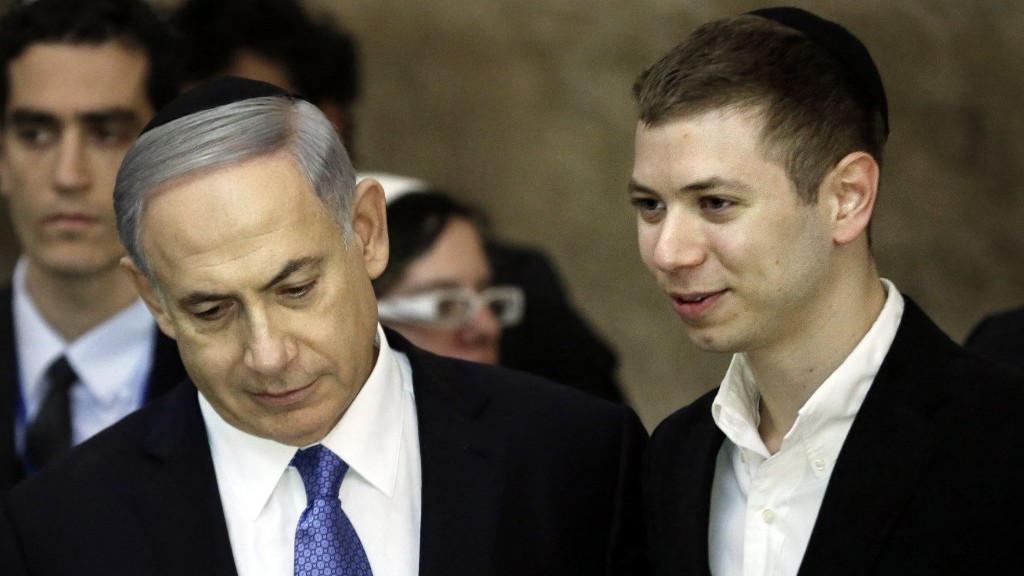
Israel’s oldest daily newspaper Haaretz revealed this week that Yair Netanyahu, eldest son of sitting Israeli Prime Minister Benjamin Netanyahu, has officially changed his legal name to Yonatan Hon, a move that comes as the Netanyahu family confronts cascading legal troubles and global political backlash.
Official Israeli tax withholding documents issued in December 2024 still bore Yair’s birth name, but updated records from 2025 list the new identity alongside the unusual, seemingly symbolic fictional address “Balfour 0” – a reference to Balfour Street, the location of the official prime minister’s residence in Jerusalem. This is not the first time Yair has altered his surname: on public social media platforms, he previously used the name Yair Hoon, a close variation of his new legal name. The root of the surname traces to his maternal grandfather Shmuel, who originally bore the last name Hoon before changing it to Ben Artzi later in life.
The name change unfolds against a backdrop of intensifying political and legal peril for the Netanyahu family, both domestically and on the global stage. In the United States, the Israeli prime minister has become an increasingly divisive and toxic figure in mainstream politics, as public backlash grows over his government’s conduct of the war in Gaza. Separately, the International Criminal Court has issued an arrest warrant for Benjamin Netanyahu alleging war crimes and crimes against humanity stemming from the military campaign in Gaza.
Yair himself has long faced public scrutiny over his business dealings in the U.S. and longstanding ties to wealthy conservative and far-right actors. The most high-profile controversy dates back to 2018, when Israeli public television leaked an audio recording of Yair speaking outside a strip club, where he appeared to boast that his father had advanced a multibillion-dollar natural gas deal that delivered major profits to a prominent Israeli tycoon. In Israel, Benjamin Netanyahu currently battles three separate active corruption investigations that have dogged his third term as prime minister.
This pattern of name changes among the Netanyahu family is not new, nor is it an isolated practice in Israeli political history. Five years ago, Yair’s younger brother Avner changed his surname to Avi Segal, Israeli outlets confirmed. Under that new identity, Avner paid £502,000 ($672,000) in cash to purchase an apartment in Oxford, England, a move widely interpreted as an effort to avoid public scrutiny and media attention. The surname Segal was the original last name of Tzila Segal, Benjamin Netanyahu’s mother, before she married family patriarch Benzion Netanyahu.
Even Benjamin Netanyahu himself adopted an alternate name during the 1980s while residing in the United States: he went by Ben Nitai at the time, later explaining he had considered permanently settling in the country. The family’s history of name changes stretches back a full century, to Benzion Netanyahu, the prime minister’s father. Born Benzion Mileikowsky in Poland, he changed his surname after immigrating to British Mandate Palestine in the 1920s to participate in Zionist settlement efforts. That choice aligned with a widespread Zionist practice of the era, where European Jewish immigrants discarded their diaspora surnames in favor of Hebrew names to frame themselves as indigenous to the land they were colonizing.
Many of Israel’s founding and early leaders followed the same convention. Israel’s first prime minister David Ben-Gurion was born David Gruen in Poland; founding foreign minister Moshe Sharett was born Moshe Shertok in Russia; early prime minister Levi Eshkol was born Levi Yitzhak Shkolnik in Russia; fourth prime minister Golda Meir was born Golda Mabovitch in Ukraine; seventh prime minister Yitzhak Shamir was born Yitzhak Yezernitsky in Russia; eighth prime minister Shimon Peres was born Szymon Perski in Poland; 10th prime minister Ehud Barak was born Ehud Brog in Mandatory Palestine; and 11th prime minister Ariel Sharon was born Arik Scheinermann in Mandatory Palestine.
This report was originally compiled with contributions from independent reporting on Middle Eastern affairs from Middle East Eye.