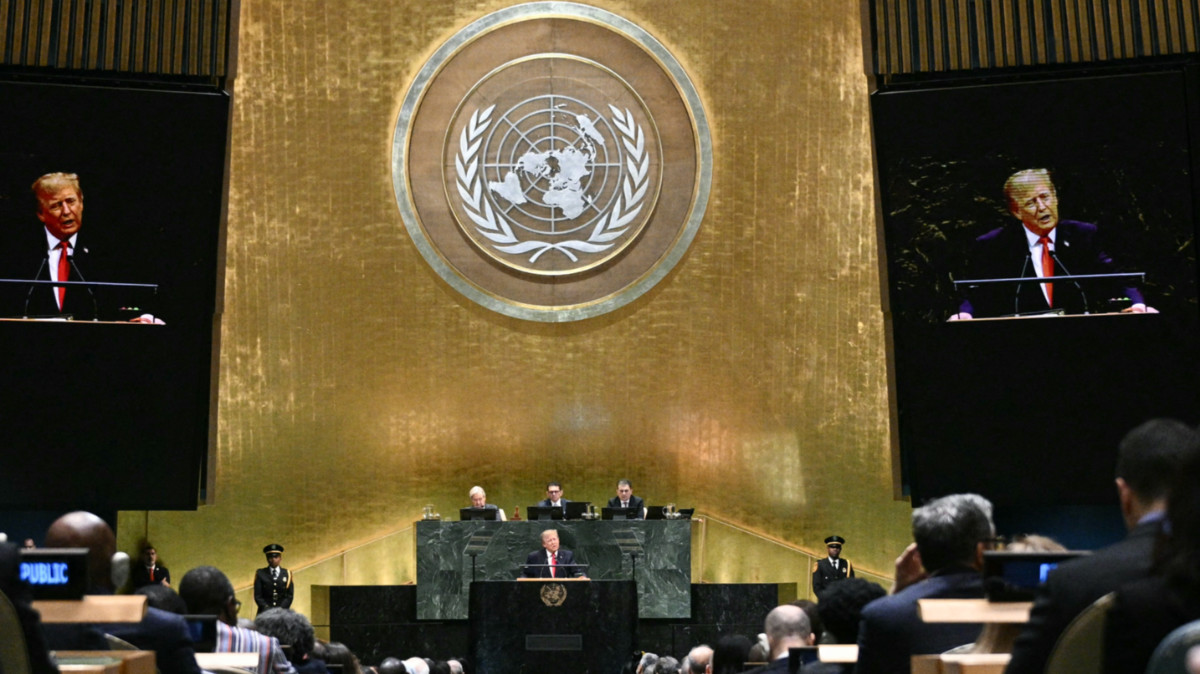
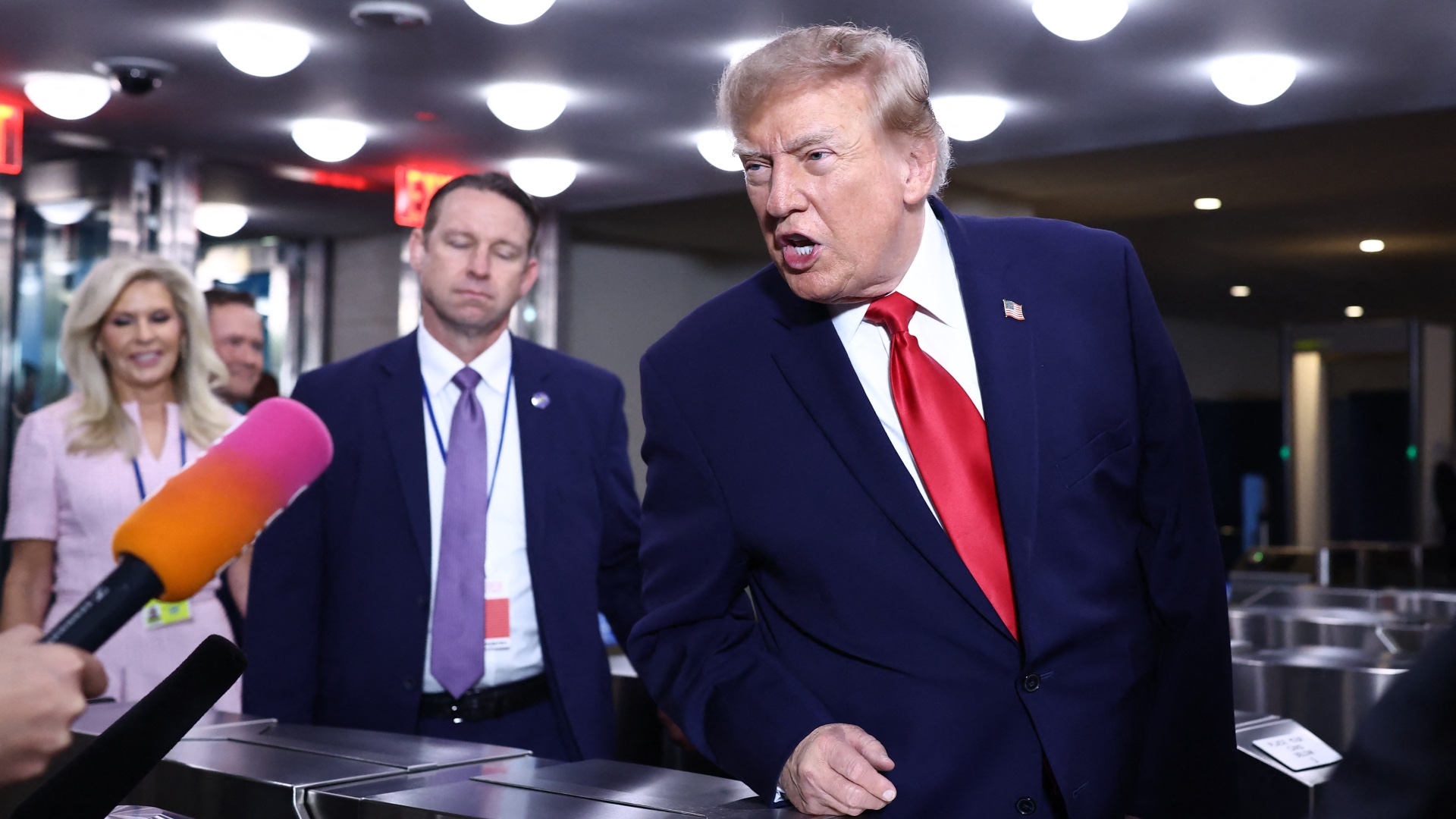
In a 38-minute address to the United Nations General Assembly Tuesday, former U.S. President Donald Trump (in his second term) laid out his 20-month foreign policy legacy through sweeping, unsubstantiated claims, while issuing a stark demand that all UN member states withdraw from the International Criminal Court (ICC).
Compared to his fiery 2024 UNGA speech packed with direct personal attacks, this year’s address carried a calmer tone on the surface, but retained multiple debunked, unproven allegations against regional adversaries. Most notably, Trump claimed without evidence that 72,000 Iranians were killed by their own government during late 2024 and early 2025 anti-government protests. This figure stands in stark contradiction to all available public data: Iranian authorities put the death toll at approximately 3,500, while independent international human rights monitors estimate the count at roughly 5,000 or higher. Throughout 2025, Trump has cited inconsistent figures ranging from 40,000 to 82,000 for these deaths, with no verifiable source for the inflated numbers; even satellite imagery, which has been used to confirm mass casualty events in other global conflicts, has shown no evidence to support his claims.
The president also repeated a false allegation that Hamas and other Palestinian groups tortured, mutilated, and killed numerous infants during the October 7, 2023 attacks in southern Israel. Israeli independent media investigations have already debunked these specific claims, and the Israel Defense Forces acknowledged that at least one soldier provided incorrect information to Israeli rescue organization Zaka that fueled the false reports. While five young children (including one four-year-old, two five-year-olds, and two six-year-olds) were among those killed on October 7, the majority of child fatalities that day were between 12 and 17 years old, with some killed by errant rocket fire.
The ICC’s recent issuance of arrest warrants for three Hamas leaders (all subsequently killed by Israeli forces) as well as Israeli Prime Minister Benjamin Netanyahu and former Defense Minister Yoav Gallant drew fierce condemnation from Trump, who labeled the court “out of control” and “a rogue institution” run by “an evil group of people.” “I call on all nations that are members of the ICC to officially resign from this rogue institution immediately,” he told the assembled delegates.
Turning to the ongoing U.S.-Israeli military campaign against Iran, now in its seventh month, Trump doubled down on his longstanding pledge to block Iran from acquiring a nuclear weapon. He claimed that shortly after taking office for his second term in 2025, he opened direct negotiations with Tehran, offering full economic cooperation in exchange for ending Iran’s nuclear program and what he calls support for terrorist groups—an offer he said Iran “absolutely refused.” While the decision to pursue direct talks drew some early praise, the diplomatic effort, led by special envoy Steve Witkoff and Trump’s son-in-law Jared Kushner, has faced widespread criticism for mismanagement and incompetence.
Since March 2025, Iranian retaliatory strikes against U.S. allies in the Gulf have disrupted global shipping, closing key chokepoints including the Strait of Hormuz and the Bab el-Mandeb (blocked by Iran-aligned Houthi forces in Yemen). The disruption has sent U.S. gasoline prices soaring, worsening a persistent affordability crisis that has not eased significantly since the COVID-19 pandemic. At least 14 U.S. military personnel have been killed in regional attacks, with nearly 600 more wounded. Echoing the blunt framing of his old reality television show *The Apprentice*, Trump teased a potential post-election deal to end the conflict: “Will a deal be made with Iran that lets them rebuild and create a far greater country than it ever was before, maybe one of the greatest in the Middle East or even the world, or do I annihilate the Islamic Republic and do it quickly, never giving them a chance to kill and destroy people and countries again?” He added that he expects a deal to be reached shortly after the upcoming November 3 midterm elections, claiming Iranian leaders are waiting to see the election’s outcome—though he noted he is not on the ballot this cycle. Forecasters widely expect the midterms to flip the U.S. House of Representatives from Republican to Democratic control, with the Senate also likely to flip or end in an even split; the results are widely viewed as a public referendum on Trump’s first 20 months of his second term.
Trump also forcefully pushed back against a recent report from his own Department of Defense inspector general that warned the U.S. is depleting its weapons stockpiles due to sustained military support for allies in the Iran campaign. “The cowards and traitors would love to say the United States is low on munitions, but that’s not true,” he said. “We have more munitions than we could ever possibly even think of using, and we’re building them at levels that we have never done before… There are 18 new massive munition plants being built by the world’s largest defense contractors right now.” He closed his remarks on Iran by calling for global collective action to enforce full economic isolation of Tehran until it halts attacks on commercial shipping, abandons its nuclear program, and ends support for armed groups he labels terrorist.
Trump’s address came just two weeks ahead of the third anniversary of the October 7, 2023 attacks, and three weeks after a Trump-brokered ceasefire between Israel and Hamas went into effect on October 10, 2025. UN Secretary-General has criticized the ceasefire as a “lesser fire,” noting that Israel has continued carrying out air strikes that killed more than a dozen children in Gaza just this month, with few of the ceasefire’s obligations met by Israeli authorities. According to the Palestinian Ministry of Health, the confirmed death toll in Gaza has now reached nearly 74,000, with the final count expected to surpass 100,000 once rubble clearing operations recover the remains of missing people.
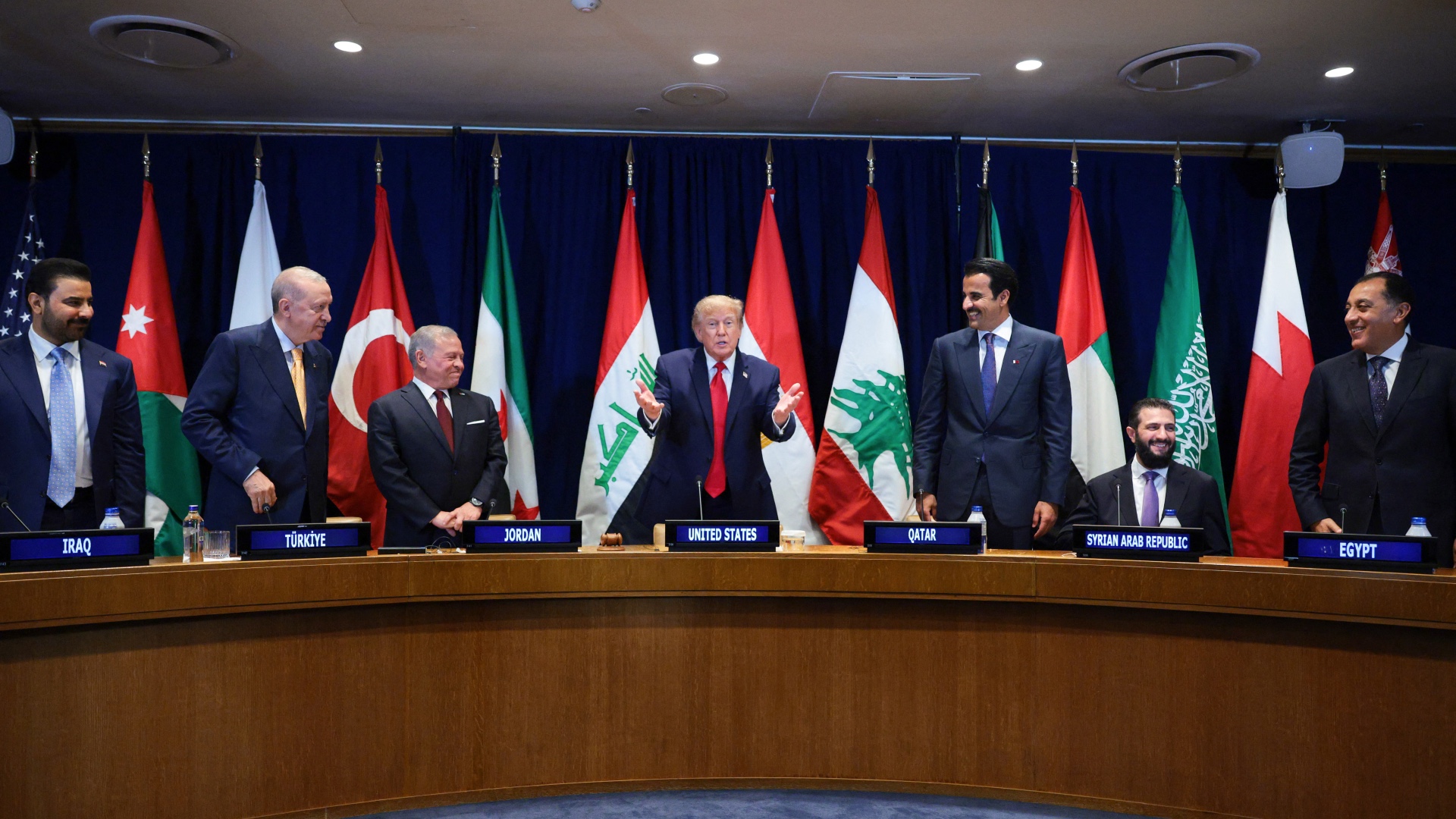
Despite little tangible progress on the Trump-created “Board of Peace” for Gaza, a body of which Trump named himself chairman for life, the president used his UNGA platform to highlight supposed international praise for the initiative, citing endorsements from the leaders of Pakistan, Azerbaijan, and Armenia. He also thanked donor nations that have contributed $1 billion to the initiative, despite multiple unconfirmed reports that the dedicated World Bank account for Gaza relief remains empty. Trump thanked the UN Security Council for unanimously approving his 20-point Gaza peace plan and formalizing the Board of Peace, noting that his administration added a last-minute reference to Palestinian self-determination to the draft resolution to win support from Arab and Muslim nations, which the administration hopes will contribute troops to a proposed international stabilization force for Gaza. Regional diplomats are scheduled to hold follow-up talks with Trump on the sidelines of this year’s General Assembly, focused largely on Iran.
Trump linked his decision to launch the February 28, 2025 military campaign against Iran to the successful U.S. abduction of former Venezuelan President Nicolas Maduro in early January 2025, framing the operation as proof of U.S. willingness to use military force to advance its interests in the Western Hemisphere—a core priority driven by hawkish Secretary of State Marco Rubio, who has long pushed aggressive policy toward Latin American adversaries. The New York Times reported earlier this year that Venezuela’s new government, led by Maduro’s former deputy Delcy Rodriguez, is effectively controlled from Washington. Trump also announced a historic $65 billion oil concession deal with Venezuela, covering 65 billion barrels of crude that he claimed would lower global energy prices, though analysts note benefits to U.S. consumers will not materialize for at least a decade, and critics question whether the deal will improve quality of life for ordinary Venezuelans.
Cuba, another longstanding U.S. adversary facing a crippling Trump administration embargo that has worsened the island’s ongoing energy crisis and collapsed its national electrical grid, was also a target of Trump’s remarks. The Cuban UN delegation walked out of the General Assembly hall mid-speech in protest as Trump called for fundamental regime change in Havana, claiming the communist government is “an absolutely failed state” facing greater pressure than ever before. He noted that Marco Rubio is leading ongoing negotiations with Cuban officials, adding “let’s see what happens.”
In a sweeping generalization on global religious freedom, Trump claimed that “Christians are being persecuted all over the world,” criticizing the UN Human Rights Council for failing to address the issue. His remarks align with repeated statements from senior administration officials, including Vice President JD Vance and Secretary of Defense Pete Hegseth, who have argued the U.S. should identify as a Christian nation in spite of the constitutional separation of church and state. Trump also used the moment to defend his administration’s hardline immigration policies, including the closure of the U.S. southern border and the rollback of multiple legal immigration pathways, claiming the UN pushes for open U.S. borders to admit criminal gangs from unstable regions.
In the only concrete policy announcement of his speech, Trump revealed that for all official U.S. government documents and communications, the term “Artificial Intelligence” will be replaced with the new name “Super Intelligence.”
This report was sourced from independent open-source reporting by Middle East Eye.