Three years into Sudan’s devastating civil conflict between the national army and the Rapid Support Forces (RSF) paramilitary group, a hidden, slow-burning crisis is endangering thousands of civilians who have begun returning to recaptured areas of the capital Khartoum: tens of thousands of pieces of unexploded ordnance (UXO), including landmines, undetonated bombs, shells, grenades and rockets, scattered across residential neighborhoods, public spaces and vital infrastructure.
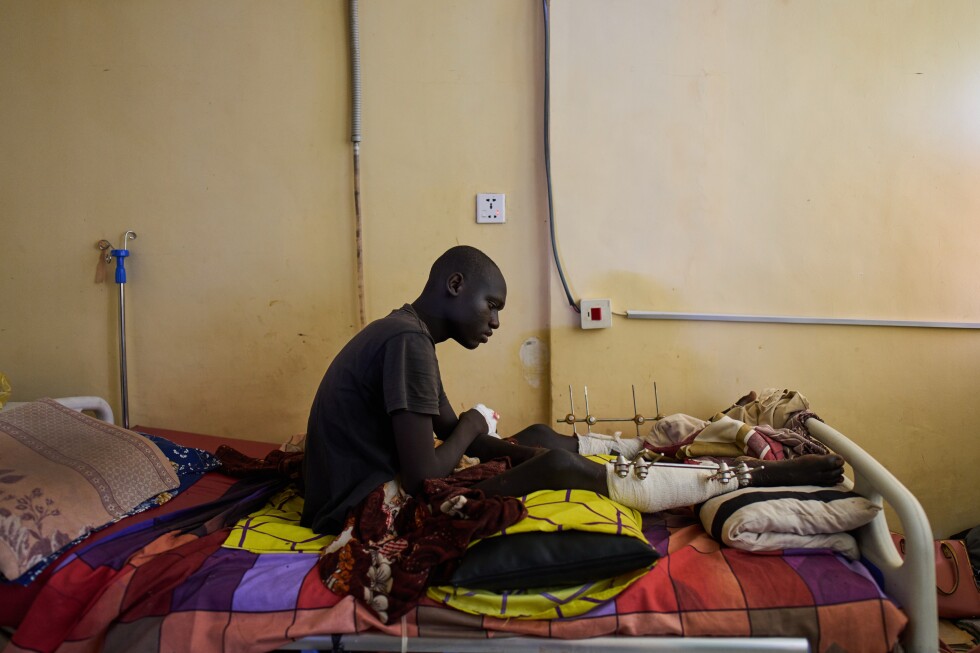
Khaled Abdulgader experienced this threat first-hand last year, when he intervened to stop children playing with an unknown object he later learned was an explosive, mistaking it for a football. The device detonated in his hand, leaving him with two fingers amputated and deep shrapnel wounds to his chest. Even as he recovered, Abdulgader tried to frame his experience as a grim stroke of luck, saying, “I feel like, ‘Thank God it was just my hands.’” He is far from alone in his injury: official and aid data counts hundreds of Sudanese killed or maimed by accidental UXO blasts since the current war broke out, and children account for a shockingly high proportion of casualties.
United Nations figures document 59 UXO-related casualties across Khartoum state in 2024, more than half of which were children. In just the first three months of 2025 alone, 21 of the 23 recorded UXO casualties were children. This deadly contamination is not an entirely new problem for Sudan: decades of successive conflicts across the country have left a total of 7,700 square kilometers of contaminated land — an area roughly equal to 7,700 standard football fields. But more than half of this current contamination stems from the 2023-present war, which has spread explosive hazards to previously unaffected areas including central Khartoum. Aid groups have documented that both warring parties, the Sudanese army and the RSF, laid extensive mines during their battle for control of the capital.
Khartoum today remains a city visibly scarred by fighting: abandoned, burned-out buildings pocked with bullet holes line empty streets, but a growing wave of displaced residents is choosing to return home. According to the UN, roughly 1.7 million people have come back to Khartoum state since the army retook control of the capital last year, many of whom have no prior experience navigating the threat of unexploded ordnance. On a reporting trip through Khartoum’s streets, Associated Press journalists observed a military explosive specialist responding to a resident’s report of a suspected RPG tail fragment in a residential home, a tiny reminder of the danger lurking underfoot.
Over the past 11 months, demining teams have cleared approximately 7.8 million square meters of land in Khartoum state, recovering and disposing of more than 36,000 explosive items, including hundreds of anti-personnel and anti-tank mines. Recovered ordnance that can be safely transported is destroyed in isolated areas away from populated neighborhoods, while larger or unstable devices are detonated on site. But the scale of the task is enormous, and demining is an inherently painstaking process: each trained demining worker can only safely clear between 10 and 15 square meters of land per day. Juma Abuanja, team leader for Sudanese demining organization Jasmar, warned that full clearance will take years of sustained work. “The presence of land mines and other explosive ordnance is of great concern to everybody,” Abuanja said.
One of Jasmar’s ongoing projects is clearing a popular public park in Khartoum, one of at least seven known minefields across the state that range from downtown locations to outer suburbs and critical bridge crossings. The 123,000-square-meter clearance operation began last August and is scheduled to wrap up in May 2025; to date, teams have found more than 160 explosive devices, including both anti-personnel and anti-tank mines. Before clearance work began, at least one civilian was killed in an accidental blast in the park, which is now cordoned off and marked with prominent danger warnings. On a recent workday, demining team members took a mid-shift break under park trees, shedding their heavy protective vests and face shields to escape Khartoum’s scorching desert heat.
Sudan’s transitional government says it is doing everything possible to mitigate the UXO risk, but faces crippling shortages of funding and personnel, a crisis amplified by the ongoing war. A government official, speaking on condition of anonymity because they were not authorized to speak to the press, told the AP that authorities are rolling out public awareness campaigns through mosques, market gatherings, radio, podcasts and school educational materials to teach civilians how to identify and report unexploded ordnance. But multiple injured civilians interviewed by the AP said they had never encountered any of these warnings, which launched in late 2024. Compounding the problem, many civilians are hesitant to report suspected ordnance to authorities: a 2025 Human Rights Watch report documented that Sudanese security forces have detained civilians in recaptured areas on unproven allegations of collaboration with the RSF, leaving many afraid they will face questioning or prosecution if they report explosive remnants of war in their communities. For others, the danger is unrecognizable until it is too late.
For 18-year-old Mogadem Ibrahim, the fatal mistake came when he picked up a piece of metal outside his Omdurman home last August, assuming it was scrap car part. When the device stuck to his hand and he pulled it free, it exploded. The blast shredded his left hand, costing him multiple fingers and leaving him unable to continue his work as a day laborer to support his family. “I feel depressed and worthless. I was supporting my family and now I’m sitting here and doing nothing,” he told the AP.
As Sudan’s war enters its fourth year, the slow, dangerous work of clearing ordnance and protecting returning civilians continues, with no quick end to the crisis in sight. This reporting is part of AP’s Africa Pulse coverage, supported by the Gates Foundation; the AP maintains full independent editorial control over all content.