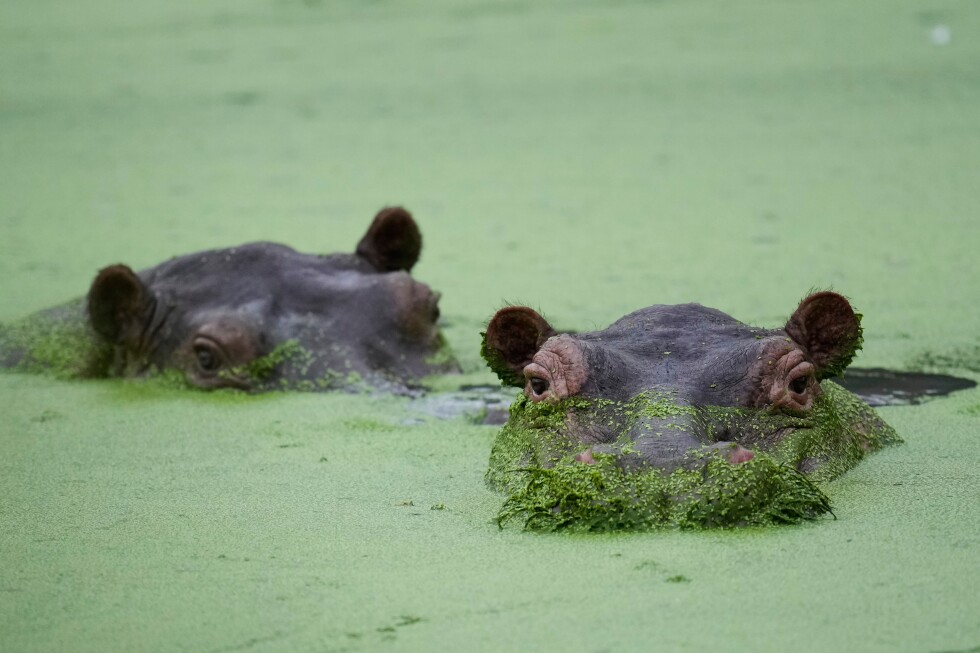
Nestled along the banks of Colombia’s Magdalena River, the quiet riverside town of Puerto Triunfo holds an unexpected, dangerous legacy left by one of the world’s most infamous drug kingpins: a rapidly growing colony of invasive hippopotamuses that have divided local communities, spurred national debate, and put environmental policymakers in an impossible position.
For local fishermen like Wilinton Sánchez, the semi-aquatic giants are a constant, deadly threat. Capable of charging 30 kilometers per hour across land and 8 kilometers per hour through water, hippos can surge from the river’s murky, tea-colored currents without warning. “We were out Saturday when one lunged … reared up and swung its jaws wide,” Sánchez recalled. “If it ever gets hold of you, it’ll tear you to pieces.”
Álvaro Molina, another longtime fisherman who has lived along the river for decades, says dangerous run-ins have become routine. Around 11 years ago, the first two hippos settled on the nearby “Island of Silence,” a vegetated river island that offered ideal living conditions: no natural predators, a stable drought-free climate, and abundant vegetation far different from their native African range. Today, their population has surged, and Molina says encounters are so common he barely blinks anymore. A few years back, his boat drifted directly atop two resting hippos, which capsized the vessel in their surprise. Molina escaped unharmed, but he says the hippos have destroyed the local fishing industry, as fear has driven dozens of workers away from the water entirely. “Whether they are killed or taken away, it does us a favor,” he said.
But for many other local residents, the hippos have become an unexpected economic lifeline. Several days a week, tour boats carrying domestic and international tourists crowd the river, visitors scanning the shoreline and murky water for a glimpse of the giants. Even the occasional sudden charge that sends boatloads of tourists screaming has done little to dampen the popularity of “hippo-watching” excursions.
Diana Hincapié, a 48-year-old restaurant owner located on the banks of the Cocorná Sur River, a Magdalena tributary, says nearly 200 tourists visit her business each month, most traveling to the area specifically to see the hippos. She argues the animals have put down roots in Colombia after three decades of reproduction, saying, “They aren’t African anymore; they are Colombian, born and bred here for over 30 years.” If the government moves forward with its plan to cull the population, Hincapié says she is ready to join mass street protests, warning that losing the hippos would decimate Puerto Triunfo’s tourism economy.
The hippo colony traces its origin back to the 1980s, when notorious drug lord Pablo Escobar imported four hippos to add to his private menagerie at Hacienda Nápoles, his sprawling, fortified valley estate. After Escobar’s death in 1993, the hippos escaped confinement and gradually spread across the Magdalena river basin. Today, the population numbers roughly 200, and Colombia’s Environment Ministry projects that without aggressive intervention, that number will surge past 500 by 2030, covering more than 43,000 square kilometers of river territory.
To curb the unsustainable growth, the Colombian government recently approved a management plan that approves three main strategies: long-term confinement of local hippo populations, transfer of animals to international zoos or wildlife sanctuaries, and euthanasia, which is framed as a last resort for cases where non-lethal options are unworkable. The plan calls for euthanizing approximately 80 hippos starting in the second half of 2024.
The announcement ignited immediate outrage across the country and beyond. Animal welfare activists have labeled the plan “mass murder” and “extermination.” Colombian Senator Andrea Padilla has called on the government to prioritize relocation over culling, arguing that responding to Escobar’s reckless illegal importation with mass killing is unacceptable. “This is a legacy left to us by a drug trafficker,” Padilla said. “How can we possibly close this chapter in the exact same way — by shooting the hippos?”
Scientists who back the cull as a necessary environmental measure have even received death threats amid the public backlash. Daniel Cadena, dean of sciences at the University of the Andes, explains that hippos are large, impactful herbivores that fundamentally alter local ecosystem structure, posing long-term risks to native Colombian wildlife. He supports a mixed strategy that includes euthanasia as a necessary component to stop uncontrolled population growth.
Euthanasia is also logistically challenging, under official government protocol: hippos must first be lured into corrals with food, immobilized, then given a lethal injection. Alternately, they may be shot with high-powered long-range rifles, as the species’ famously thick skin makes penetration difficult for lower-powered weapons.
Efforts to pursue non-lethal relocation have so far hit a dead end. The Environment Ministry confirmed that while some countries initially expressed interest in accepting transferred hippos, no nation has formally committed to taking in the animals. High transportation and care costs, as well as legal restrictions on importing invasive species, have deterred potential hosts, leaving the controversial cull plan on the table as the government weighs its options to address a problem decades in the making.