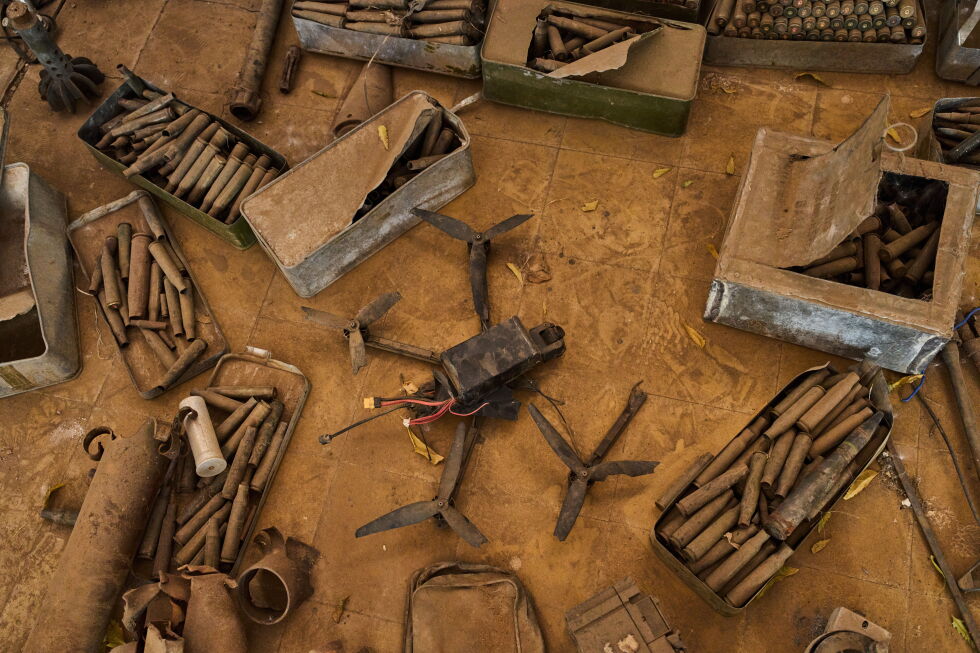
As Sudan’s brutal civil war enters its fourth year, a new wave of overnight drone strikes carried out by the Rapid Support Forces (RSF), Sudan’s main paramilitary group, has left at least 15 people dead and dozens more injured in the central Sudanese city of el-Obeid, health officials confirmed Thursday. The rising reliance on unmanned aerial attacks has become one of the most dangerous and destabilizing features of the ongoing conflict, which has already plunged the nation into one of the world’s worst humanitarian crises.
The assault began late Wednesday, hitting multiple locations across el-Obeid including an area adjacent to a Sudanese military position, according to two health workers from el-Obeid Hospital, the main facility receiving casualties from the strikes. The officials spoke on condition of anonymity, as they lack official authorization to engage with media outlets. They added that more than 10 people were wounded, with several suffering critical injuries that require urgent advanced care.
Dr. Mohamed Elsheikh, spokesperson for the Sudan Doctors Network, an organization that monitors casualty figures across the country, told the Associated Press that RSF drones also targeted two additional civilian sites: a funeral gathering at a local cemetery, where four attendees were killed, and a functioning gas station. Dr. Elsheikh noted that he could not immediately confirm whether the casualties included only civilians, only combatants, or a mix of both.
Aid workers on the ground report that drone strikes have intensified sharply across el-Obeid in recent days, with public gatherings of any kind repeatedly targeted. An anonymous aid worker with the global humanitarian organization Mercy Corps, speaking out of fear of retaliation from armed groups, explained that the escalating violence has forced local schools to suspend all classes, while city markets only operate partially as residents stay home to avoid attack.
Emergency Lawyers, a Sudan-based aid and conflict monitoring group, released a statement Thursday warning that the final death toll is expected to rise, as drone sorties continued to fly over el-Obeid well into Thursday. The group documented that residential homes near the headquarters of the Sudanese military’s 5th Infantry Division were hit, alongside a truck transporting critical food supplies into the city. The truck’s driver was killed in the strike.
“This series of attacks indicates a widespread pattern of targeting civilian gatherings, neighborhoods and infrastructure, including during rescue operations and funerals,” the group said, adding that it has grave concerns over the indiscriminate nature of these strikes, which put non-combatant residents at constant lethal risk.
Sudan’s long-running conflict first erupted in April 2023, when decades of latent tensions between the Sudanese Armed Forces (SAF) and the RSF boiled over into open civil war. To date, the conflict has killed at least 59,000 confirmed people, displaced more than 13 million Sudanese from their homes, and pushed large swathes of the country into catastrophic famine conditions. The United Nations estimates that more than 30 million Sudanese — over two-thirds of the country’s total population — require urgent life-saving humanitarian assistance.
As the conflict has dragged on, military control has become geographically split: the Sudanese military holds power across northern, eastern, and central Sudan, including strategic Red Sea ports and the country’s critical oil refining and pipeline infrastructure. The RSF and its allied militias control the entire Darfur region and large portions of Kordofan along Sudan’s border with South Sudan, both resource-rich regions holding major oil reserves and gold deposits.
Security and conflict experts confirm that drone warfare has now overtaken other forms of attack as the deadliest threat to civilian populations in Sudan, with both warring parties receiving shipments of drones and other military equipment from multiple countries across the Middle East and beyond. Humanitarian workers add that the recent surge in drone attacks across Kordofan has severely hampered already fragile aid operations in the region, leaving vulnerable communities cut off from critical food, water, and medical support.