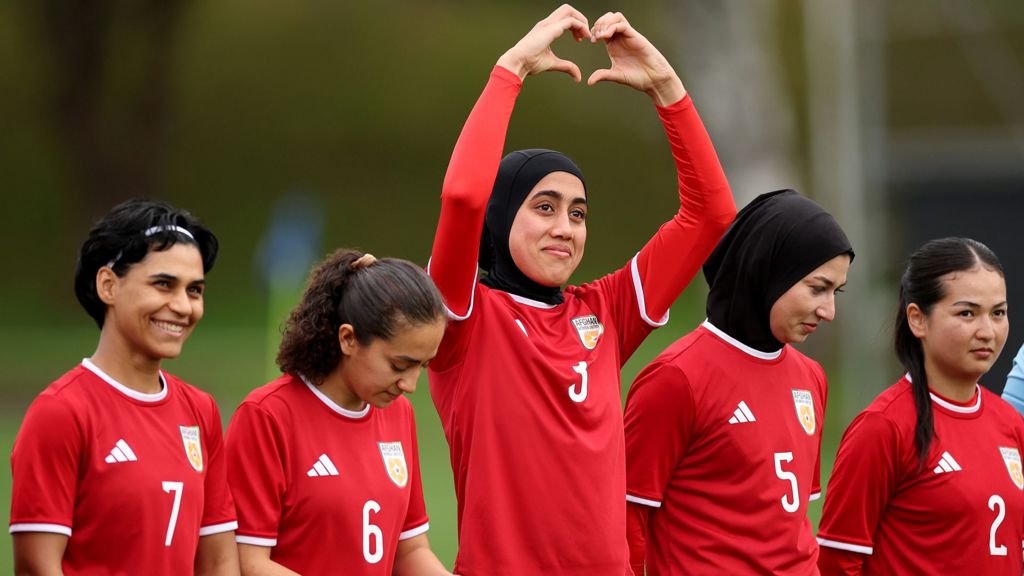
In a bustling changing room in Auckland, New Zealand, 23 displaced Afghan women footballers go through their pre-match rituals. Some stretch tired muscles and lace up worn boots, while old teammates, separated by years of exile and uncertainty, embrace tightly. Midfielder Fatima Haidari turns to her squad, her voice steady and firm: “Be strong as always, because we do not just play for a team—we play for every Afghan woman denied the right to be here.” Applause fills the small room, where a tattered Afghan flag hangs on the wall and a soft patriotic hum drifts from a portable speaker. As the women join in the song, many blink back tears, their hands resting on the fabric of their matching kits. After a final huddle and a round of encouragement from their coach, they step out onto the pitch—ground that for decades, forces in their home country have insisted women do not belong.
This gathering marks a historic milestone: it is the first time the full squad of Afghan Women United has assembled in person since FIFA’s landmark April ruling that cleared the way for the team to represent Afghanistan in future official international matches. Compiled entirely from Afghan women players who fled the Taliban takeover in 2021 and now resettled across the globe, the team traveled to New Zealand to hold a week-long training camp and compete in two unofficial friendly fixtures against the Cook Islands.
For years, this moment seemed impossible. After the Taliban seized control of Afghanistan in August 2021, the regime imposed sweeping, harsh restrictions on women and girls, barring them from secondary education, university, most professional careers, and all organized sport. The original Afghan women’s national team, founded in 2007, was immediately disbanded, and its players were forced to evacuate the country, scattering across Australia, the United Kingdom, Portugal, and other nations. Years of relentless advocacy from the players and their supporters eventually led to the formation of a refugee collective, which became Afghan Women United. With FIFA’s historic ruling, the team can now pursue qualification for major international tournaments, including the FIFA Women’s World Cup and the Olympic Games.
For many of the players, just being able to train and compete together as a full squad is a victory years in the making. As asylum seekers and refugees spread across 10 different countries, securing coordinated travel documents and meeting in person has been an uphill battle over the past five years. For 23-year-old Manozh Noori, who now calls Australia home, the road to this gathering started as a secret on the streets of Kabul. Growing up, Noori played football with neighborhood boys, hiding her passion from her family after she secretly joined a local club at 16. Fearing her older brother, who was the family’s primary breadwinner, would disapprove, she played for six years wearing a face covering to conceal her identity, climbing the ranks to win multiple league titles, national championships, and individual awards.
In 2018, her teammates convinced her to remove the covering for a national television interview. When the segment aired, her secret was out. “I was so scared,” Noori recalled, her voice thick with emotion as she spoke from her Auckland hotel ahead of the matches. “I turned off the electricity to try to stop my family from watching the news, but word still got to my brother. He was furious. He threatened to cut off all support for the family if I didn’t quit immediately. My mother was crying—she didn’t know how we would survive without his help.”
Noori stepped away from the game for a short time, but eventually returned, supported by another brother living in Germany who funded her training. When the Taliban took over in 2021, she fled Afghanistan, but not before burying all her medals and trophies in her family’s garden. They remain there today. “One day I will go back and dig them out,” she says, a small smile crossing her face. Football has already given her more than trophies: two years after resettling in Australia, she was able to bring her mother and sister out of Afghanistan, allowing her sister to resume her education. “I hope my brother now realizes I am not a bad person,” she says.
For many players on the squad, football was not just a passion—it was their lifeline through the chaos of the Taliban takeover. “If I wasn’t a footballer, I would still be in Afghanistan, one of millions of girls who are not allowed to study, speak up or choose their own future,” says 24-year-old Mursal Sadat, who also lives in Australia. Evacuated from Kabul at 19, Sadat now works as a youth football coach, a facilitator, and an advocate for refugee and women’s rights. In Afghanistan, she faced constant harassment and judgment for playing football, with people telling her no one would ever marry a female athlete. Today, she is engaged to a man still living in Afghanistan, whose entire family supports her work with the team. “They tell me, ‘You are the pride of our family. We are so lucky to have you,’” she says.
When the team stepped onto the pitch in Auckland, steady rain poured down, but the players refused to be deterred. They have faced far harsher conditions back home. Defender Najma Arefi, 22, who now lives in Doncaster, England, remembers training in her home city of Herat when girls were only allocated the worst, hottest time slots, forcing her to practice in temperatures that exceeded 45 degrees Celsius. She persisted, and eventually helped her Herat-based team win a national championship— a victory that shifted local attitudes toward women’s football. “There were billboards of us across Herat,” she recalls. “People were proud. More families started letting their daughters play football.”
Today, Arefi studies criminal justice at college in the UK, makes her own choices about her life, and plays football regularly. “Having that freedom is incredible,” she says. But she carries a heavy weight: guilt and grief for the millions of women and girls still trapped in Afghanistan, denied the same opportunities. “Sometimes I put too much pressure on myself, because I have to make the most of every chance I get,” she says, tears rolling down her cheeks. She credits former team founder Khalida Popal with pushing FIFA to recognize the exiled squad, calling the ruling a historic achievement that she will always be proud of.
When approached for comment by the BBC, Taliban sports director Ahmadullah Wasiq declined to address FIFA’s recognition of the women’s team. He did extend an invitation for FIFA to visit Afghanistan and resume general football support in the country—support the global governing body largely withdrew after the Taliban takeover, and has stated will not resume until women are allowed to play.
On the pitch, the results of the two friendlies did not go the way of the Afghan side: the Cook Islands won the first match 1-0, and claimed a second 3-0 victory three days later. But for the women of Afghan Women United, the scoreboard does not define what these matches mean. After years of exile, displacement, and being told they could not play, this gathering was their answer: they have not disappeared, and they will not be silenced. Their dream of competing on the world stage for Afghan women is just beginning.