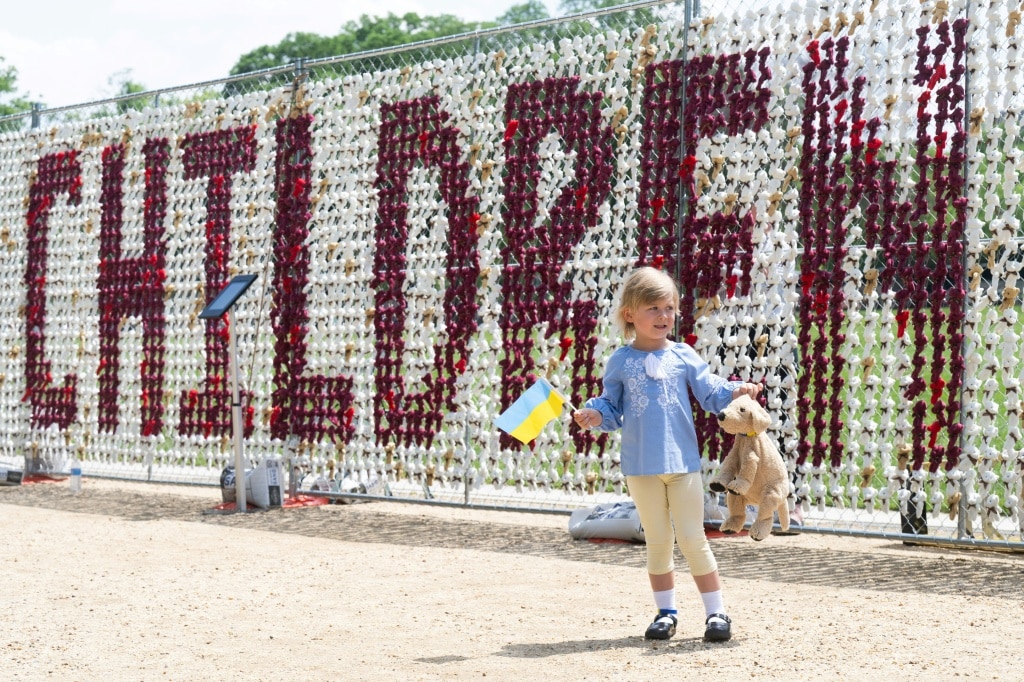
In a striking, somber display just steps from the U.S. Capitol in Washington D.C., 20,000 stuffed teddy bears line a National Mall fence, each one standing in for a Ukrainian child Kyiv accuses Russia of abducting since the full-scale invasion began in 2022. On Thursday, Ukrainian activists and U.S. lawmakers gathered at the installation to draw global attention to the missing children, uniting under the urgent rallying cry: “Bring Them Home.”
For 24-year-old Ukrainian activist Mariia Hlyten, the sheer number of toys on display underscores the scale of the crisis unfolding while world powers work toward diplomatic resolution. “When you see the scale… you then start to understand how terrifying this is, and that all this time, while we are waiting for some kind of negotiations, there are children’s lives at stake,” Hlyten said, emphasizing that the abducted children must be repatriated without delay.
The event was organized by Razom for Ukraine, in partnership with the American Coalition for Ukraine. Three senior U.S. lawmakers addressed the crowd, each condemning the alleged abductions as a deliberate act of cultural erasure and a violation of international law. Senate Democrat Richard Blumenthal argued that Russian President Vladimir Putin’s campaign extends far beyond territorial conquest. “What Vladimir Putin is doing here is not trying to take territory alone. He’s not trying to defeat a nation alone,” Blumenthal said. “He’s trying to destroy the people, that is the purpose of abducting children, changing their names, re-education. Killing their identity, if not the children themselves — making sure that they never grow up speaking their own language, knowing their own religion and culture.”
House Democrat Jamie Raskin echoed Blumenthal’s criticism, calling the forced removals a blatant violation of international humanitarian standards and the laws of war. “It’s a war crime and if it’s done intentionally… it is part of the proof of genocide,” Raskin said.
Standing nearby draped in Ukraine’s blue-and-yellow national flag, 28-year-old Arkady Dolina, a Ukrainian and relative of Hlyten, described the mass abductions from Russian-occupied Ukrainian territories as “absolutely horrible.” He framed the campaign as the latest chapter in a long-running Russian policy of forced indoctrination, saying: “This is the continuation of a centuries long Russian policy to abduct, indoctrinate kids and then send them as their cannon fodder to fight their stupid, useless, brutal wars.”
Moscow has repeatedly denied all accusations of forcibly abducting Ukrainian children. Still, claims from Kyiv have gained traction from international bodies and world governments. In February, Ukrainian President Volodymyr Zelensky announced that roughly 2,000 children had been successfully returned to Ukraine from Russia and Russian-held territories, but thousands more remain held captive. In March, the U.S. government launched a $25 million fund to support efforts to reunite displaced Ukrainian children with their families, a cause that former U.S. First Lady Melania Trump has also publicly backed. In 2023, the International Criminal Court issued arrest warrants for Putin and his children’s rights commissioner, charging the pair with the war crime of unlawful deportation of Ukrainian children.
Kyiv alleges that Russia has systematically worked to erase the Ukrainian identity of abducted children, forcing them to undergo pro-Russian indoctrination, compelling many to take Russian citizenship. These claims have been corroborated by firsthand testimony from Ukrainians who have escaped Russian occupation.