The sharp crack of sniper fire cuts through the quiet eucalyptus canopies of outback Queensland near Townsville, a region that has not seen active conflict since World War II. Moments later, missile strikes send plumes of smoke billowing into the sky, the hum of surveillance drones rising above the treeline before being drowned out by the thrum of military helicopters passing overhead. No piece of advanced military hardware is left out of this display, and no expense has been spared. But this is no active war zone – it is one of the largest joint military exercises the Indo-Pacific has seen in recent years, a visible sign of Australia’s shifting strategic posture amid growing great power competition.
Brigadier Ben McLennan of the Australian Army frames the training as a necessary response to an increasingly unstable global landscape. “War is no longer the distant abstract concept it once was for many Australians,” he explained, noting that even thousands of miles from active conflicts in Ukraine and the Middle East, the nation already feels their ripple effects through spiking fuel costs and soaring inflation. When pressed to name a potential adversary, McLennan remained deliberately vague, only noting that the exercise prepares Australian forces for “the worst type of war – a total war on the scale of the World Wars.”
This large-scale drill, dubbed Exercise Southern Jackaroo, brings together thousands of troops from Australia, the United States, and Japan to deepen defensive coordination across the Indo-Pacific. The growth in participation underscores just how much Australia’s security alignment has shifted over the last decade: in 2012, just 200 U.S. Marines rotated through northern Australia for annual training. Today, that number has jumped to roughly 2,500. The expansion extends beyond troop numbers, too: key northern Australian bases, including RAAF Tindal in the Northern Territory, have undergone major upgrades to accommodate long-range U.S. B-52 bombers. The most ambitious security partnership, however, remains AUKUS – the trilateral pact between Australia, the U.K., and the U.S. that will provide Australia with nuclear-powered submarines, a landmark agreement that has sharply deepened the nation’s security ties with Washington.
Australia’s approach stands out among other middle-sized global powers. While nations like Canada have re-evaluated their security commitments amid growing uncertainty over U.S. reliability, Canberra has doubled down on its alignment with Washington. This shift, however, is out of step with shifting public opinion among Australian voters, according to recent polling from the Lowy Institute, an independent Australian think tank. Just 31% of Australians now trust the United States to act responsibly in global affairs, and only 28% extend that trust to China – a stark gap between public sentiment and the government’s current policy trajectory.
This divergence reflects the central paradox shaping modern Australian foreign policy: while Canberra deepens its security alliance with the U.S. to counter China’s growing military buildup and expanding regional influence in the Pacific, China remains Australia’s largest and most economically critical trading partner. The economic ties between the two nations run deep: China overtook other partners to become Australia’s top export market in the early 2010s, driven by insatiable demand for Australian commodities. The relationship reached its peak in 2015, when the two nations signed a landmark free trade agreement following a state visit by Chinese President Xi Jinping, who addressed Australia’s parliament.
That era of relatively warm bilateral relations collapsed quickly after 2020, when Australia called for an independent international investigation into the origins of COVID-19. Beijing retaliated with steep tariffs on a range of Australian exports, and in 2021, Canberra canceled Victoria’s state-level participation in China’s Belt and Road Initiative, making Australia the first nation to walk back from the global infrastructure program. Diplomatic frictions deepened amid the detention of Australian citizens in China, including journalist Cheng Lei, who was released in 2023 after more than three years in custody.
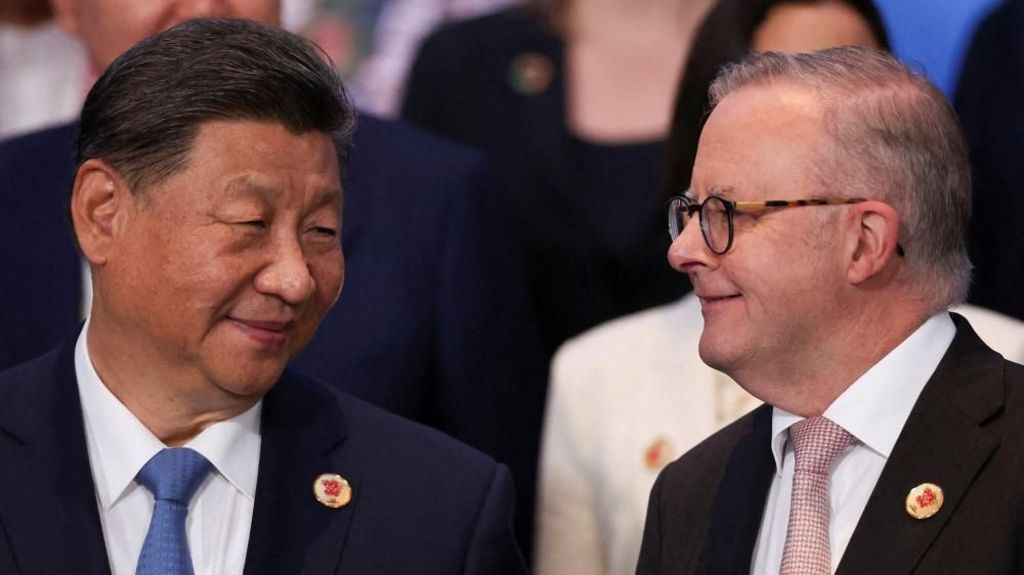
Relations have warmed slightly under current Prime Minister Anthony Albanese’s center-left Labor government, but frictions remain. Earlier this year, Beijing imposed a 55% tariff on Australian beef imports, despite the terms of the 2015 free trade agreement, a move framed as protection for China’s domestic agricultural sector. Even so, public attitudes toward China have softened in recent years: the 2026 Lowy Institute Poll finds that 61% of Australians now view China primarily as an economic partner rather than a security threat, an 11-point increase from 2025. For the first time, a narrow majority of 51% of respondents say that Australia’s relationship with China is more important than its relationship with the United States. Australians remain wary of Chinese investment in the nation, however, with most preferring investment from Western nations with similar regulatory frameworks and higher levels of established trust.
Former Australian Prime Minister Kevin Rudd, a veteran China analyst who speaks fluent Mandarin, recently warned that the global order is undergoing “radical changes” driven by China’s growing global influence at a time when the United States continues to debate its own role as a global superpower. Marina Yue Zhang, an associate professor at the University of Technology Sydney, notes that growing numbers of Australians are questioning the reliability of the U.S. as a long-term security ally, particularly amid domestic political upheaval in Washington.
When Chinese President Xi Jinping met U.S. President Donald Trump in Beijing earlier this year, Xi referenced the “Thucydides Trap” – the theory that a rising power challenging an established hegemon will almost inevitably be drawn into conflict. For Australia, sitting directly between the two competing superpowers, this great power rivalry creates an unavoidable dilemma. Washington remains Canberra’s core security partner, even as public trust in the U.S. declines, while Beijing is the foundation of Australia’s economic prosperity. “It’s not an either-or choice for Australia – picking one side and cutting off the other would be directly against the nation’s core interests,” Zhang explained. “It’s getting harder and harder to walk this middle line, but Australia has no other choice but to maintain this delicate balancing act.”