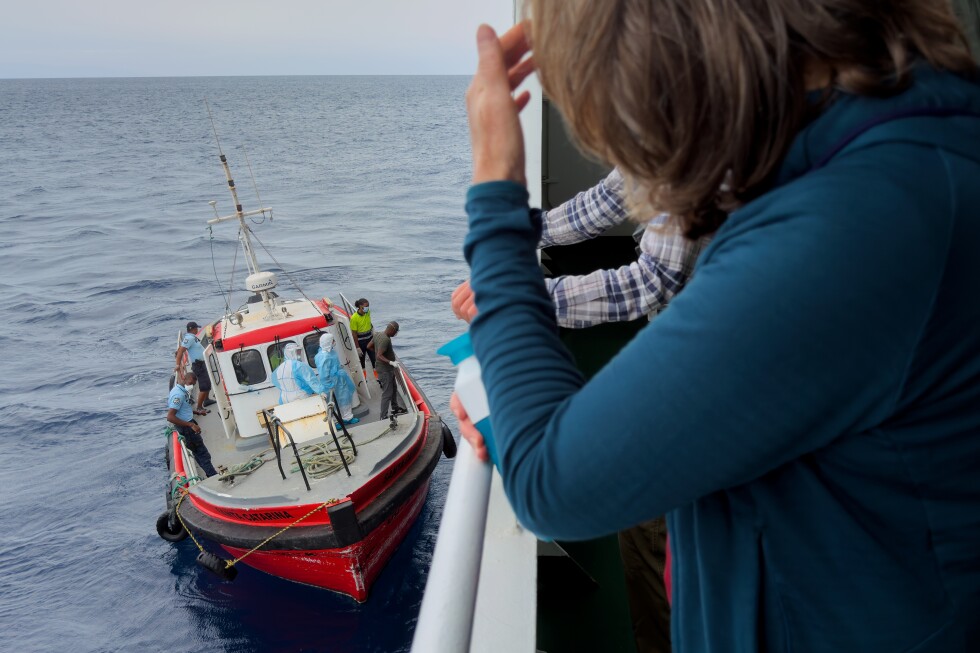
As the Dutch-flagged cruise vessel MV Hondius, which has been hit by a deadly hantavirus outbreak, prepares to dock off the coast of Tenerife in Spain’s Canary Islands this Sunday, emergency and public health teams across the globe are scrambling to coordinate evacuation protocols and track down potentially exposed passengers who left the ship before the outbreak was confirmed.
Three fatalities have already been linked to the outbreak, and five passengers who disembarked the ship earlier have tested positive for the virus, according to cruise operator Oceanwide Expeditions. The company confirmed Friday that no remaining passengers or crew members currently show visible signs of hantavirus infection, even as preparations for a controlled, phased evacuation move forward.
Spain’s emergency services chief Virginia Barcones outlined strict protocols for the arrival, stating that all people on board will be moved to a fully isolated, cordoned-off zone once the ship docks. Evacuation will proceed in small groups via shuttle boats, with passengers transported to cordoned-off sections of Tenerife’s airport in dedicated, guarded isolation vehicles only after their repatriation flights are fully ready for departure. Canary Islands public officials have moved quickly to reassure local residents that the broader population faces minimal exposure risk.
The United States and United Kingdom have both arranged special charter flights to repatriate their citizens who remain on the vessel. The U.S. will fly roughly 17 American passengers back to Omaha, Nebraska, where they will be quarantined at the University of Nebraska Medical Center’s specialized National Quarantine Unit – a facility purpose-built to handle high-risk infectious diseases, previously used to treat Ebola and the earliest known COVID-19 cases in the U.S. “We are prepared for situations exactly like this,” noted Nebraska Medicine CEO Dr. Michael Ash, adding that none of the American passengers currently show symptoms. The UK will evacuate nearly 24 British nationals remaining on board via a chartered flight of its own.
Global public health authorities have stressed that the overall risk of a widespread community outbreak from this event remains low. The World Health Organization (WHO) confirmed Friday that a KLM flight attendant who was feared to have contracted the virus after sharing a flight with an infected passenger has tested negative. WHO spokesperson Christian Lindmeier emphasized that this negative result should ease public anxiety, reiterating, “The risk remains absolutely low. This is not a new COVID.”
Hantavirus is most commonly transmitted to humans through inhalation of air contaminated by rodent droppings, and does not spread easily between people. The Andes virus strain detected in this outbreak is a rare exception, with documented limited person-to-person transmission in uncommon circumstances. Symptoms typically develop between one and eight weeks after exposure, creating a challenge for contact tracers tracking potentially infected people who left the ship weeks ago.
The outbreak’s slow detection created significant challenges for contact tracing efforts. The first passenger death on board occurred in mid-April, but nearly two dozen passengers from 12 different countries were allowed to disembark on April 24, before any official confirmation of hantavirus. It was not until May 2 that health authorities formally confirmed hantavirus in a passenger from the ship, prompting a global race to track down all people who may have been exposed.
As of Friday, new suspected cases continued to emerge outside the vessel. UK health authorities reported a third suspected hantavirus case in a British former passenger currently on the remote South Atlantic territory of Tristan da Cunha, where the ship made a stop in April. In southeastern Spain, a former passenger in Alicante who shared a flight with an infected Dutch cruise passenger who later died in Johannesburg is currently undergoing testing for the virus. Two confirmed British cases are already hospitalized, one in the Netherlands and one in South Africa.
South African health authorities are focusing contact tracing efforts on an April 25 flight from St. Helena to Johannesburg, which carried multiple passengers who disembarked the cruise ship at the remote South Atlantic island. U.S. health officials are monitoring a small number of former passengers who have already returned to the U.S., along with their close contacts, and have reported no symptomatic cases so far.
For passengers still on board the MV Hondius, life has continued with relative calm in recent days, with many engaging in birdwatching, reading, or attending shipboard talks while adhering to masking and social distancing rules. But two Spanish passengers, who spoke to the Associated Press on condition of anonymity over fears they will face social ostracism after disembarking, said they fear the reaction they will face from the public. “We’re scared by all the news that’s coming out, by how people are going to receive us, by how people see us,” one passenger said. “We’re just normal people. We’ve heard that this is a millionaires’ cruise, and it’s the complete opposite of reality. And we’re scared by this.”