South Korean voters headed to polling stations across the country on Wednesday to cast ballots in high-stakes local elections and parliamentary by-elections, widely viewed as a pivotal mid-term assessment of public support for President Lee Jae Myung’s one-year-old liberal administration. The election cycle comes 18 months after former conservative President Yoon Suk Yeol’s catastrophic martial law declaration triggered a national political crisis that ended with Yoon’s impeachment, removal from office, and eventual conviction on rebellion charges, leaving the main conservative opposition People Power Party (PPP) fractured and deeply weakened.
Across roughly 14,300 polling locations open from 6 a.m. to 6 p.m. local time, more than 44.6 million eligible voters chose candidates for 17 key races, including 16 mayoral and provincial gubernatorial seats, 12 of which are currently held by the PPP. The elections also fill 14 vacant seats in South Korea’s 300-member National Assembly through by-elections, adding another layer of political consequence to the day’s voting.
Early pre-election opinion polling pointed to a dominant showing for Lee’s Democratic Party (DP), with some projections suggesting the liberal party could seize as many as 15 of the 16 available gubernatorial and mayoral posts. But more recent survey data indicates that PPP and independent candidates have narrowed the gap, with some even pulling ahead of DP contenders in five to seven competitive races. Political analysts widely agree that given the opposition’s fractured position, the DP needs a landslide victory — including a win in the closely watched Seoul mayoral race — to solidify Lee’s political mandate and extend liberal control of South Korean politics for years to come.
“The conservatives’ support base has been fractured and weakened in the wake of Yoon’s impeachment, while the liberals’ support base has grown stronger. Considering that, results of the elections will determine whether their dominance would prolong for a considerable time,” explained Jeong Han-Wool, director of the Korean People Research Institute.
Choi Jin, head of the Seoul-based Institute of Presidential Leadership, noted the DP entered the contest with a built-in advantage: widespread public anger remains over Yoon’s 2024 martial law imposition, and the Lee administration is still viewed by many voters as a new government that deserves more time to deliver results, rather than facing pushback mid-term. Choi defines a resounding DP victory as winning at least 12 of the 16 top local posts, and warns that a loss in the Seoul mayoral race would deal “a tremendous blow” to Lee’s government.
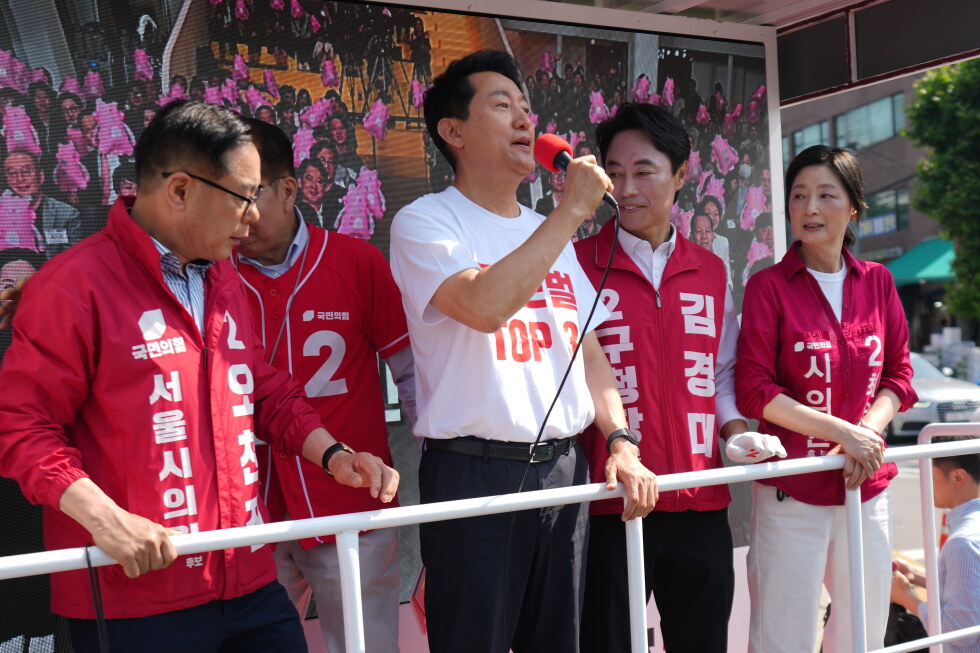
The Seoul contest has emerged as the highest-profile race of the election cycle, pitting the DP’s Chong Won-o — a former Seoul district leader who rose to prominence after Lee praised his local governance last fall — against incumbent mayor and PPP political heavyweight Oh Se-hoon. On the eve of voting, Oh argued that the national political landscape benefits from bipartisan checks and balance, urging voters to keep Seoul, the last major conservative stronghold, in opposition hands. “Our country would be safer when the rival forces keep each other in check than one side controlling everything. Please, leave Seoul, the last stronghold, in our hands,” Oh told reporters Tuesday.
For his part, Chong called on Seoul voters to deliver what he framed as a “stern verdict” on Oh’s tenure, criticizing the incumbent for what he described as incompetent and irresponsible leadership during his time in office.
Thursday marks exactly one year since Lee took office, after winning a snap election called following the Constitutional Court’s ruling to remove Yoon from office over his martial law order. Lee currently holds an approval rating above 60%, and Yoon was convicted of rebellion and sentenced to life in prison by a Seoul district court in February 2025.
In the wake of Yoon’s ouster, the PPP has been mired in bitter internal conflict between reformist lawmakers who supported the impeachment and hardline loyalists who remained loyal to the ousted leader. One of the highest-stakes parliamentary by-elections pits expelled PPP reformist leader Han Dong-hoon against DP candidate Ha Jung-woo, a former AI policy adviser to Lee, in Busan — South Korea’s second-largest city. Polling shows Han holds a narrow lead in the race.
Jeong argues that a Han win could allow anti-Yoon conservative reformists to regroup and establish a new competitive force within South Korea’s divided conservative movement. But Choi offers a different take, noting a Han victory could actually deepen conservative divisions, as Yoon loyalists would feel heightened political pressure and close ranks to defend their influence.