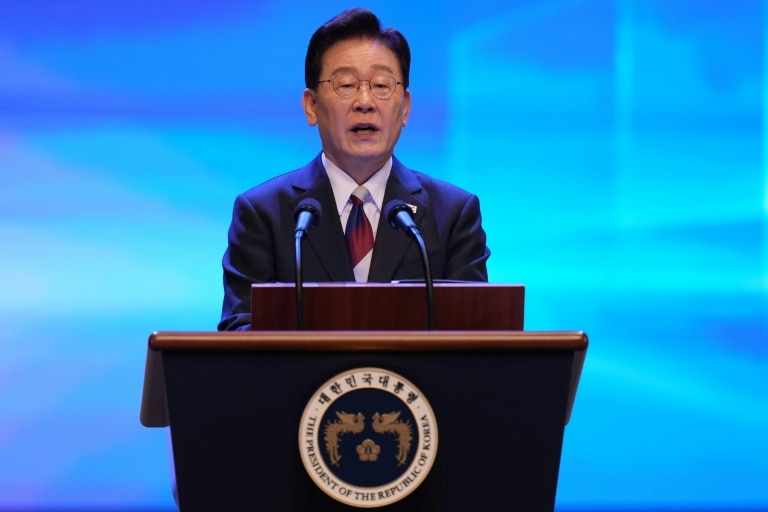
On the 81st anniversary of Korea’s liberation from 35 years of Japanese colonial rule, South Korean President Lee Jae Myung has tabled a historic offer to North Korea: open direct negotiations to formally end the Korean War, a conflict that has remained technically unresolved for 72 years.
The 1950–1953 Korean conflict, initiated by a North Korean incursion across the 38th parallel, concluded not with a binding peace treaty but only an armistice agreement, leaving the Korean peninsula divided and the two neighboring states locked in a decades-long stalemate of mutual military deterrence. In his keynote address to the national liberation day ceremony, Lee extended an olive branch to Pyongyang, calling on both sides to set aside hostile posturing and engage in dialogue as the primary parties directly impacted by the unresolved conflict.
Beyond formalizing an end to the war, the South Korean leader noted that open talks could also create a pathway to negotiate concrete, effective measures to roll back North Korea’s advancing nuclear weapons program.
Lee’s proposal comes at a moment of escalating regional friction, as Pyongyang ramps up its opposition to the upcoming annual joint military drills hosted by South Korea and the United States. North Korea has already issued harsh warnings that it will strengthen its military deterrence in response to the exercises, which it frames as a provocative rehearsal for an invasion of its territory. The reclusive state has also reacted aggressively to Japan’s expanding military posture in the Pacific, launching two short-range missiles in recent weeks after Tokyo announced it would upgrade its defense capabilities amid growing regional security concerns.
Since the 2019 Hanoi summit between North Korean leader Kim Jong Un and then-U.S. President Donald Trump collapsed over disagreements on the scope of denuclearization and the removal of international sanctions, Pyongyang has repeatedly cemented its status as an “irreversible” nuclear power, rejecting calls to give up its atomic arsenal.
Lee, a dovish leader who took office in Seoul in June 2025, has already fundamentally shifted South Korea’s policy toward the North away from the hardline stance adopted by his hawkish predecessor. He has repeatedly offered to hold talks with Pyongyang’s nuclear-armed leadership without preconditions, and last month Seoul’s unification minister confirmed that the South Korean government had abandoned its previous policy of prioritizing pressure to force complete North Korean denuclearization. Instead, the current administration is now focused on halting further expansion of Pyongyang’s nuclear activities as a more achievable near-term goal.
To date, North Korea’s leadership has not responded to Lee’s repeated outreach. Instead, Pyongyang has moved to deepen its strategic and military partnership with Moscow, in what analysts describe as a mutually beneficial arrangement. Analysts assessing the relationship note that North Korea has supplied troops and ammunition to support Russia’s ongoing war in Ukraine, and in exchange, Pyongyang is receiving much-needed financial aid, food supplies, energy resources, and advanced military technology from the Kremlin. North Korean leader Kim Jong Un is widely expected to travel to Russia later this year to hold talks on expanding weapons cooperation between the two states.
The United States, South Korea’s longstanding security ally, currently deploys roughly 28,500 troops across South Korea to deter potential North Korean aggression. Colonel Ryan Donald, spokesperson for the combined U.S.-South Korea Forces Command, noted this week that North Korea’s deployment of personnel to Ukraine has already altered the security threat landscape on the Korean peninsula. “They’ve taken those lessons they learned there and brought them back to North Korea,” Donald told reporters, ahead of the 11-day joint military exercise set to launch Monday. He added that the upcoming training has been adjusted to account for this evolving threat.