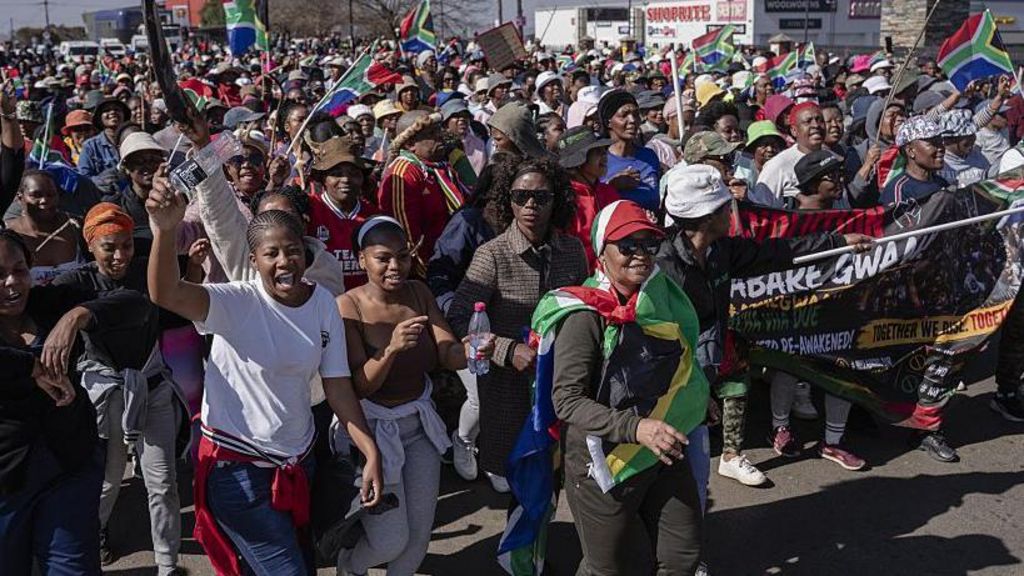
As South Africa approaches an unofficial, self-declared deadline for undocumented foreign migrants to leave the country, anti-immigrant demonstrations continue to roil communities across the nation, prompting a new warning from President Cyril Ramaphosa that any protests must be carried out without intimidation, threats or targeted violence.
Tensions around immigration have mounted steadily in recent months, with growing public pressure pushing thousands of undocumented migrants from other African nations to flee South Africa preemptively out of rising fear for their personal safety. For many, the decision to leave has come at devastating personal cost: one undocumented Malawian migrant spoke to the BBC about feeling relieved to escape potential violence but heartbroken to leave his four young children behind in the country he called home.
Ramaphosa, who has repeatedly called for peaceful demonstration amid the unrest, has acknowledged widespread public demands for comprehensive immigration reform while pushing back against aggressive, exclusionary rhetoric targeting foreign-born residents. In his weekly public newsletter, the president reminded South Africans that a large share of foreign nationals residing in the country are lawful residents. “They work, study, raise families, invest in our economy and contribute positively to our society. They too are entitled to the protection of our laws and our Constitution,” he wrote. He added that constitutionally protected rights to protest and free speech do not extend to threats, intimidation, vandalism or violent action against migrant communities.
Official South African data estimates that more than three million documented foreign nationals currently live in the country, with tens of thousands more residing in the country without formal authorization. In the weeks leading up to this week’s deadline, thousands of vulnerable migrants have sheltered in temporary transit camps across the country, waiting for repatriation processing after fleeing their homes to avoid anti-migrant violence.
In Durban, the site of some of the largest and most violent recent anti-migrant demonstrations, authorities are currently dismantling the large white tent camp that has housed hundreds of primarily Malawian migrants, as buses prepare to carry the migrants back across the border to their home country. Among those departing was Nelson Mbewe, who originally moved to South Africa to find steady work to support his family back in Malawi. “But we’ve faced challenges – they’re saying we should go back home because we do not have the right documents,” Mbewe told the BBC. “It’s their country, so what can we do? That’s why we have accepted that we just have to unwillingly go back home.”
Mbewe also had a sharp message for South African protesters who use the slur “Makwerekwere” – a derogatory, xenophobic term for foreign African migrants – to describe people like him. “Think before taking any action,” he said. “Those of us that they call Makwerekwere were making a contribution to the development of their country because they don’t know hard manual labour is – all they know is begging.”
Since the current wave of anti-migrant protests began earlier this year, South African government data shows more than 12,000 immigrants have been either deported or have voluntarily repatriated to their home countries. Governments of origin including Ghana, Malawi, Mozambique, Nigeria and Zimbabwe have organized large-scale repatriation operations via both bus and air over the past month, with roughly 3,500 undocumented migrants volunteering to leave South Africa to escape rising tensions.
The repatriation process has already sparked a cross-border diplomatic dispute: South African authorities claim more than 500 of the repatriated Nigerians lacked valid documentation, a claim the Nigerian government has publicly disputed.
Authorized anti-migrant marches are scheduled to take place Tuesday in major urban centers including Durban and Johannesburg, alongside other smaller communities across the country. Law enforcement officials have warned protest organizers to prevent violent activity, confirming they have deployed extra personnel to respond to any potential public disruption.
Xenophobic violence targeting foreign African migrants has been a long-simmering crisis in South Africa for decades. The worst recorded outbreak of anti-migrant unrest in 2008 left more than 60 people dead across the country during a nationwide wave of rioting targeting non-South African residents.