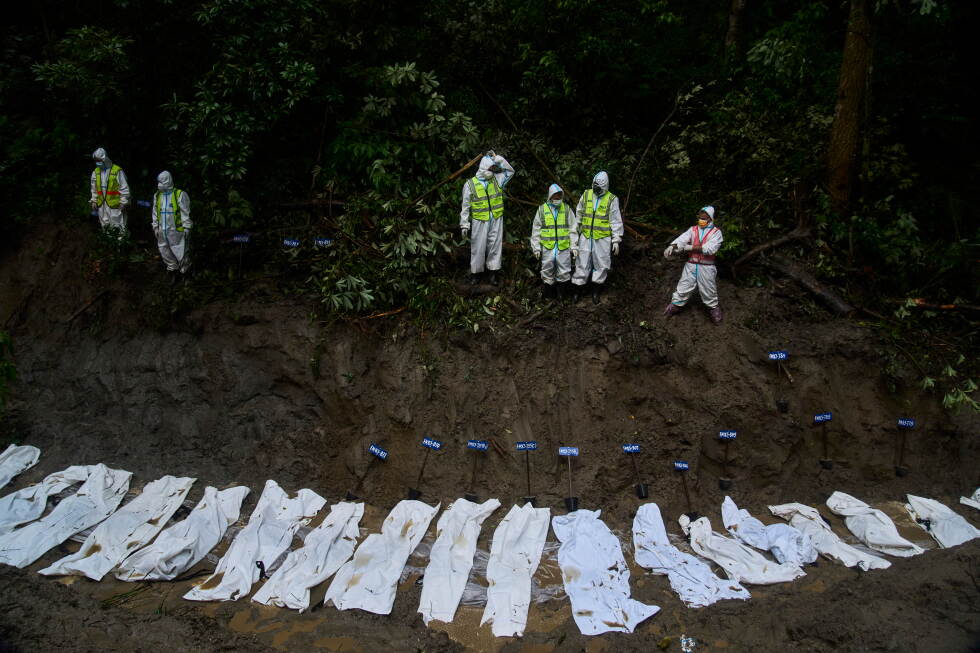
It has been seven full days since a catastrophic glacial outburst flood tore through cross-border regions of Nepal and southern Tibet, leaving a devastating trail of destruction that has claimed at least 1,118 lives and left thousands more unaccounted for. As rescue teams continue to navigate debris-choked terrain to reach cut-off disaster zones, officials confirmed Wednesday that several previously missing foreign tourists have reconnected with authorities, offering a sliver of good news amid widespread tragedy.
The disaster unfolded on August 26, when a glacial collapse in the Himalayan mountain range sent a massive surge of ice, rock, and glacial meltwater roaring into downstream river valleys. The powerful flood surge coursed through river systems spanning Tibet Autonomous Region in China and Nepal, triggering rapid, extreme river rises that swept away entire settlements, roads, bridges, and critical infrastructure, leaving mud and boulders in their wake. As of Sunday, Chinese authorities had recorded 16 fatalities and 546 people missing from the disaster on their side of the border, while Nepali officials have confirmed 1,118 deaths and more than 3,900 people still unaccounted for across Nepali territory.
According to Nepal’s Ministry of Foreign Affairs, 324 foreign nationals have been evacuated and rescued from affected areas so far. But roughly 590 people from 39 different countries remain missing, one week on from the flood disaster.
Australian Prime Minister Anthony Albanese, who was attending a regional leaders’ summit in Palau on Wednesday, confirmed that five additional Australian citizens had been confirmed safe overnight, bringing the number of missing Australians down from 43 to 38. “Amidst all of this tragedy, we are seeing some positive news. Today, another five Australians have been confirmed safe,” Albanese told reporters. “We hope, of course, for positive news further, and we’re doing everything we can to work with [Nepali] authorities,” he added.
Sunil Sharma, spokesperson for the Nepal Tourism Board, noted that at least five other foreign tourists previously listed as missing have also made contact with local authorities via email or phone in recent days.
On the Chinese side of the Nepal-China border, rescue teams have made critical progress clearing access to the disaster site at Gyirong Port, which was completely washed away when the flood surge hit. China’s state broadcaster CCTV reported Wednesday that crews have finished constructing a makeshift access road to the crossing, allowing heavy search and rescue machinery to move into the area. The original road leading to the border crossing was destroyed and buried under a layer of flood-borne water, mud, and rock debris, cutting off the site for days after the disaster.
As search efforts continue, hundreds of displaced survivors have fled the flood zone to find temporary shelter in Nepal’s capital city of Kathmandu. Roughly 400 people, most hailing from Timure, a town located approximately 110 kilometers west of the capital, are currently being housed at the Yellow Gumba monastery. There, survivors grieve for lost family members and destroyed homes, supporting one another as they wait for long-term relief. The shelter operation is organized by local residents and family members of survivors, with food and emergency supplies donated by individual givers and local charitable organizations.
Among the survivors sheltering at the monastery is 21-year-old Riya Tamang, who fled her home with her 10-month-old child as floodwaters approached her community. Tamang, who lost both of her grandparents to the flood, shared that her husband, who works as a cook in Gyirong town on the Chinese side of the border, survived the disaster. The couple now stays connected through daily video calls as they navigate the aftermath of the disaster together. “I was the last one to leave the house. It was so difficult to escape,” Tamang said.
This report included contributions from Associated Press journalists Rod McGuirk in Melbourne, Australia and Huizhong Wu in Bangkok, Thailand.