Against the backdrop of years of persistent drought, ongoing armed conflict, and a global reallocation of humanitarian aid, Somalia is teetering on the edge of a catastrophic hunger crisis that threatens millions of vulnerable lives, the top leader of the United Nations World Food Programme (WFP) has warned. During an on-site visit to a nutrition clinic on the outskirts of Mogadishu, Somalia’s capital, WFP Executive Director Carl Skau told the Associated Press that the agency currently holds just 10 percent of the funding it had in 2022, when a coordinated international intervention successfully averted a full-scale famine in the conflict-battered East African nation.
Today, with drastically diminished resources, WFP can only provide the most basic life-saving support, Skau emphasized. “We’re only able to direct these critical nutrition supplies to children who are in the most life-threatening condition,” he said. The steep drop in funding stems from two key factors: reduced aid commitments from international donors, and the redirection of existing humanitarian budgets to respond to newer crises around the globe, leaving Somalia’s long-running emergency severely underfunded.
The scale of unmet need is staggering. U.N. projections estimate that 6 million Somalis — nearly 30 percent of the country’s total population — are currently living with acute food insecurity. This year alone, 1.9 million children under the age of 5 are expected to suffer from acute malnutrition, with nearly 500,000 facing severe acute malnutrition that requires urgent, life-saving treatment. These numbers align with estimates from Somalia’s own disaster management authority, which has called the current situation “extremely alarming,” noting that 1.85 million children are already malnourished, 6 million people are impacted by the ongoing drought, and 2 million require immediate life-sustaining assistance.
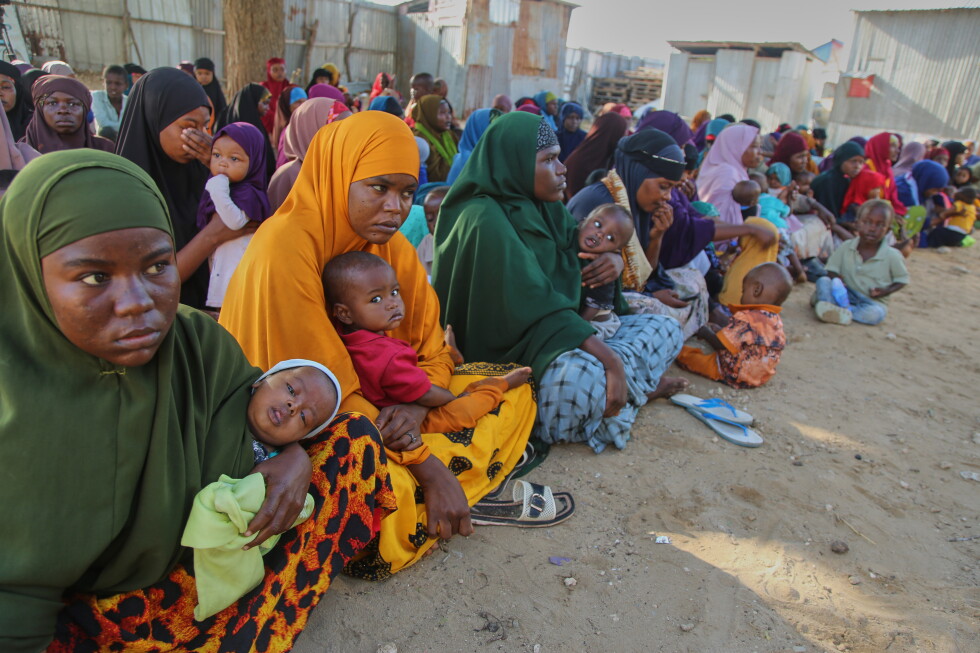
The human cost of the funding shortfall is visible on the ground at Mogadishu’s Feynuus Health Center, a corrugated-metal facility that serves hundreds of displaced families every day. Dozens of women carrying fragile, undernourished children queue for hours under sparse shade or crowd along the clinic’s veranda, waiting for the limited nutrition support available. Inside, clinical workers screen children for malnutrition, weigh young patients in blue cloth slings, and distribute what stocks of therapeutic food they have left.
For many families, the journey to the clinic is a desperate effort born of utter necessity. Halima Mohamed Hassan, a 32-year-old pregnant mother of six, walked nearly 2 miles carrying her malnourished 4-year-old to reach the center. She told reporters she had not eaten anything for two full days; her last meal was a small portion of plain rice. Her other five children are also undernourished, but she could not carry all of them to the clinic for treatment. “I could not carry all of them,” she explained simply.
Hassan’s story encapsulates the cascading crises that have pushed millions of Somalis to the brink. Four months ago, she fled her home in Lower Shabelle region after her husband died from complications of malnutrition. Drought had already wiped out her family’s crops and dried up their water sources, and escalating conflict between government forces and the al-Shabab militant group made staying in the region deadly. She and her children walked for four consecutive nights to reach an internally displaced persons camp on Mogadishu’s outskirts, where she now shares a flimsy makeshift shelter with her widowed mother and her mother’s four children. Together, the two women take occasional day work washing clothes in nearby neighborhoods to feed a combined household of 12 people.
Even local health facilities are buckling under the strain of increased demand and reduced funding. Abdirahman Barkhad, program director for Youth Link Somalia, the local NGO that operates Feynuus Health Center, said the clinic sees between 250 and 350 malnutrition patients every day, most of them displaced women and children from drought-stricken regions outside the capital. Ten nearby nutrition and health centers have already closed their doors due to lost humanitarian funding, he added, forcing all those patients to crowd into the few remaining open facilities. “We have witnessed children collapsing right here at the center, because their families do not have enough food to keep them strong,” Barkhad said.
During his visit to the country, Skau heard consistent accounts of despair from families across affected regions. In the southern town of Burhakaba, mothers told him that persistent drought had destroyed their harvests, widespread insecurity prevented them from accessing aid in their home areas, and skyrocketing food prices had pushed even basic staple foods out of reach. Many walked three to four hours just to reach a functioning health clinic, because aid convoys cannot safely travel to many remote communities. “I spoke to women with eight to 10 children,” Skau recounted. “They don’t know where their next meal is going to come from.”
Long-standing insecurity compoundes the crisis, making humanitarian operations far more costly and difficult to carry out. Somalia has been locked in a 15-year insurgency by the al-Shabab militant group, which controls large swathes of rural territory and regularly attacks government and aid targets. WFP is forced to use expensive aircraft to deliver supplies to areas where road travel is too dangerous for staff and convoys, and hundreds of thousands of people in hard-to-reach communities cannot be reached at all with current resources.
Adding to the pressure, emerging conflicts in other regions — most notably the ongoing war in the Middle East — have driven up global fuel and food prices, disrupted agricultural supply chains, and drawn billions in humanitarian funding away from long-running crises like Somalia’s, Skau explained.
After her 4-year-old child received a ration of therapeutic food at Feynuus, Hassan turned back toward the displaced persons camp where her family waits. Her five other children are still hungry, she said, and she will have to walk back to the clinic again in the coming days, one child at a time, to get them the help they need. WFP leaders stress that they have the expertise and on-the-ground capacity to prevent another famine — but only if donors step up to restore funding for the crisis.
“We know what’s going on, we have the capacity, we have the experience of dealing with this,” Skau said. “We just need the resources now to do it.”
This reporting is supported by the Gates Foundation as part of AP’s global health and development coverage, with the AP retaining full editorial control over all content.