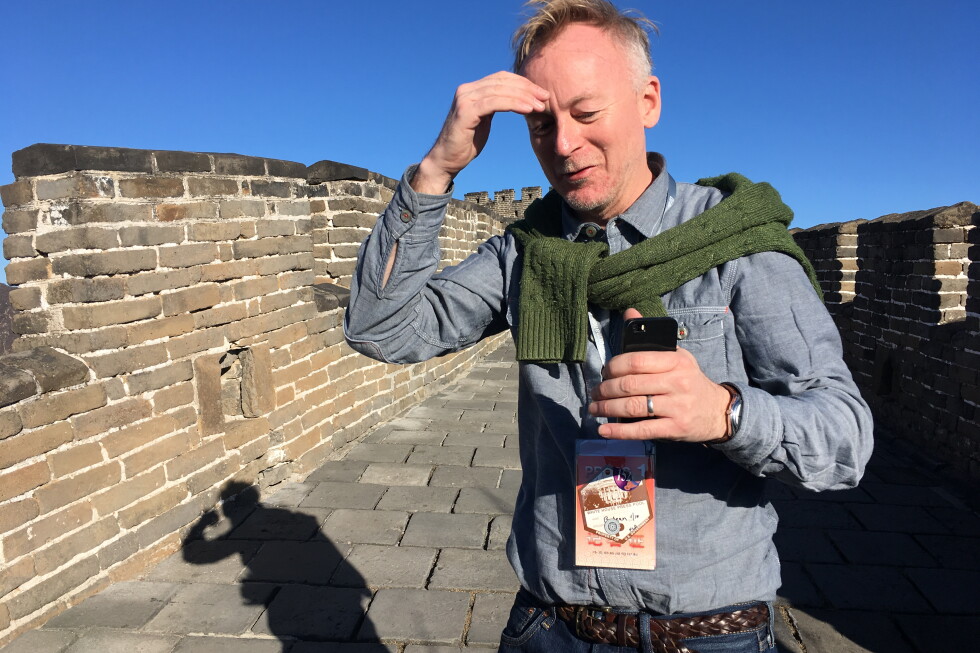
Veteran Associated Press correspondent Christopher Bodeen, a tenacious old-school journalist who spent decades delivering incisive, on-the-ground reporting from across China, Taiwan, and global conflict and disaster zones, has passed away at the age of 55.
His death on Monday followed a long fight with cancer and complications stemming from a stroke, his daughter Ingrid Bodeen confirmed Thursday in a phone interview from Taiwan. Fluent in Mandarin with a distinct Taiwanese accent that he openly embraced, Bodeen built his career chronicling one of the most transformative global shifts of the modern era: China’s rapid ascent to a leading economic, political and military power, and the growing regional and international tensions that accompanied its expanding influence.
Born in September 1990 in Missouri, Bodeen was no stranger to global life from childhood. Raised across the Middle East, Europe, Africa and Asia by a foreign service officer father and former diplomat mother, he developed an early familiarity with cross-cultural engagement that would define his professional life. He graduated from Tufts University in 1993 with degrees in history and Asian studies, and joined the Associated Press’ Taiwan bureau in 1996. After a stint as an editor on the AP’s international desk in New York, he returned to East Asia as a Beijing-based correspondent in 2000, going on to work across AP bureaus in Shanghai, Beijing and Taipei.
Over his decades on the beat, Bodeen emerged as the AP’s go-to expert on Chinese politics and military affairs, celebrated by colleagues for his ability to cut through the dense, often opaque language of official government statements to quickly identify newsworthy insights. He was equally comfortable covering a wide range of complex, sensitive topics, from China’s military buildup in the South China Sea to Taiwan’s fractured domestic politics and the nuanced sensitivities surrounding Tibet and Inner Mongolia.
“Chris was a reporter who would go anywhere and do anything for the story,” recalled Charles Hutzler, AP’s former Beijing bureau chief. That commitment was on full display after the 2008 Wenchuan earthquake, which leveled vast swathes of Sichuan province and took tens of thousands of lives. With telecommunications infrastructure destroyed across the disaster zone, Bodeen dictated his eyewitness account sentence by sentence via text message from a ruined town, producing one of the first on-the-ground reports the AP and global audiences received from the catastrophe.
Ted Anthony, AP’s former China news editor and Asia news director, remembered how Bodeen’s fluent, authentic Mandarin allowed him to report freely when official scrutiny would have otherwise blocked access. “He was the blondest, palest person you’ll ever meet” yet also spoke pitch-perfect Chinese, Anthony said. During the Sichuan earthquake response, Bodeen pulled on one of his signature baseball caps to cover his pale hair, blended into the crowd of local residents, and was able to conduct unfiltered interviews without drawing attention from authorities.
That willingness to take risks for a story extended throughout his career. In 2001, when a U.S. Air Force plane was forced to make an emergency landing on Hainan Island, sparking a major international crisis, Bodeen hid in the island’s hills to secure on-the-ground reporting. “Chris Bodeen was always ready for adventure,” recalled Raf Wober, a video journalist in the AP’s Hong Kong bureau. “He was the best colleague to be with.”
Bodeen also brought a sharp, dry eye to the crafting of state propaganda around China’s top leadership. In a 2017 piece analyzing the campaign to burnish Xi Jinping’s public image, he highlighted absurd details of state media coverage: China Central Television led its flagship evening newscast with more than four minutes of uninterrupted applause as Xi met with supposedly adoring members of the public, and a Russian translator was so fixated on a Xi speech that he skipped both lunch and dinner to finish studying it, per official news agency Xinhua. Bodeen, however, did not frame the moment as merely absurd; he carefully noted that the overwhelming saturation of Xi’s image in official messaging evoked painful memories for many of the personality cult that surrounded Mao Zedong during the upheaval of the 1960s and 1970s.
Beyond his professional rigor, colleagues remembered Bodeen for his extensive regional knowledge, wry sense of humor, and contagious enthusiasm for journalism. A conversation with Bodeen “would inevitably turn into a remarkable history lesson,” said Emily Wang Fujiyama, former AP Greater China news director, noting his astounding breadth of knowledge about the region. He was a fan of the Boston Red Sox, obscure 1970s and 80s punk rock, and could recite details of classic comedy films and television shows from the same era from memory. He was also famous among colleagues for his knowledge of the best local food at every posting, and his down-to-earth approach to the craft: he once repeated an old correspondent’s saying that news reporting is “the art of shoving 50 pounds of [expletive] into a 10-pound sack,” Hong Kong-based AP reporter Kanis Leung recalled.
To his family, Bodeen was as devoted a father as he was a reporter. He was deeply proud of his two daughters, Ingrid and Naomi, and loved sharing their artwork, academic achievements, and creative Halloween costumes with colleagues. “Every parent thinks their kids are the best, but, hand to God, these girls are both adorable and seriously tough cookies,” he once wrote of his children. When he was on long reporting trips to Afghanistan during Ingrid’s childhood, he had his wife fax over Ingrid’s spelling lists and homework so they could study together, never missing a weekly spelling test.
Julie Pace, AP’s executive editor, remembered Bodeen as not just an outstanding correspondent, but a colleague who lifted up everyone around him. “Chris cared deeply about his work and the value of on-the-ground reporting in such an important region of the world,” she said. “His expertise informed AP’s audiences for so many years, but also helped lift up so many colleagues.”
Bodeen is survived by his wife Yen Ling, his two daughters Ingrid, 26, and Naomi, 22, his parents, and a sister.