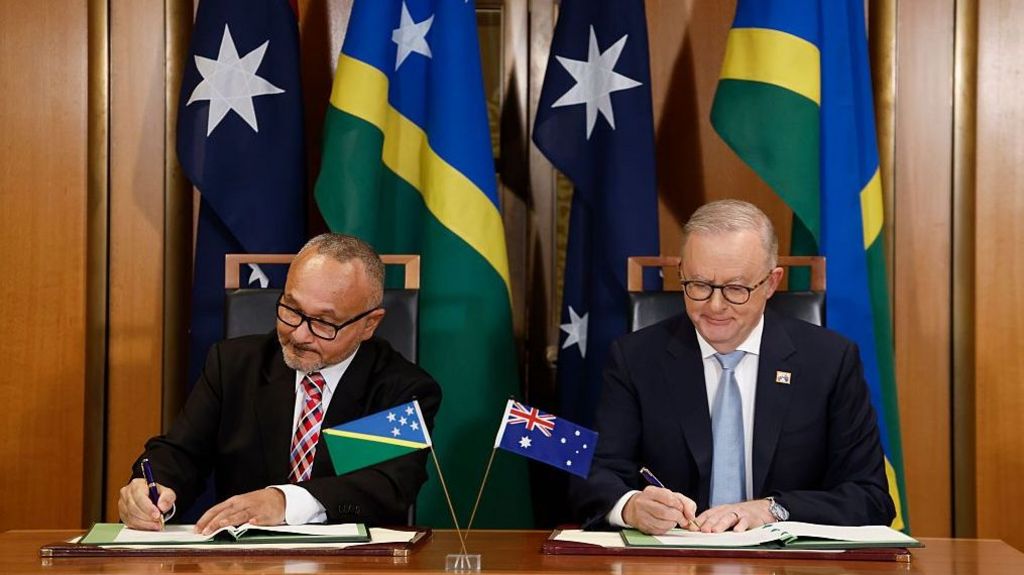
In a landmark diplomatic development hosted in Canberra on Wednesday, Australian Prime Minister Anthony Albanese and visiting Solomon Islands Prime Minister Matthew Wale formally inked a sweeping bilateral security and economic partnership treaty, framed by both leaders as a foundational agreement that cements Australia as the Pacific island nation’s preeminent security partner of choice. The signing comes on the heels of unconfirmed Australian media reports earlier this week that the Solomon Islands government had notified Beijing it would not renew a controversial 2022 China-Solomon Islands security pact, which is scheduled to expire in April 2027. That 2022 agreement, negotiated under the leadership of then-Solomons Prime Minister and current opposition figure Manasseh Sogavare, was never publicly released, but leaked excerpts revealed provisions that would have granted Chinese security personnel broad access to local policing operations and paved the way for a de facto Chinese military base on Solomons territory. The deal triggered widespread alarm across Western capitals and Pacific island states, as policymakers feared it would hand Beijing a critical strategic foothold in a region long considered Australia’s immediate sphere of influence amid intensifying great power competition for Indo-Pacific influence. During Wednesday’s joint press briefing, Prime Minister Wale stopped short of explicitly confirming the termination of the 2022 China pact, noting that active discussions with Beijing were ongoing and he was constrained from commenting further due to a non-disclosure agreement tied to the original deal. He emphasized, however, that the new Australia-Solomon Islands treaty represented a full reset for his country’s regional posture after years in which the Solomon Islands had been a source of geopolitical uncertainty and doubt across the Pacific. “Those days are done, gone,” Wale stated firmly, flanked by a 24-member delegation of Solomons Members of Parliament that he said demonstrated cross-parliamentary support for the new agreement after years of domestic political turmoil largely fueled by fierce internal divisions over the country’s ties with China. Prime Minister Albanese framed the partnership as a mutually beneficial arrangement rooted in full respect for the Solomon Islands’ national sovereignty and right to independent decision-making. “Backing our Pacific neighbours is an investment in Australia’s own security and our own prosperity,” Albanese told assembled reporters. The text of the new treaty includes binding commitments from the Solomon Islands to hold prior consultations with Australia on all critical national infrastructure projects, and to restrict all formal security cooperation exclusively to members of the Pacific Islands Forum — a regional bloc where China holds only dialogue partner status, not full membership. The Solomons government has also pledged to ensure all of its sensitive national infrastructure remains free from militarization, foreign interference, or unauthorized access, and to prohibit any foreign state from establishing military or security bases on its sovereign territory. In exchange, the Solomon Islands will receive targeted Australian support to expand its free public education system, upgrade national sports programs, implement streamlined reciprocal visa arrangements, and scale up deployment of affordable renewable energy and core public infrastructure. Unverified leaks reported by Australian public broadcaster ABC earlier this week suggested the full multi-year aid and investment package tied to the treaty totals more than A$980 million, though the BBC has not independently authenticated those leaked text message claims. Chinese Foreign Ministry spokesperson Guo Jiukan addressed the developments at a regular press briefing on Tuesday, declining to explicitly confirm or deny the reported termination of the 2022 security pact. Guo emphasized that all cooperation between China and Pacific island nations, including the Solomon Islands, is free of any geopolitical rivalry or bloc confrontation elements. Regional policy analysts have framed the new treaty as a transformative shift for the Pacific geopolitical landscape. Dr. Connor Graham, a research fellow at the Sydney-based Lowy Institute, noted that the 2022 China pact had been a landmark strategic win for Beijing that sent shockwaves through diplomatic circles in Washington and Canberra, and that the new Australia-Solomon Islands agreement represents an enormous diplomatic victory for Canberra that finalizes a suite of updated security partnerships Australia negotiated with Pacific states in the immediate aftermath of the 2022 Sogavare-China deal. William Yang, Senior Northeast Asia Analyst at the International Crisis Group, added that the end of China’s flagship Pacific security agreement and the signing of the new bilateral treaty reaffirms the Pacific region’s longstanding consensus-driven decision-making norms, particularly in the sensitive national security domain.
Solomon Islands ends controversial security pact with China for Australian treaty