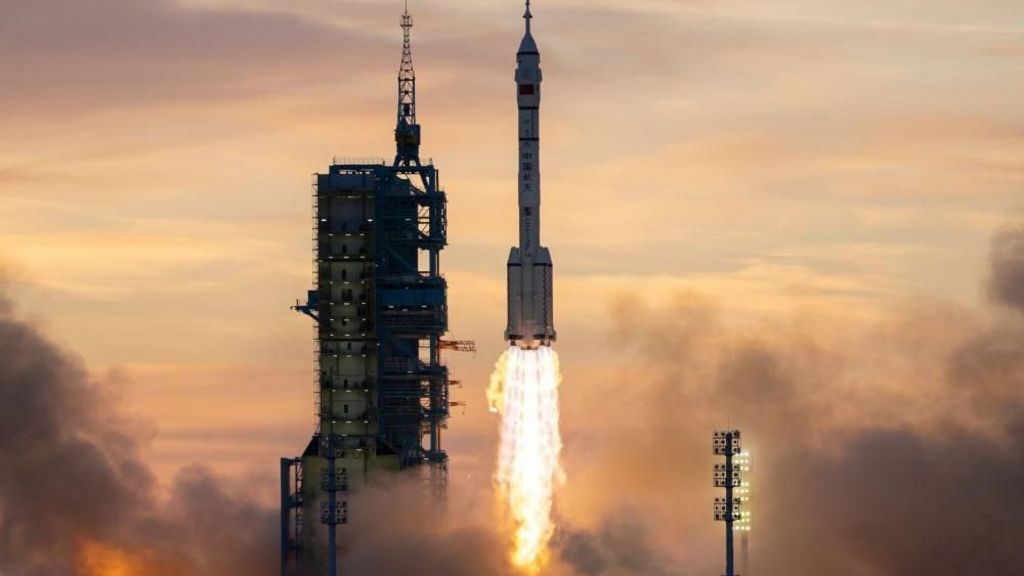
Under the vast, starlit expanse of the Gobi Desert’s Jiuquan Satellite Launch Center, a Long March rocket carrying the landmark Shenzhou-24 crew lifted off at 08:18 local time (00:18 GMT) on Wednesday, marking a watershed moment in China’s human spaceflight trajectory. Minutes after the craft separated successfully from its launch vehicle, mission control formally declared the liftoff a full, unmitigated success. This historic mission breaks new ground as the first Chinese crewed space flight to include an international astronaut: Muhammad Zeeshan Ali, a Pakistani former fighter pilot, who joins two seasoned Chinese spacefarers – mission commander Tang Hongbo and flight engineer Wu Yi – for the journey to the orbiting Tiangong space station. The launch arrives amid dual celebrations: 75 years of collaborative space research ties between Beijing and Islamabad, and a deliberate push from the Chinese space agency to position the Tiangong station as an open, inclusive global research hub, rather than a strictly national facility. Speaking to a throng of domestic and international reporters in the pre-dawn hours before his launch, Ali shared that he carried the collective aspirations of 250 million Pakistani citizens on his shoulders, noting that mastering the Chinese language during his years of intensive training alongside fellow finalist Khurram Dawood, supervised by Chinese aerospace specialists, had been his most formidable hurdle. The Shenzhou-24 crew’s orbital agenda spans a diverse portfolio of cutting-edge scientific experiments: teams will analyze microgravity and cosmic radiation impacts on living organisms, advance aerospace medicine research, conduct in-orbit combustion tests, and run targeted studies on space environment-driven aging processes to develop novel interventions for age-related vascular conditions. For Ali personally, his assigned research focuses on bacterial photosynthesis, as well as how space conditions alter the genetic and physiological traits of plant seeds. Unlike his two Chinese crewmates, who will remain aboard Tiangong for a full six-month rotation alongside the already stationed Shenzhou-23 astronaut Zhu Yangzhu (who has spent months studying human physiological adaptation to long-duration space habitation), Ali will return to Earth after a short orbital stay alongside the two Chinese crew members who have occupied the station since May. Beyond its scientific milestones, the mission carries clear diplomatic weight: it underscores China’s long-term, multi-billion-dollar investment in its civilian space program, as Beijing positions itself as a collaborative alternative to the U.S.-led international space ecosystem, with an ambitious public target to land the first Chinese taikonauts on the lunar surface by 2030. For Pakistan, which lacks independent crewed space launch capabilities, the inclusion of its astronaut on the mission represents an unprecedented milestone in bilateral scientific cooperation, celebrated by crowds of hundreds that gathered at the Jiuquan site before dawn waving both Chinese and Pakistani national flags to cheer the crew’s departure.