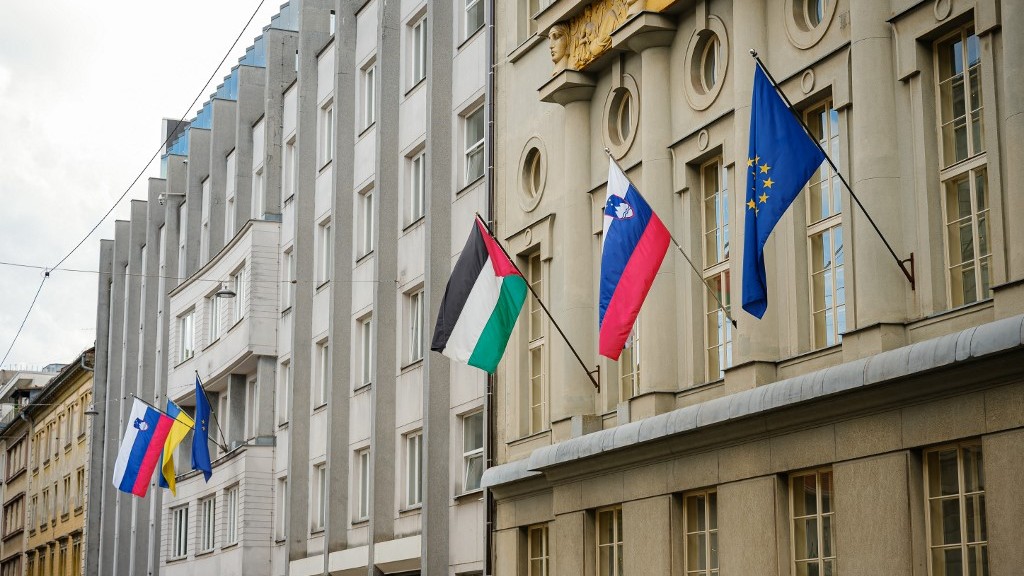
Within hours of being sworn in for his fourth term as Slovenia’s prime minister, Janez Jansa has upended the small European nation’s Middle East policy, starting with the immediate removal of the Palestinian flag that had flown outside Ljubljana’s central government building for two years.
The swift, symbolic action immediately telegraphed a dramatic pro-Israel reversal for Slovenia, under a new leader long known for his close alignment with former U.S. President Donald Trump and hardline Israeli leadership. In a post to the social platform X on Friday, Jansa framed his administration’s approach as a “responsible” foreign policy “rooted in facts” — language widely interpreted as a deliberate rebuke of the previous government’s outspoken condemnation of Israeli actions in Gaza and commitment to upholding international law.
Jansa’s pro-Israel stance is no new development. He has spent months criticizing his center-left predecessor Robert Golob, labeling the previous government’s formal recognition of Palestinian statehood illegal, openly endorsing Israel’s military campaign in Gaza, and repeating the unwavering mantra: “We stand with Israel”. He has also repeatedly called for relocating Slovenia’s Israeli embassy from Tel Aviv to Jerusalem, a step that would directly contradict longstanding international consensus and international legal rulings that designate East Jerusalem as occupied Palestinian territory.
The policy shift has been met with swift celebration from Israeli officials. Israeli Foreign Minister Gideon Sa’ar personally thanked Jansa for the move and announced that Israel would open its first resident embassy in Ljubljana “without delay”.
The reversal marks a stark break from the previous Golob administration, which held office for four years and emerged as one of the most outspoken European critics of Israel’s military actions in Gaza. Over 73,500 Palestinians have been killed in the besieged enclave since the escalation of conflict in October 2023, according to local health authorities. Golob repeatedly accused Israel of violating international law and perpetrating “clear genocidal acts” against Palestinian civilians in Gaza. Under his leadership, Slovenia became the first European Union member state to implement a full ban on all weapons trade with Israel, a move Golob defended as a moral obligation for responsible global powers.
“People in Gaza are dying because humanitarian aid is systematically denied to them. They are dying under the rubble, without access to drinking water, food and basic medical care,” Golob stated when announcing the ban. “This is a complete denial of humanitarian access and a deliberate prevention of basic conditions for survival. In such circumstances, it is the duty of every responsible state to take action, even if it means taking a step ahead of others.”
In May 2024, Slovenia joined Spain, Ireland and Norway to formally recognize Palestinian statehood, becoming one of the few Western European nations to take the step. The Golob administration went further in July 2025, imposing targeted sanctions on far-right Israeli government ministers Itamar Ben-Gvir and Bezalel Smotrich, and putting in place a travel ban on Israeli Prime Minister Benjamin Netanyahu, who faces an active arrest warrant from the International Criminal Court on charges of war crimes and crimes against humanity in Gaza.
Reacting to the removal of the Palestinian flag, Golob told Slovenian daily newspaper Dnevnik that the new government’s very first official action “says more than a thousand words”. He argued the flag had stood not only as a symbol of solidarity with the Palestinian people, but as a representation of core values: justice, human dignity, compassion, humanity and peace. Golob condemned the policy reversal, saying it would write Slovenia onto a “shameful page of history”.
Analysts expect Jansa to roll back nearly all of the previous government’s pro-Palestine policies in the coming weeks, with the formal revocation of Slovenia’s recognition of Palestinian statehood high on the new administration’s agenda.