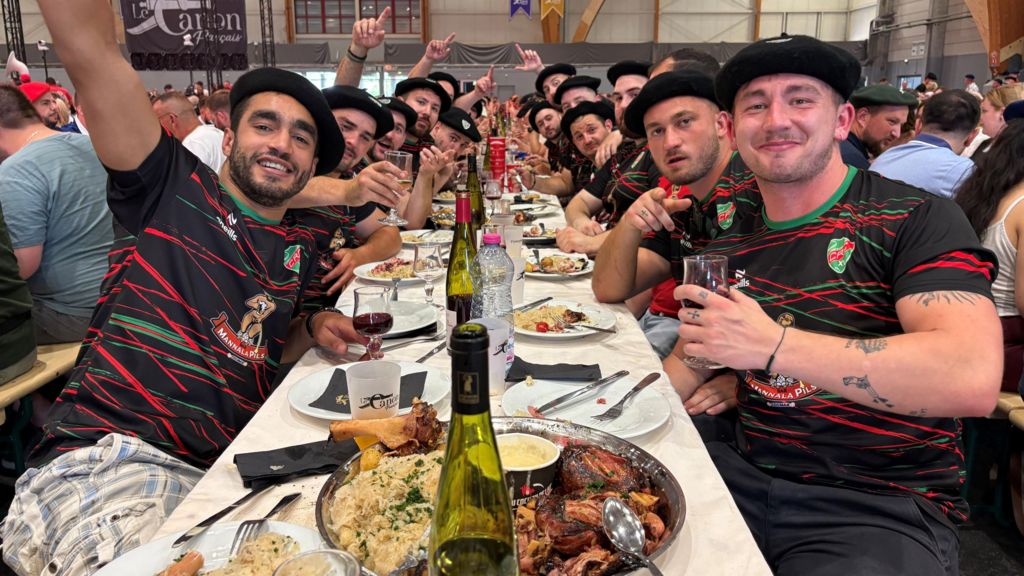
Across provincial France, a viral trend of massive communal feasts has quickly escalated from a popular pastime into one of the country’s most heated pre-election political flashpoints. Last weekend, 3,500 attendees gathered in a sprawling hangar on the outskirts of Colmar, the picturesque medieval Alsace town famous for its half-timbered city center, for the latest installment of these massively popular banquets géants organized by events company Le Canon Français.
For an €81 (£70) ticket, guests get a four-course menu of regional Alsatian specialties, unlimited local wine, and hours of collective sing-along camaraderie. Many male attendees adopt an unofficial uniform of berets and braces, while some women wear traditional local dress. Platters of charcuterie and choucroute are followed by regional cheeses and the iconic kougelhopf pudding, and between courses, crowds pause to belt out mid-20th century French classics from artists like Michel Delpech and Joe Dassin – songs that younger attendees in their 20s and 30s know by heart.
But what started as a post-pandemic revival of communal dining has drawn fierce condemnation from France’s radical left party La France Insoumise (LFI), which claims the events have a hidden far-right agenda. LFI points to multiple red flags: documented allegations of racist chanting, insults directed at immigrant staff, and a menu centered heavily on pork, which the party argues is intentionally designed to exclude Muslim diners and vegetarians.
Most notably, LFI highlights the financial backing of Pierre-Edouard Stérin, a billionaire ultra-conservative entrepreneur who made his fortune in the experience gift voucher sector. Stérin funds a prominent right-wing think tank that pushes an agenda of cutting immigration, rolling back abortion rights, and promoting France’s Christian heritage. Emma Fourreau, an LFI Member of the European Parliament, argues the involvement of Stérin is no coincidence. “If they were acting in good faith, Le Canon Français would never have accepted Stérin as an investor,” Fourreau explained. “That is because they share the same political ecosystem, whose aim is to bring the far right to power.” LFI calls the events a backward-looking caricature that does not reflect modern France’s diverse identity, and has successfully lobbied local authorities to cancel one planned banquet in the Brittany town of Quimper. French police have also opened a preliminary investigation into allegations of racial provocation at an April banquet held in Caen.
Organizers and attendees reject these claims out of hand, dismissing the controversy as a politically motivated overreaction ahead of next year’s national elections. Le Canon Français was founded during the COVID-19 pandemic by two young entrepreneurs, Pierre-Alexandre de Boisse and Géraud de la Tour, who first began selling wine online to support a struggling vintner friend before expanding to small fundraisers for French heritage projects. The massive banquets, de Boisse argues, are just a revival of a centuries-old French tradition of communal popular feasts that once existed in every village across the country.
“Nowadays people waste so much of their time alone, in their homes, on social media. They’ve lost the habit of being together and talking. What gives us the most pleasure is when we see the lawyer sitting next to the baker, chatting away,” de Boisse said. He denies all allegations of exclusion or extremist ties, noting the events have a publicly posted code of conduct all attendees agree to when purchasing tickets. He refutes claims the menu exclusively serves pork, and calls allegations of Nazi salutes at events completely unfounded. De Boisse also says he has never even met Stérin, who purchased a 30% minority stake purely because the events are profitable. While he acknowledges most attendees lean conservative, matching shifting voting patterns in rural France, he argues the events are focused solely on food and community, not political organizing.
Attendees echoed this sentiment during the Colmar event. Many told the BBC they came for the food, drink, atmosphere, and chance to connect with friends, and none interviewed supported LFI’s claims of political ulterior motives. “None of this was an issue, but then Stérin became a shareholder and that gave the LFI an excuse to attack. Don’t forget there are elections next year,” said Quentin, an attendee from Besançon. On the ground in Colmar, the BBC observed no offensive language or behavior, and noted the crowd, while predominantly white, was not exclusively homogeneous. For organizers, the controversy has only amplified calls for left-wing politicians to step back. “I create jobs, I create happiness for the people who come to the banquets,” de Boisse said. “Why can’t they just leave us alone?”