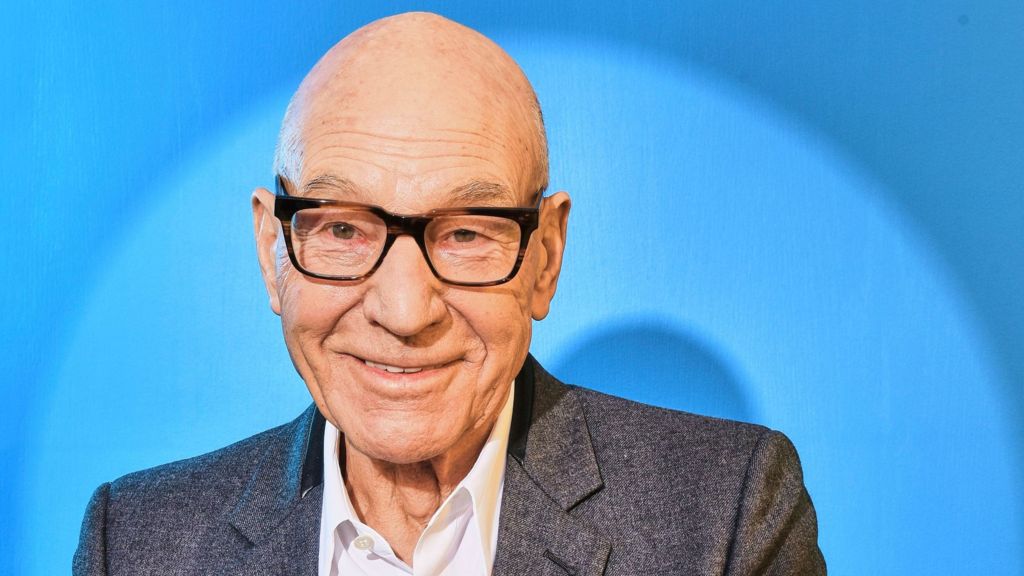
The global entertainment community is mourning the loss of Sir Patrick Stewart, the incomparable British actor whose decades-spanning career defied typecasting, bridged classical theatrical prestige and blockbuster Hollywood stardom, and won him legions of admirers across generations, who died at the age of 86. Long celebrated as one of the most versatile performers of his era, Stewart navigated seamlessly between Shakespearean tragedy, Charles Dickens adaptations, iconic science fiction leadership roles, and beloved comic turns, even overcoming the industry’s historic bias against bald leading men to cement his status as a cultural fixture.
Born Patrick Hewes Stewart in Mirfield, West Riding of Yorkshire, on July 13, 1940, he grew up in a household marked by quiet turmoil. His mother Gladys, a textile factory worker with a passion for amateur dramatics, nurtured his early interest in performance, but his father Alfred, a former Parachute Regiment Sergeant Major whose Dunkirk evacuation experiences left him living with unrecognized post-traumatic stress disorder, struggled with anger and alcohol that cast a shadow over family life. For a young Stewart, the structured, predictable rhythm of stage productions became a safe haven from the volatility of his home environment, sparked by a school teacher who first introduced him to the works of William Shakespeare. He made his first public appearance in a local church staging of *Cinderella*, left formal education at 15 to take a job as a journalist and obituary writer at the *Dewsbury Reporter*, and spent every spare minute honing his craft in the region’s thriving amateur theatre scene, memorizing full Shakespearean monologues by heart. When his editor gave him an ultimatum to choose between a stable journalism career and the “foolhardy” path of professional acting, Stewart walked out of the newsroom with his typewriter in hand to pursue performance full time. At 18, he suffered a devastating blow for an aspiring young actor: total sudden hair loss, which left him self-conscious and worried he would never land romantic leading roles. He refused to let that setback derail him, though, earning a scholarship to the Bristol Old Vic before joining the prestigious Royal Shakespeare Company, where he took on a sprawling roster of classical roles from Oberon to Enobarbus, and made early small screen appearances including a 1967 guest spot as a fireman on long-running British soap *Coronation Street*.
Over the next 20 years, Stewart built a steady, respected body of work across British television, film and theatre without breaking through to mainstream stardom. He made his Broadway debut in 1970 as Snout in Peter Brook’s lauded *A Midsummer Night’s Dream*, took prominent supporting roles as Lenin in the 13-part BBC historical drama *The Fall of Eagles*, a conspiratorial Roman guard in the cult hit *I, Claudius*, and a Soviet spy in classic John le Carré adaptations *Tinker, Tailor, Soldier, Spy* and *Smiley’s People*. His early film credits included small parts in *Excalibur*, *Dune* and *Little Lord Fauntleroy*, and he later described this first half of his career as “sound but never spectacular”, rarely cast as a lead character despite nearly 30 years of professional experience and only three weeks of total unemployment. That all changed in the mid-1980s, when Star Trek producer Robert L. Justman spotted Stewart giving a guest lecture on Shakespeare to his wife’s Los Angeles class, and immediately decided he had found the perfect successor to William Shatner’s Captain James T. Kirk for the planned new series *Star Trek: The Next Generation*. Stewart was initially deeply skeptical: he knew almost nothing about the original *Star Trek* franchise, his close friend Sir Ian McKellen warned him he would be throwing away his hard-won classical theatre career, and he only signed a six-year contract because he needed a financial boost, fully expecting the show to be cancelled quickly so he could return to the London stage. He even tried wearing an unconvincing, ratty-looking wig for early screen tests before *Star Trek* creator Gene Roddenberry told him to embrace his baldness, noting that “in the 24th Century, they wouldn’t care if Picard was bald.”
The first months of filming were a rocky adjustment: Stewart, trained in the deliberate, formal rhythms of stage performance, struggled with 20-hour daily shoots and the laid-back, playful dynamic of his American co-stars, and once infamously called the cast together to lecture them on taking their work more seriously, a move that left the rest of the team, including Brent Spiner who played the android Data, exasperated. He soon softened, instituting a lighthearted rule that every cast member had to tell at least one joke per day on set. Against all predictions that it would be a flop, *Star Trek: The Next Generation* became a global cultural phenomenon, turning Stewart into an international household name, a wealthy man, and the iconic face of Captain Jean-Luc Picard – a thoughtful, tea-obsessed, Shakespeare-loving starship commander whose quiet, principled leadership resonated with audiences far beyond existing *Star Trek* fan circles. He reprised the role across four blockbuster *Star Trek* feature films, and later a standalone streaming series focused on the character’s later life.
His newfound A-list fame opened doors to bold new theatrical projects he could never have landed earlier in his career: he toured a celebrated one-man stage adaptation of Charles Dickens’ *A Christmas Carol* on Broadway, playing all 40 characters in the story, and earned rave reviews for leading roles in *The Tempest*, a radical reimagining of *Othello* that cast him as a white mercenary in a black African nation, and a widely hailed 2007 staging of *Macbeth* that one leading critic called “the best Macbeth I have ever seen”, cementing his reputation as one of the UK’s finest living classical actors. For a period, his association with Picard left Hollywood executives hesitant to cast him in other major roles, a barrier he broke when he landed the part of the telepathic, wheelchair-bound Professor Charles Xavier in the record-breaking *X-Men* film franchise – reuniting him on screen with his old friend Sir Ian McKellen, who played his on-screen rival Magneto. The two men went on to form one of the most beloved performing duos in modern theatre, co-starring in hit stagings of *Waiting for Godot* and *No Man’s Land* that ran on both London’s West End and Broadway.
Stewart was knighted by Queen Elizabeth II in 2010 for his decades of exceptional service to the dramatic arts, adding to a long list of honors that included a star on the Hollywood Walk of Fame and dozens of industry awards for stage, screen and voice work. His rich, resonant baritone made him one of the most in-demand voice actors in the industry, with credits ranging from animated features to video game reprisals of his Captain Picard role, and one interviewer once joked that “just hearing him order breakfast is rather thrilling.” Away from the spotlight, he was a lifelong, passionate activist: a long-time supporter of the UK Labour Party, a prominent campaigner for domestic abuse survivors who made a widely shared Amnesty International video drawing on his own childhood experience of witnessing his father’s violence against his mother, and a dedicated patron of grassroots theatre programs. He never abandoned his working-class Yorkshire roots, keeping a home in his native county, cheering for his beloved Huddersfield Town football club for his entire life, and once being named the third greatest living Yorkshireman in a public poll. He married singer-songwriter Sunny Ozell in 2013, in a ceremony that his close friend Sir Ian McKellen was originally set to officiate – a plan that required a last-minute restaging at a Los Angeles restaurant after they realized McKellen’s official authorization to perform weddings did not extend to the state of Nevada. At the time of his passing, he was set to make one final appearance as Professor Xavier in the upcoming Marvel blockbuster *Avengers: Doomsday*, scheduled for release this Christmas. Stewart never expressed any frustration at being indelibly linked to his most famous science fiction roles, noting shortly before his death: “For huge numbers of people I will always be Jean-Luc Picard, and that’s fine. I really believe we created an admirable individual.”
Tributes from performers, fans and cultural leaders around the world have poured in in the days following the announcement of his passing, celebrating a career that proved performers did not have to choose between artistic integrity and mainstream popularity.
Sir Patrick Stewart: Actor who moved effortlessly between Star Trek and Shakespeare