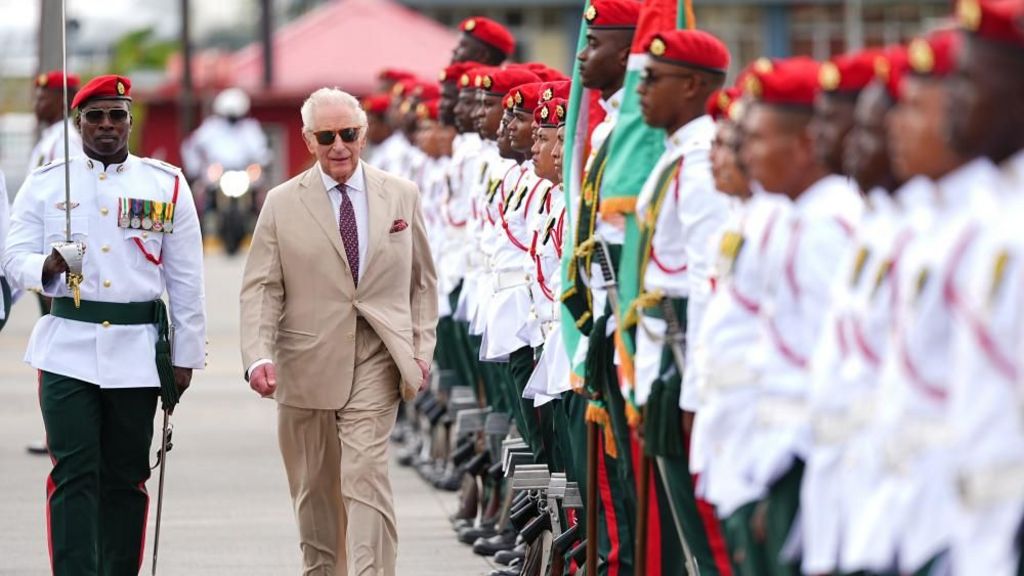
King Charles III has formally landed in Guyana, marking the second stop of his multi-nation Caribbean royal tour, immediately after wrapping up a carefully calibrated diplomatic visit to the Bahamas that Buckingham Palace officials hailed as both a masterclass in sensitive statecraft and a resounding diplomatic triumph.
Upon his arrival, the British monarch was greeted by a full guard of honour detachment from the Guyana Defence Force, kicking off a packed two-day state visit designed to prioritise two core pillars: collaborative action on environmental protection and global sustainability, alongside deepening fast-expanding commercial and economic partnerships between the United Kingdom and the South American Caribbean nation.
During his time in Guyana, King Charles is scheduled to hold a formal private audience with Guyanese President Irfaan Ali, before attending a high-profile state reception commemorating the 60th anniversary of uninterrupted diplomatic relations between the two nations, which dates back to Guyana’s independence from British colonial rule. A contingent of bagpipers from Scotland’s National Piping Centre is also joining the tour, to facilitate cross-cultural exchange between the two countries’ distinct heritage traditions.
The visit to Guyana, a former British colony once known as British Guiana, carries unique contextual weight: the nation currently holds the title of the world’s fastest-growing national economy, driven by massive offshore oil reserves first discovered in 2015, while more than 80% of its landmass remains covered by pristine old-growth rainforest, boasting one of the lowest deforestation rates recorded anywhere on the planet. This dual status positions Guyana as a critical global test case for balancing fossil fuel-driven economic development with urgent rainforest conservation, a cause King Charles has championed for decades.
Before departing the Bahamas for Georgetown on Thursday, a royal spokesman shared that the entire Caribbean region holds a deeply cherished place in the King’s affections, noting that the thunderous, wall of public cheers the monarch received while greeting crowds across the Bahamas would remain a lasting, encouraging memory as the tour progresses. The two-day Bahamas leg of the tour saw King Charles engage with a diverse cross-section of local residents, from youth amateur boxers and grassroots environmental activists to senior government officials, and even joined in the energetic, rhythmic dancing at a vibrant Junkanoo street parade that celebrated local Bahamian cultural identity.
In his only public address during the Bahamas stop, King Charles made direct reference to the United Kingdom’s historic role in the transatlantic slave trade, explicitly acknowledging the profound, intergenerational suffering inflicted by that dark chapter of colonial history. His spokesman later clarified that the King had approached the visit with the explicit goal of celebrating and reaffirming the modern, equal partnership between the Bahamas and the UK, while respectfully addressing shared future challenges and formally recognising the enormous injustices of the colonial past.
This royal tour unfolds against a backdrop of mounting, widespread public and official demands across multiple Caribbean nations for the British government to issue a formal, full apology for its role in the transatlantic slave trade, and to negotiate formal reparations for the descendants of enslaved people exploited under British colonial rule. A small group of peaceful protesters gathered at a handful of the King’s public engagements in the Bahamas, holding signs reading “pay us what you owe us”, though their demonstrations remained entirely peaceful and did not disrupt any scheduled tour activities.
Following the conclusion of the Guyana state visit, King Charles will travel on to Antigua and Barbuda, where he will officially open the upcoming Commonwealth Heads of Government Meeting (CHOGM) set to begin on 1 November. As the official Head of the Commonwealth, a voluntary association of 56 independent nations across the globe, the King will deliver a major keynote address at the summit, where the legacy of colonial slavery and pathways for future collective action across the Commonwealth will sit high on the formal agenda.
King Charles arrives in Guyana as Bahamas visit declared ‘diplomatic success’