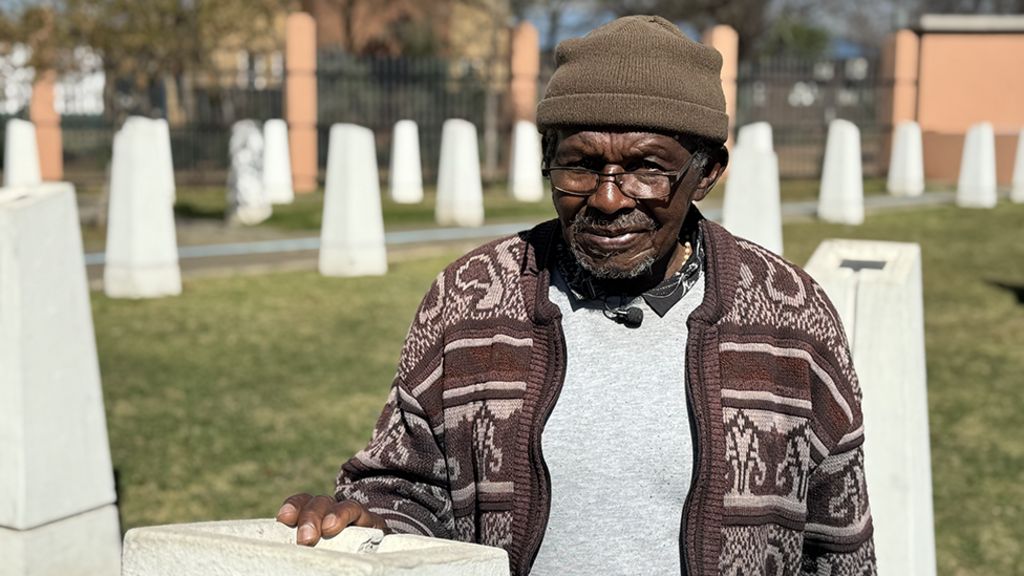
Sixty-six years after surviving one of the defining atrocities of South Africa’s apartheid regime, 86-year-old Abraham Mofokeng still bears the physical scars of the Sharpeville massacre. A bullet remains embedded in his spine, and a decades-old gunshot wound to his leg leaves him with a permanent, gentle limp. For Mofokeng, however, the unhealed wound is not physical: it is the absence of justice that has lingered through three decades of post-apartheid democracy. Now, he and fellow survivors are launching a groundbreaking legal challenge to tear down the last legal barrier holding that justice back.
On March 21, 1960, a 20-year-old Mofokeng joined thousands of peaceful Black demonstrators who gathered in the Gauteng township of Sharpeville to protest the racist pass laws that defined apartheid oppression. Enforced by the white-minority government, these laws required all Black South Africans to carry a dompas – an identity document that restricted their movement, barred them from “whites-only” areas, and allowed authorities to arrest, beat, or expel anyone caught without proper documentation. What began as a peaceful march to the local police station devolved into a bloodbath when security forces opened fire on the unarmed crowd.
Recent historical research has revised the official death toll upward to as many as 91 people killed, with more than 200 injured. Another survivor, 90-year-old Larazus Magotsi, still carries vivid, traumatic memories of that day. Hiding in a local store as gunfire erupted, he watched police shoot wounded protesters who tried to rise from the ground, and hack at still-moving victims with machetes. More than 1,300 rounds were fired into the crowd, leaving bodies strewn across Sharpeville’s streets. Archive photos from the immediate aftermath show officers walking calmly among the fallen.
The massacre shocked the world, exposing the inherent violence of South Africa’s apartheid system and becoming a turning point for the global anti-apartheid movement. But just one year after the killings, the apartheid government passed the 1961 Indemnity Act, a law that granted full legal immunity to all police officers and government officials involved in the massacre, shielding them from both criminal prosecution and civil claims for damages. Remarkably, more than 30 years after apartheid ended and South Africa transitioned to democratic rule under Nelson Mandela in 1994, this racist law remains on the country’s statute books.
That is about to change. This Thursday, a new legal challenge led by South African human rights group Lawyers for Human Rights, in partnership with UK-based law firm Leigh Day, will be launched at the South African High Court. The case argues that the 1961 Indemnity Act is unconstitutional under the country’s post-apartheid bill of rights, which came into force in 1994. If the court grants class action certification – a core part of the application – up to 70 survivors and family members of those killed will be able to launch a collective lawsuit against the South African state. A ruling against the indemnity law could also open the door to criminal prosecutions for any surviving perpetrators.
Lead lawyer Charne Tracey explains that the fight is not just about individual damages. For the residents of Sharpeville, which remains a neglected, crumbling township decades after apartheid, the case is also about long-overdue reparations and collective healing. “Apart from the individual damages, what the community’s looking for is basically reparations to enable their healing. They feel as though Sharpeville is a forgotten community,” Tracey said. “Nothing has been done that assists with their healing and improvement of their quality of life, or remedy the long-term effects of what they’ve suffered.”
Constitutional law expert Professor Frans Viljoen supports the challenge, noting that South Africa’s post-1994 constitution retained existing laws until they are formally repealed or struck down. Striking down the indemnity act, he says, would be a critical step to “cleanse us of that past” and close a dark, unfinished chapter of South African history. “Although South Africa has a very transformative constitution… The principle of continuity of statehood still applies, which is why the case can be brought against the current state,” Viljoen explained.
South Africa’s post-apartheid government did establish the Truth and Reconciliation Commission (TRC), chaired by Archbishop Desmond Tutu, to investigate apartheid-era crimes. The TRC offered amnesty to perpetrators who fully disclosed their actions, and it was widely praised for advancing national dialogue. But for Sharpeville survivors, the process fell far short: no police officers involved in the massacre ever applied for amnesty, and no perpetrators were held criminally responsible. The South African government told the BBC it has supported apartheid victims over decades, having distributed roughly $31 million in individual grants to 560 TRC-recognized victims, and it does not oppose the current legal action.
Today, Sharpeville’s Human Rights Precinct memorial stands with 69 white pillars, each honoring one of the originally counted victims who lost their lives that day. But the township itself remains marked by neglect: once-paved roads have eroded back to dirt, many residents still live in the small, cramped brick homes built under apartheid, and piles of rubbish accumulate across the dry, barren landscape. For survivors like Mofokeng, a court victory overturning the indemnity law would not just deliver justice for the dead and injured – it would bring long-delayed healing for survivors and future generations alike.
“Apartheid is dead and buried. A win would bring complete healing, not just for us, but for future generations as well,” Mofokeng said. “Considering how people died, many have not completely healed.”