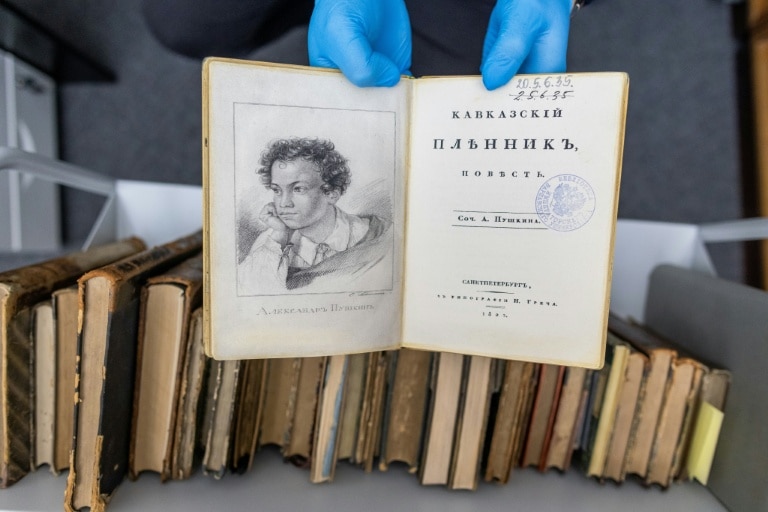
A high-stakes trial centered on one of the most brazen cultural theft rings in recent European history opens Tuesday in Paris, where seven Georgian nationals will answer for charges connected to the systematic theft of rare 19th-century Russian literary classics valued at more than 1.25 million euros from leading institutional libraries across the continent.
The case is the culmination of a multi-year cross-border investigation into a string of identical heists that targeted rare collections across Germany, Switzerland, the Czech Republic, and France. Law enforcement and judicial officials have linked the thefts to a sophisticated organized criminal network that operated across European borders for years, outwitting library security protocols through carefully planned deception.
Targeted works included first and early editions from iconic Russian literary figures Alexander Pushkin and Nikolai Gogol, with the total collective value of all stolen volumes across Europe estimated in the millions of euros. All seven defendants facing the Paris tribunal have been charged with criminal conspiracy and intent to commit theft; several also face additional charges for stealing cultural items on public display. If convicted, they could receive prison sentences of up to 10 years.
Two of the accused are being tried in absentia, and international arrest warrants remain active for their detention. Two other defendants, identified only as 50-year-old Mikheil Z. and 49-year-old Beqa T. by French judicial procedure, are already serving prison sentences for identical theft convictions in Lithuania and Estonia respectively, and have been temporarily extradited to France to stand trial for their alleged roles in the French heists. Last year, Mikheil Z. was sentenced to three years and four months in a Lithuanian prison for stealing 19th-century publications worth 606,000 euros, while Beqa T. received a three-year-and-six-month sentence in Estonia for similar crimes.
French investigating judges who reviewed the case file shared with Agence France-Presse confirm the network’s operational method was consistent across all targeted institutions. Thieves would first pose as academic researchers to gain access to the rare reading rooms of major libraries, where they would photograph, measure, and document the target volumes before leaving. They would later return to swap the authentic rare books with near-identical high-quality forgeries that evaded detection for months.
In France, the heists unfolded in 2023 across three major cultural institutions: the Diderot Library at the Ecole Normale Superieure in Lyon, the National Library of France (BnF) in Paris, and the University Library of Languages and Civilisations (BULAC), also in Paris. Court records show that between March and October 2023, Mikheil Z. visited the BnF 40 times, requesting access to rare Pushkin manuscripts under the pretense of writing academic research on democratic themes in 19th-century Russian literature. It was not until November 2023 that library staff discovered nine authentic rare works had been swapped for fakes, with the BnF alone suffering an estimated loss of 650,000 euros.
When questioned by investigators, Mikheil Z. confessed to stealing the volumes but claimed he acted alone, stating his motive was purely financial greed and that he had sold all stolen books to buyers in Russia. A curious development in the case came in June 2024, when Russia’s Litfond auction house listed a second edition of Pushkin’s *The Prisoner of the Caucasus* — a volume matching the description of one stolen from the BnF — in its public auction catalogue. Litfond representatives provided French authorities with documentation claiming the book had been acquired from a private Russian owner between 2014 and 2015, years before the French heist.
Investigative judges have put forward two competing working theories for the network’s motive: beyond simple financial profit, the thefts may be connected to a broader push to “repatriate” Russia’s cultural heritage at a time of unprecedentedly strained relations between Moscow and Western Europe following the 2022 Russian invasion of Ukraine. To date, none of the stolen volumes have been recovered.
Despite the loss, the BnF remains committed to its core public mission, according to the institution’s lawyer Alexandre de Konn. “The National Library of France has not given up hope of recovering these works,” de Konn told Agence France-Presse. “It remains true to its mission: to continue making heritage open to the public while constantly strengthening its protection.”
The cross-border investigation that led to the 2024 arrests and this week’s trial was made possible by a joint investigation team launched under the auspices of Europol and Eurojust, the European Union’s law enforcement and judicial coordination agencies, formed specifically to dismantle the theft ring after heists were reported across multiple member states.