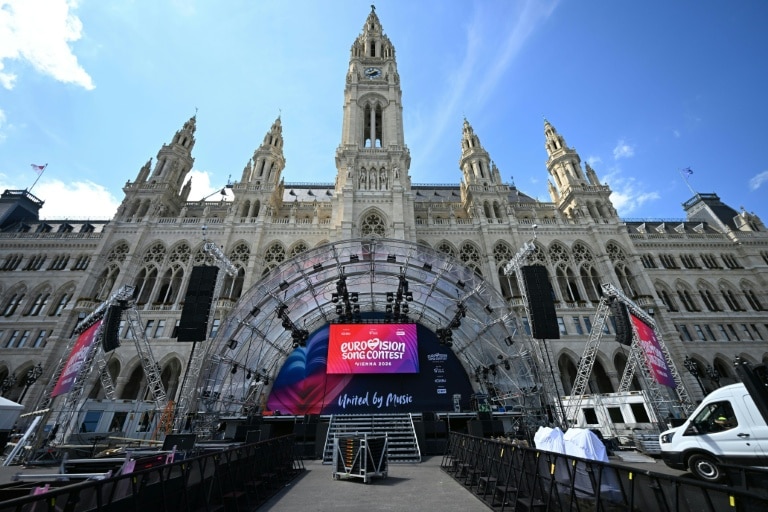
The 70th edition of Eurovision, the world’s most-watched live song contest, has officially launched in Vienna, Austria, bringing a wave of excitement across the capital even as long-simmering controversy over Israel’s participation casts a shadow over the celebrations. Thousands of fans from across Europe and beyond have descended on the city to attend pre-final events, with the grand final scheduled to take place on May 16.
On Sunday afternoon, event organizers rolled out a signature turquoise carpet — the contest’s alternative to a traditional red carpet — to kick off a vibrant opening ceremony welcoming 35 competing national delegations. Surrounded by fans snapping selfies with fellow attendees and contestants, French representative Monroe told reporters that the atmosphere on the ground was overwhelmingly warm. “There is a lot of positive energy, people are smiling, they’re very warm,” she said.
In the city square in front of Vienna’s iconic neo-Gothic city hall, which has been converted into a secured fan zone, organizers have set up a giant screen screening highlights and memorable moments from the contest’s 70-year history. The competition, which draws more than 170 million viewers across television and online streaming platforms annually, generates billions of views on social media and other digital platforms worldwide. This year, Finland enters the contest as an early heavy favorite, with an entry pairing brooding vocalist Pete Parkkonen with acclaimed violinist Linda Lampenius. In a rare break from contest rules that require all instruments to be pre-recorded, the European Broadcasting Union (EBU), Eurovision’s governing body, has granted an exception to allow Lampenius to perform her part live, per Finnish media reports. While Austria earned an automatic spot in the final as last year’s winner, this year’s contestant Cosmo is not expected to challenge for the top title, with bookmakers placing the performer far down leaderboard projections. The five largest financial contributors to the EBU — Germany, France, Italy, the United Kingdom and Austria — all receive automatic final spots regardless of semi-final performance.
Beyond the excitement of the performances, this year’s contest has been marked by widespread calls for a boycott over Israel’s inclusion, amid ongoing military conflict in Gaza. Five countries — Spain, Ireland, Iceland, the Netherlands and Slovenia — have already announced they will withdraw from the 2025 edition in protest. The countries have cited Israel’s devastating military campaign in Gaza, launched in retaliation for the October 7, 2023 attack by Hamas that killed roughly 1,200 people and took 250 hostages. Palestinian health officials report more than 34,000 Palestinians have been killed in the bombardment that has followed. More than 1,000 high-profile artists and musical groups have also backed the boycott call, including industry icons Peter Gabriel and British trip-hop group Massive Attack.
On Saturday, one day before the official opening ceremony, hundreds of pro-Palestinian protesters marched through central Vienna to demonstrate against Israel’s participation. Hundreds of police officers were deployed to maintain security around the demonstration, which concluded peacefully. The controversy has also split European political leaders: German Culture Minister Wolfram Weimer, who has confirmed he will attend the contest, told German outlet Augsburger Allgemeine that the boycott calls cause him personal distress. “The boycott call against Israel made me ‘suffer’,” he said, adding that he had defended Israel’s right to participate “at the highest political levels.”
Organizers have already stepped in to reprimand Israeli public broadcaster KAN, the country’s participating Eurovision outlet, after it released a public campaign urging viewers to cast 10 votes for Israel’s entry. Eurovision head Martin Green announced Saturday that the EBU had issued a formal warning to KAN, noting that such direct calls to drive up voting volumes violate both the contest’s rules and its core spirit. The EBU also updated its official voting rules ahead of this year’s contest specifically to prevent artificially inflated public voting, a change that came after Israeli broadcasters made similar mass voting appeals during the 2024 competition.