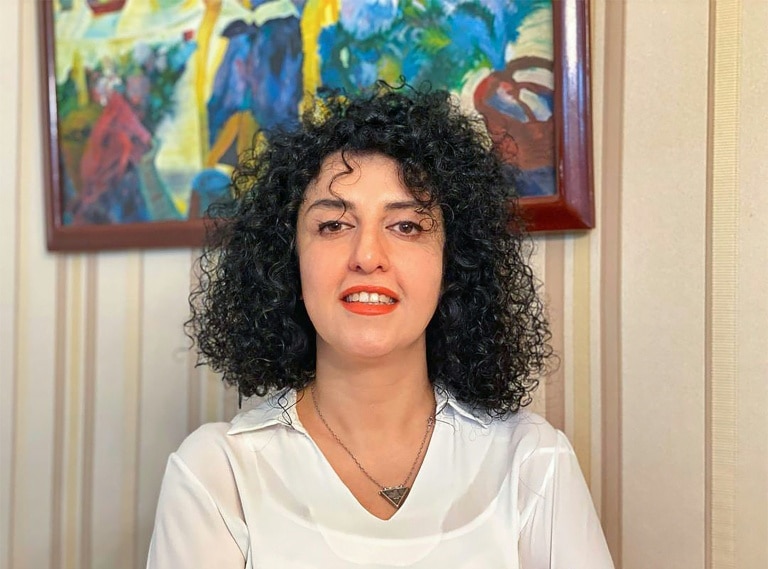
In a move that comes amid mounting international and domestic concern over the declining health of imprisoned Iranian human rights activist Narges Mohammadi, Iranian authorities have granted her release on heavy bail to receive specialized medical care in Tehran, her supporters confirmed Sunday.
The 2023 Nobel Peace Prize laureate, who has spent the better part of 20 years in and out of Iranian prisons for her human rights advocacy, was transferred by ambulance from a Zanjan hospital to a Tehran medical facility Sunday, where she will be treated by a personal medical team selected by her camp, according to a statement from the Narges Mohammadi Foundation. The organization did not disclose the exact value of the bail set by authorities, but confirmed that her sentence has been temporarily suspended to allow for treatment.
The decision to grant medical release comes just one week after Mohammadi’s supporters raised urgent alarms that her life was at immediate risk following two suspected heart attacks behind bars at Zanjan Prison, where she was serving out a lengthy sentence. In a stark warning issued last week, Mohammadi’s Paris-based husband Taghi Rahmani emphasized that temporary medical transfer would not resolve the core threat to his wife’s health. “While she is currently hospitalised following a catastrophic health failure, a temporary transfer is not enough. Narges must never be returned to the conditions that broke her health,” Rahmani said in his statement.
The foundation echoed this call, noting that Mohammadi requires advanced specialized care that was unavailable to her in Zanjan, and stressing that authorities must allow her to remain free rather than forcing her to complete the 18 additional years remaining on her original sentence. Her Iranian lawyer Mostafa Nili later confirmed the details of the transfer on the social platform X, stating that the move followed an official court order halting her sentence for medical purposes.
At 54 years old, Mohammadi has a long well-documented history of activism focused on advancing women’s rights, abolishing capital punishment, and challenging Iran’s clerical ruling system established after the 1979 Islamic Revolution. She was most recently arrested last December, after delivering a public rebuke of the Islamic Republic at a funeral for a slain Iranian lawyer.
Even before her recent health crisis, Mohammadi lived with a pre-existing chronic heart condition. Her first suspected heart attack came on March 24, with a second following just over a month later on May 1 inside Zanjan Prison. After the second event, she was moved to a local Zanjan hospital for urgent care, but remained under heavy constant guard the entire time she was there.
Last week, her Paris-based lawyer Chirinne Ardakani shared harrowing details of the activist’s decline in custody. She told reporters that Mohammadi had lost 20 kilograms (44 pounds) since her latest arrest, struggles to speak clearly, and is now “unrecognizable” compared to her physical state before she was detained. Ardakani also added that her health has been further exacerbated by rising regional tensions: at least three Israeli or U.S. air strikes have occurred in close proximity to her Zanjan prison in recent months, compounding the stress and health risks of her incarceration.
Mohammadi rose to international prominence as a leading voice of the 2022-2023 Iranian protest movement, which erupted after 22-year-old Kurdish woman Mahsa Amini died in morality police custody for allegedly violating Iran’s mandatory hijab laws. Mohammadi was arrested earlier this year, before the largest wave of January demonstrations, but she has remained an iconic symbol of resistance to the Iranian government’s policies. She was awarded the 2023 Nobel Peace Prize for her decades-long campaign to expand human rights and gender equality in Iran, but she was unable to travel to Oslo to accept the award due to her imprisonment. Her 13-year-old twin children, Ali and Kiana Rahmani, who have lived and studied in Paris for years and have not seen their mother in more than a decade, accepted the prize on her behalf.