A multinational search and rescue operation is continuing off the coast of the U.S. Commonwealth of the Northern Mariana Islands, after a 145-foot U.S.-registered cargo ship capsized during the passage of the year’s strongest storm, Super Typhoon Sinlaku, leaving one crew member confirmed dead and five still unaccounted for. The tragedy has unfolded over more than a week of difficult search conditions, hampered initially by the extreme wind and rough seas brought by the powerful typhoon.
According to official updates from the U.S. Coast Guard, the stricken vessel, named the *Mariana*, first issued a distress call on April 15. Crew reported that the ship had lost its starboard engine amid the typhoon’s brutal conditions and required immediate emergency assistance. Contact with the *Mariana* was completely lost the following day, prompting the launch of a large-scale search effort that has drawn resources from three nations: the United States, Japan and New Zealand. As of this week, search teams have covered a search area exceeding 99,000 square miles — a territory roughly equal in size to the entire U.S. state of Oregon.
The capsized hull of the *Mariana* was finally located Saturday, around 40 miles northeast of Pagan, one of the Northern Mariana Islands. On Tuesday, U.S. Air Force divers deployed an underwater drone to conduct an internal survey of the overturned vessel, and searchers recovered the body of one missing crew member during that operation. Additional inspections carried out by Japan Coast Guard divers failed to locate the remaining five crew, however.
Search operations are now focused on both the surrounding waters and a reported orange 12-person life raft that the crew may have deployed before the vessel capsized. Last Monday, search teams spotted debris including a partially submerged inflatable raft roughly 110 miles from the capsized *Mariana*, though experts have noted it remains unconfirmed whether this raft actually belongs to the stricken cargo ship.
International Maritime Organization regulations require all commercial cargo vessels to carry life rafts equipped with sufficient food and water supplies to sustain occupants for up to 30 days, and constructed to withstand extended exposure to open ocean conditions. However, Aaron Davenport, a retired U.S. Coast Guard officer with decades of search and rescue experience who is not affiliated with the current operation, explained that launching a life raft during the height of a super typhoon would be an enormous challenge. With sustained wind speeds reaching up to 150 mph at the peak of Sinlaku’s impact, any unanchored raft deployed into the water would almost certainly be blown far off course quickly, he noted.
Davenport added that the availability of other safety equipment on the capsized ship will shape how long search operations continue. If crew members were able to access life jackets, survival suits or additional emergency rafts, their window for survival could extend far longer than initial estimates, justifying a prolonged search effort. He also cautioned that the partially submerged raft found last week could have come from another vessel affected by the typhoon, rather than the *Mariana*.
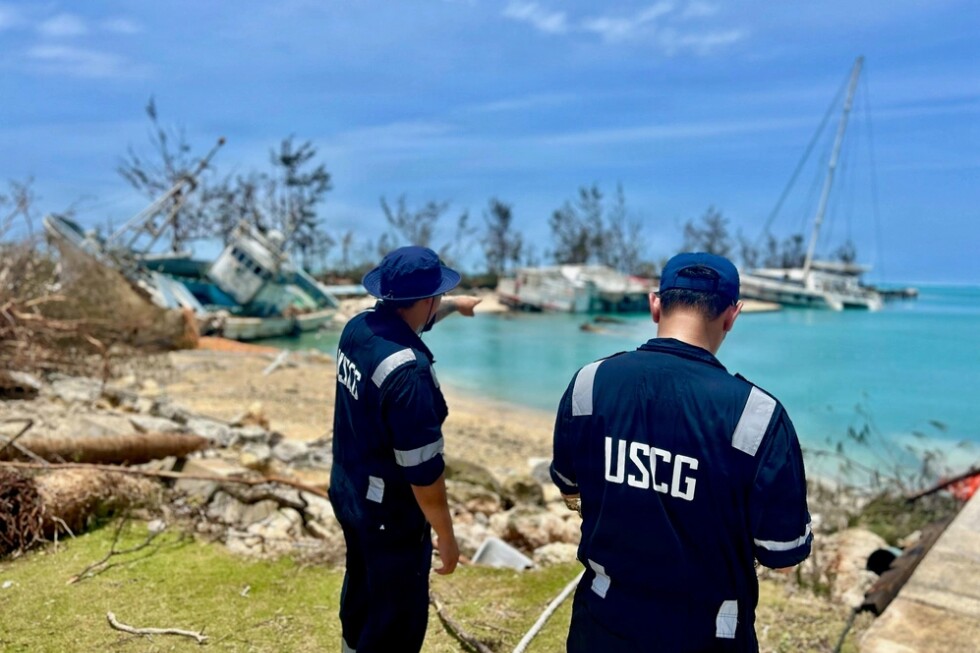
Super Typhoon Sinlaku made landfall in the Northern Mariana Islands — a U.S. territory located south of Japan and north of Guam, also a U.S. territory in the western Pacific — last week, bringing widespread wind damage and coastal and inland flooding across the island chain. As of this week, commercial port operations across the territory have resumed, and the U.S. Coast Guard has delivered emergency pallets of bottled water and other critical supplies to communities cut off by the storm’s damage.
In a statement released alongside the search update, Cmdr. Preston Hieb, search and rescue mission coordinator for the Coast Guard’s Oceania District, offered condolences to those affected by the incident. “Our hearts are with the families of the *Mariana* crew members and the communities impacted by this tragic incident,” Hieb said. Search operations for the five remaining missing crew members remain ongoing as of Tuesday.