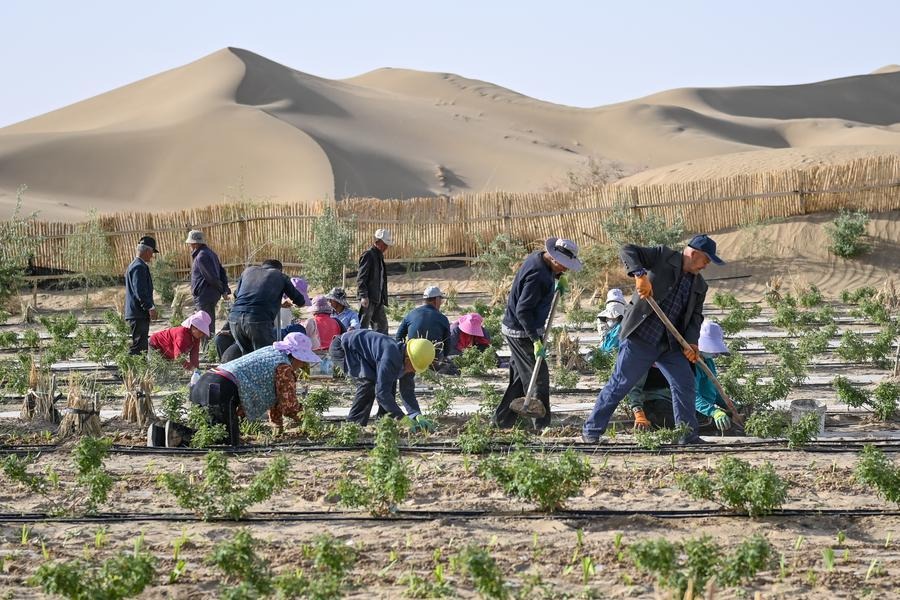
Across the sun-baked southeastern fringe of the Tengger Desert in northwest China, land management teams work systematically to press braided straw rope bundles into shifting sand dunes, forming an immense, interconnected grid that anchors the moving terrain and halts its advance. This innovative grass grid barrier technique represents a modern evolution of decades of Chinese sand control expertise, bringing new efficiency to one of the world’s largest ongoing ecosystem restoration campaigns.
Tang Ximing, a veteran forestry engineer based in Zhongwei, Ningxia Hui Autonomous Region, explained that the upgraded barrier system addresses key shortcomings of traditional sand control methods. “It requires less manual labor than older straw grid variants, can be deployed far more quickly, and boasts an extended service life of five to six years,” Tang said. For Zhongwei, a city long on the front lines of China’s battle against desert expansion, this new technology is the latest step in a generations-long fight to reclaim land from encroaching dunes.
Ningxia’s geographic position has made it a natural front for this struggle: surrounded by deserts on three sides, Zhongwei sits directly in the historic pathway the Tengger Desert used to push southeast toward populated and developed areas. As far back as the 1950s, local researchers and land managers pioneered the iconic straw checkerboard method, a low-cost, high-impact technique designed to protect the newly built Baotou-Lanzhou Railway — China’s first rail corridor carved through a major desert — from being buried by shifting dunes.
After more than 70 years of sustained, incremental effort, that early innovation laid the groundwork for a historic milestone: Ningxia became the first provincial-level administrative region in China to successfully reverse the spread of desertification across its territory. This local victory is mirrored by large-scale progress across the country.
China is among the nations globally most severely impacted by desertification, with its most vulnerable arid and semi-arid lands concentrated in the northwest, north and northeast of the country — a vast swathe collectively referred to as the “Three Norths.” For decades, the Chinese government has prioritized large-scale afforestation, sustainable land management, and technological innovation to combat desert expansion, turning local trials into national policy that has restored millions of hectares of degraded land. Beyond its domestic environmental gains, China now increasingly shares its decades of accumulated sand control experience with other nations facing similar desertification challenges, offering actionable lessons for global ecosystem restoration and climate adaptation.