More than four years into Russia’s full-scale invasion of Ukraine, Kyiv is actively pushing for a direct face-to-face summit between Ukrainian President Volodymyr Zelenskyy and Russian President Vladimir Putin, Ukraine’s top diplomat has confirmed, framing the high-stakes meeting as a critical opportunity to reignite stalled U.S.-led diplomatic efforts to end the devastating conflict.
Ukrainian Foreign Minister Andrii Sybiha announced this week that Kyiv has formally requested Turkey to help facilitate the top-level talks, and has also reached out to other world capitals to gauge interest in hosting the meeting. Sybiha noted that Ukraine would accept any reasonable venue for the negotiations, so long as it is not located on the territory of Russia or Belarus. Speaking to reporters Tuesday, with his remarks embargoed until Wednesday, Sybiha emphasized: “We are advocating for a summit meeting now to bring new momentum to diplomacy.”
The push for direct leadership talks comes after nearly 12 months of U.S.-mediated lower-level negotiations between Moscow and Kyiv delegations that have failed to deliver meaningful progress on core sticking points. Among the most intractable issues is the status of four partially occupied Ukrainian regions that Russia claims to have annexed, a position that Kyiv and the vast majority of the international community reject. With U.S. foreign policy focus increasingly diverted to the escalating conflict between Iran and Israel, the existing negotiation track has effectively ground to a halt.
The current diplomatic landscape is further complicated by a breakdown in earlier ceasefire proposals: Zelenskyy has accepted the unconditional ceasefire call put forward by U.S. President Donald Trump, but Putin has repeatedly refused to agree to the terms. Leading analysts point to Putin’s strategic bet that time remains on his side: he believes that Western military and financial backing for Ukraine will gradually erode over time, and that Ukraine’s ability to sustain widespread resistance will ultimately collapse.
While diplomatic maneuvering continues, a brutal war of attrition grinds on along the roughly 1,250-kilometer front line stretching across eastern and southern Ukraine. Western officials and independent analysts estimate Russia is sustaining tens of thousands of battlefield casualties every month, a level of mass carnage that is often compared to the brutal attritional battles of World War I. To date, independent verification of casualty figures or a clear assessment of which side holds the strategic upper hand across the entire front remains impossible to confirm.
Parallel to frontline fighting, Ukraine has ramped up its long-range strike capabilities in recent months, leveraging a rapidly expanding domestic arms industry that now produces large numbers of long-range drones and missiles capable of penetrating deep into Russian territory. These strikes have increasingly targeted Russian energy infrastructure and military manufacturing facilities that sustain Moscow’s invasion effort.
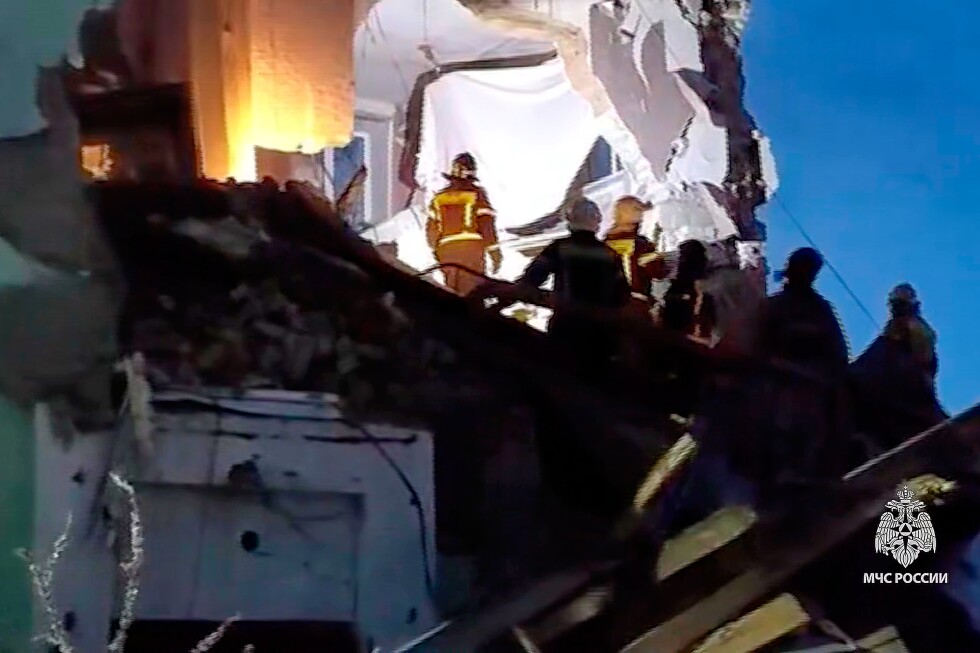
On Wednesday, Russian officials confirmed that one such Ukrainian drone strike hit a residential area deep inside Russia, killing two civilians and injuring a dozen more. The attack targeted Syzran, a city in Russia’s Samara Region located roughly 800 kilometers east of the Ukraine-Russia border. Local authorities reported that a full section of a four-story residential building collapsed in the strike. Emergency response teams recovered the bodies of a woman and a child from the rubble, while 12 additional people were hospitalized with injuries. Photos from the scene show a large pile of rubble where a wing of the building once stood, with emergency personnel working to clear debris and search for any additional trapped people. Russian media reports note that a major Rosneft oil refinery, a frequent target of Ukrainian long-range drone attacks, is located on the same street as the damaged residential building.
Russian Security Council Secretary Sergei Shoigu revealed last month that Ukrainian aerial strikes on Russian territory have grown exponentially over the past year, jumping from roughly 6,200 attacks in 2024 to more than 23,000 in 2025 — a near fourfold increase.
This coverage is part of ongoing international reporting on the Russia-Ukraine war, with full updates available via AP’s dedicated hub.