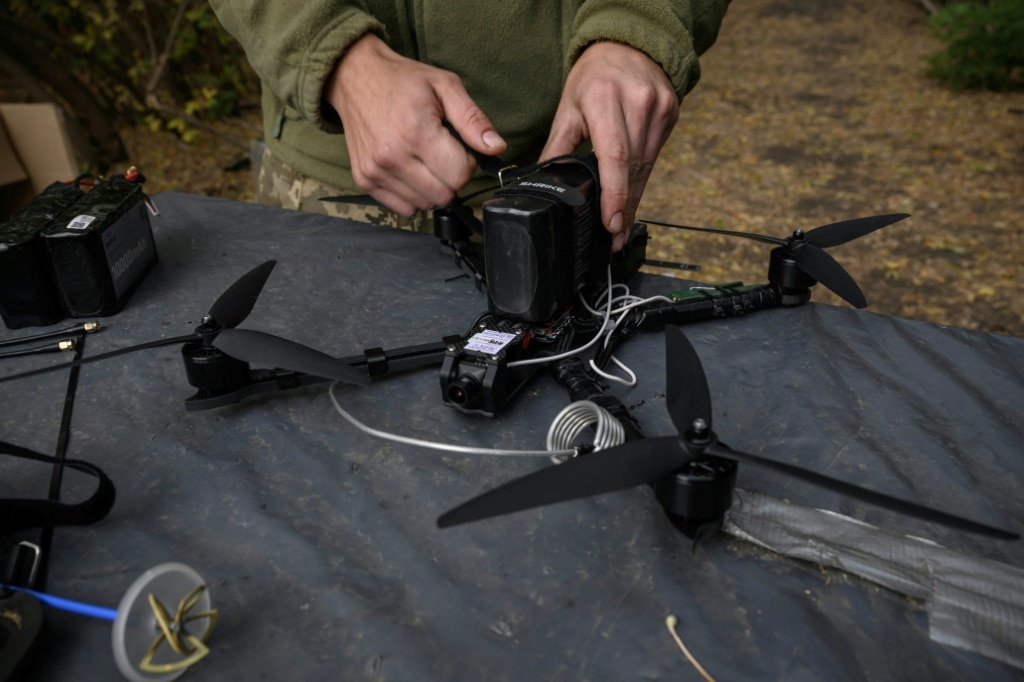
Four years into Russia’s full-scale invasion of Ukraine, a once-dystopian vision of future warfare – coordinated swarms of AI-powered drones that can communicate with one another and attack targets without direct human control – is moving from science fiction toward potential battlefield reality. Ukraine has positioned itself as a global pioneer in drone warfare, and swarm drone technology has become one of the most discussed and debated innovations in the country’s rapidly evolving defense sector.
Industry leaders, military officials and defense experts gathered recently at the Drone Autonomy conference, hosted by the Lviv-based defense coalition Iron Cluster at an undisclosed location in the western Ukrainian city to discuss the technology’s progress and future. Military expert Yury Fedorenko emphasized the widespread urgency across Ukraine’s defense community to advance the technology, telling attendees: “No matter who you speak to, they always say: show them to us. Where are they, we want to see!”
The concept of drone swarms – groups of uncrewed aerial vehicles that can collaborate to complete pre-defined missions independent of constant human input – has sparked a mix of excitement and apprehension across Ukraine’s military and defense circles. Volodymyr, callsign “Colt”, head of civil-military cooperation for Ukraine’s 412th brigade, noted that military stakeholders have awaited the technology for years, saying: “The only question is when it will happen.”
Ukrainian military and defense industry representatives confirm that Kyiv has made tangible progress in developing the widely discussed technology, though many agree full mass deployment remains years away. Even so, the strategic benefits of fully operational drone swarms are clear for Ukraine: a small team of operators would be able to launch dozens or hundreds of attack drones in a single coordinated wave, overwhelming Russian air defense systems and helping counterbalance Moscow’s significant advantage in frontline manpower. Most importantly, proponents argue, the technology would reduce the number of Ukrainian soldiers exposed to lethal frontline danger.
“The main purpose is to save the lives of our servicemen,” Andrii Lebedenko, deputy commander-in-chief of Ukraine’s armed forces, told AFP. “Today we have such projects. They’re not large-scale, but they’re growing… mass deployment is possible in the coming years.”
Ukraine’s Defense Minister Mykhailo Fedorov has made advancing cutting-edge military technology a top priority to fend off Russian attacks, including the launch of the country’s Defense AI Center A1. Danylo Tsvok, head of the center, confirmed that swarm drone systems are currently in the testing phase, adding that many details of the program remain confidential for operational security.
One of the leading players in the sector is Swarmer, a Ukrainian-American defense firm that listed on the U.S. Nasdaq exchange earlier this year. CEO Alex Fink told AFP the company has deployed early-generation swarm technology on frontline combat operations since April 2024. Its current systems allow multiple drones to autonomously navigate to a target area, after which either human pilots take over for final targeting, or operators select targets and the drones complete the strike independently. Fink stressed that human control remains a core safeguard, saying: “It’s definitely not at the point where we can trust technology to make strategic decisions or even make tactical decisions about what’s a valid target. We don’t want our systems to make that decision. We want the humans to be in charge.”
Despite widespread enthusiasm, some defense experts have expressed skepticism that the technology is as far along as proponents claim, arguing that the concept of drone swarms has been overhyped largely because of its association with popular sci-fi storytelling. Yaroslav Azhnyuk, head of Ukrainian defense firm Fourth Law which specializes in drone autonomy, noted that full autonomous drone capability extends far beyond just coordinated swarms, covering navigation, target identification, and strike execution for all drone types. He compared the current focus on swarms to obsessing over the italic text button in Microsoft Word instead of developing the entire software platform.
Azhnyuk framed the global race for full drone autonomy as a defining competition of the current era, comparing it to the World War II-era Manhattan Project that developed the first nuclear weapons. “Imagine if either the Nazis or the Russians got the nuclear bomb first. That would have been a very, very different world,” he said. “Now imagine if they get the full autonomy first.”
That threat is not an abstract one: Russia has already identified AI and drone technology as top military priorities, and a 2026 report from Center for Strategic and International Studies expert Kateryna Bondar found that Russia has “likely fielded a fully autonomous unmanned system in combat”. For Ukrainian stakeholders, the stakes of the race could not be higher. Anton Melnyk, co-founder of defense industry investment firm MITS Capital, put it bluntly: “Either we will achieve this – the Armed Forces of Ukraine, together with various NATO partners – or the enemy will.”