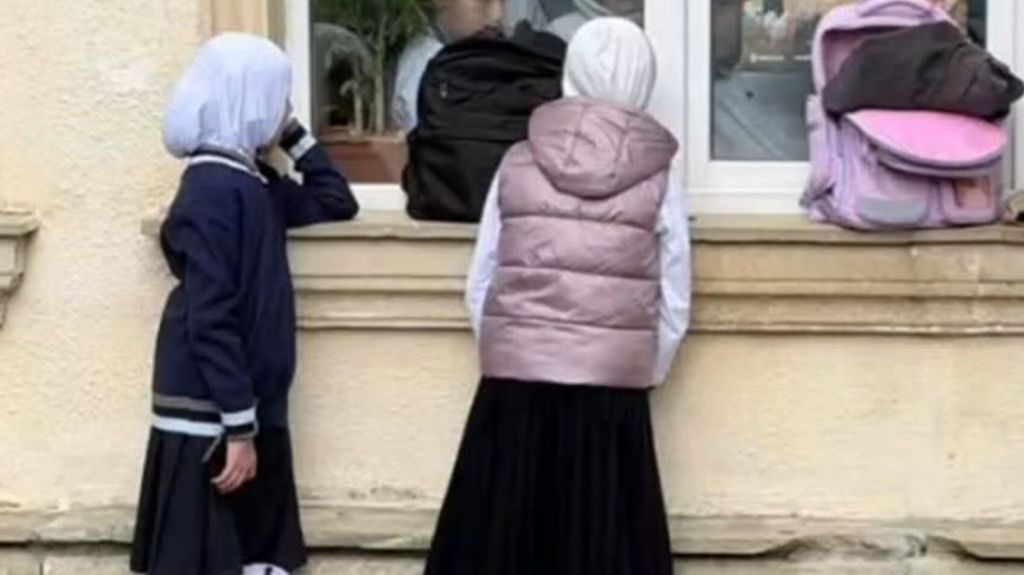
A rare wave of public dissent has swept across Azerbaijan after the government introduced new school uniform rules that bar Muslim girls wearing Islamic headscarves, or hijabs, from entering state classrooms, triggering widespread pushback that has now strained Baku’s long-standing alliance with Turkey.
The controversy began on October 14, when Azerbaijan’s Ministry of Education began enforcing new uniform regulations approved in late September. The rules ban any clothing that violates the country’s constitutionally mandated secular principles for public education. While the hijab is not explicitly named in the text, enforcement has focused exclusively on turning away female students who wear the religious head covering. Similar restrictions were extended to teachers in early October.
Footage captured at a Baku school entrance shows a teenage girl in a navy blue hijab confronting a school staff member, asking: “You are telling me, I can’t come to school? Why should I have to give up my religion?” The video, shared widely across Azerbaijani social media, shows a group of fellow hijab-wearing students standing behind her applauding her challenge. Protests quickly erupted outside state schools in the capital Baku, as well as several southern districts including Masally and Jalilabad, concentrated mostly in religiously conservative neighborhoods near the Iranian border.
Public demonstrations are uncommon in Azerbaijan, a country of 10.5 million people rich in oil and gas reserves, where President Ilham Aliyev has held power since 2003 and tolerates almost no public dissent. The government has a long track record of detaining opposition politicians and independent journalists, and strictly enforces the country’s secular constitutional order.
Azerbaijan’s geographic and geopolitical position puts it between two powerful neighbors: Turkey, its closest political and military ally, and Iran, which shares a 765-kilometer southern border with Baku. While Azerbaijanis are a Turkic-speaking people with deep cultural ties to Turkey, more than 60% of the population identifies as Shia Muslim, matching the religious identity of majority-Iran.
Since the protests began, authorities have moved quickly to crack down on demonstrators. Azerbaijan’s Interior Ministry confirmed it had detained 37 people by Monday on charges of obstructing the new rules and “grossly violating public order.” Shahiza Huseynova, a mother who joined protests outside a school in Baku’s Mashtaga district, was detained on Tuesday. In an interview with German-based independent Azerbaijani outlet Meydan TV, Huseynova’s husband Agha said she was given an explicit ultimatum: “Either you take off your child’s hijab and send them to school, or you go to prison.”
Authorities have also targeted activists organizing alternative support for barred students. On Tuesday, activist Ilkin Huseynov launched an online platform called “Let Leyli Go to School,” which connected students barred from class with volunteer teachers offering free lessons. But on Wednesday afternoon, Huseynov left his Baku home with a group of unidentified men and has not been heard from since; his phone remains switched off, and the platform’s Instagram page was taken down by Thursday. Azerbaijani internet users have also reported being blocked from accessing Instagram and TikTok without a virtual private network, a common tactic Baku uses to restrict access to protest content.
Azerbaijani officials have defended the new rules, framing the ban as a defense of secular education. “A child has no freedom to choose a religion. This is a conscious prerogative of adults,” ruling party MP Nigar Arpadarai told local outlet 1news.az, arguing that children were being pressured by their families to wear hijabs rather than choosing them of their own free will.
In recent days, the dispute has spilled across the border into Turkey, creating an unprecedented rift between the two closest allies, who describe their relationship as “one nation, two states.” Turkey provided critical military support to Azerbaijan during its 2020 war with Armenia over the Nagorno-Karabakh region, but Ankara has emerged as the most vocal critic of Baku’s hijab ban.
Turkish President Recep Tayyip Erdoğan, a devout Muslim who has campaigned on building a “pious generation” in Turkey, has seen senior members of his ruling AK Party publicly condemn the restrictions. Oktay Saral, Erdoğan’s chief adviser, called the Azerbaijani policy “unacceptable” and urged Baku to “reverse this mistake” in a post on X, writing: “A headscarf is not an obstacle; it is a requirement of one’s faith!” Several AK Party MPs joined in the criticism.
Small demonstrations have also been organized outside Azerbaijan’s embassy in Ankara and consulate in Istanbul by Turkish Islamist groups. Azerbaijan’s ruling New Azerbaijan Party has hit back, accusing Turkish officials of waging an “openly defamatory” information campaign based on “baseless accusations” and warning that Saral’s comments risk damaging bilateral ties. Baku has repeatedly cautioned Ankara against interfering in its internal affairs, with Aliyev himself saying earlier this month that no one should “stick their noses into our way of life.”
Geopolitical friction adds another layer of tension to the dispute. Turkish protesters have linked Azerbaijan’s strict enforcement of the hijab ban to Baku’s close diplomatic and economic ties with Israel, which purchases Azerbaijani oil and sells Baku advanced weaponry. Turkey’s own relations with Israel have collapsed in recent weeks over the ongoing conflict in Gaza, leaving Azerbaijan caught in the middle as it tries to maintain good relations with both countries. This delicate balancing act was on display Thursday, when Israeli President Isaac Herzog addressed a regional security summit hosted in Baku – delegations from Turkey, Iran and several other countries walked out of the hall in protest.
Azerbaijan has long been wary of growing religious influence from Iran, where a larger ethnic Azerbaijani population lives than in Azerbaijan itself. Earlier this week, a pro-Iranian hacker group calling itself the 313 Team (Cyber Islamic Resistance) claimed responsibility for a cyberattack that took down more than 100 Azerbaijani state websites.