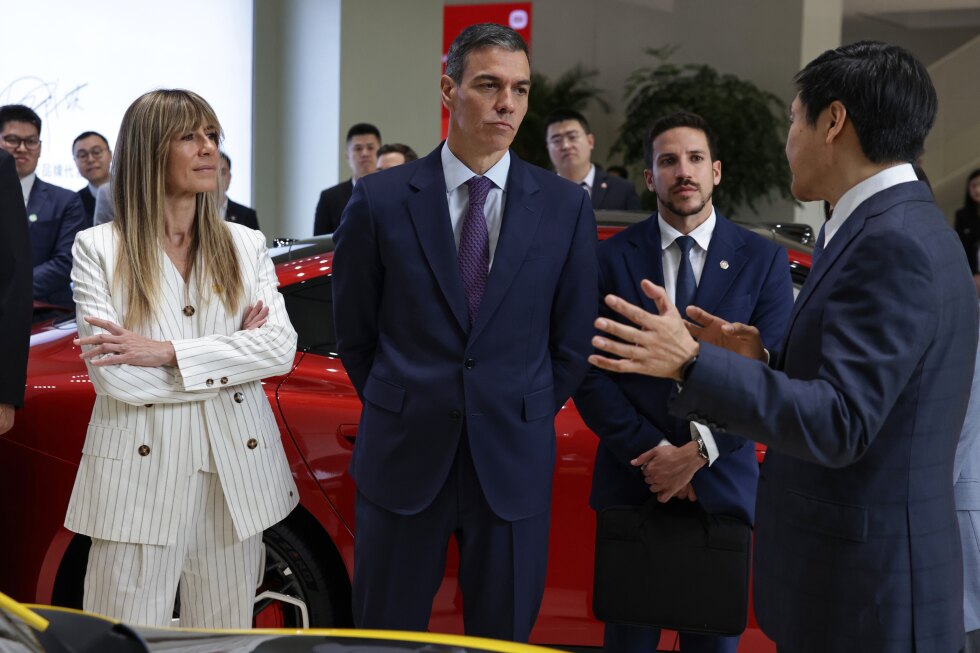
MADRID – Spanish Prime Minister Pedro Sánchez has returned to China for his fourth visit in as many years, a high-profile diplomatic trip aimed at forging stronger political and economic bonds between Madrid and Beijing, the world’s second-largest economy. The visit unfolds against a fraught global geopolitical backdrop, as European leaders scramble to push for a diplomatic end to the U.S.-Israeli military conflict in Iran – a conflict Sánchez has emerged as one of Europe’s most outspoken critics of, a stance that has severely strained Madrid’s relations with Washington.
Ahead of his scheduled bilateral meeting with Chinese President Xi Jinping, Sánchez delivered a policy address at Beijing’s prestigious Tsinghua University on Monday, where he called on China to step into a more prominent leadership role in the emerging multipolar global order. “This means, for example, demanding that international law be upheld, and that an immediate ceasefire be reached in all active conflicts: Lebanon, Iran, Gaza, the West Bank, and Ukraine,” Sánchez stated during the speech.
The core objective of Sánchez’s visit aligns with Spain’s long-stated policy of diversifying its diplomatic and economic partnerships with major global powers. Spanish government officials have made clear that Madrid aims to attract greater Chinese direct investment and expand Spanish export volumes to the Chinese market, even though all EU trade negotiations – including those for Spain, one of the bloc’s 27 member states – are handled at the union level.
Like many other European nations undergoing a urgent energy transition away from fossil fuels, Spain – which already generates over half of its domestic electricity from renewable sources – relies on access to Chinese critical raw materials, photovoltaic solar panels, and other green technology that are central to its decarbonization goals.
In recent weeks, Spain has taken an unusually bold stance among European nations against U.S. and Israeli military operations in the Middle East. The Sánchez government has already closed Spanish airspace to U.S. military aircraft deployed to the Iran conflict, and denied Washington access to jointly operated military bases located in southern Spain. This public break with U.S. policy has given added strategic weight to Sánchez’s annual trip to China, according to regional policy experts.
“Against the backdrop of growing friction with the U.S. administration, these yearly high-level meetings have taken on increased geopolitical significance,” explained Eric Sigmon, a Madrid-based political analyst and former U.S. national security adviser.
Sánchez’s three-day visit, running from April 13 to 15, includes scheduled talks with not only President Xi, but also Chinese Premier Li Qiang and Zhao Leji, Chairman of the Standing Committee of the National People’s Congress and the third-ranking leader of the Communist Party of China.
Unlike many other major European Union economies, Spain has maintained a far less adversarial approach to China in recent years. As the fourth-largest economy in the eurozone, Spain has actively worked to rebalance its bilateral trade relationship with Beijing: China currently runs a substantial trade surplus with Spain, a dynamic that reflects the gap between the two nations’ economic scale – 49 million people for Spain versus more than 1.4 billion for China.
Data from the American Enterprise Institute’s China Global Investment Tracker shows that while Chinese foreign direct investment into other major EU economies including France and Germany has declined over the past five years, Chinese investment in Spain has actually grown consistently since 2019, even though total volumes still remain lower than in several other Western European countries.
As a mid-sized global political power, Spain has framed its foreign policy under Sánchez as one that pursues stronger independent bilateral ties with all of the world’s major economies – including China, a growing India, and the United States – rather than aligning strictly with any single bloc. The country’s long-term commitment to deepening relations with Beijing was underscored last November, when King Felipe VI carried out an official state visit to China, the first by a Spanish monarch in 18 years.
Sigmon noted that the economic and commercial dimension of the relationship remains the central priority for Madrid. “Spain needs foreign capital and new investment, and it clearly views China as a promising source of that funding,” he said. For China, meanwhile, Spain acts as a uniquely cooperative and open partner within Western Europe, he added. Still, Sigmon cautioned that the inherent asymmetry in the size and scope of the two economies means Spain may struggle to secure major concessions from Chinese negotiators in key areas of interest, including advanced technology access and market access openings for Spanish exporters.