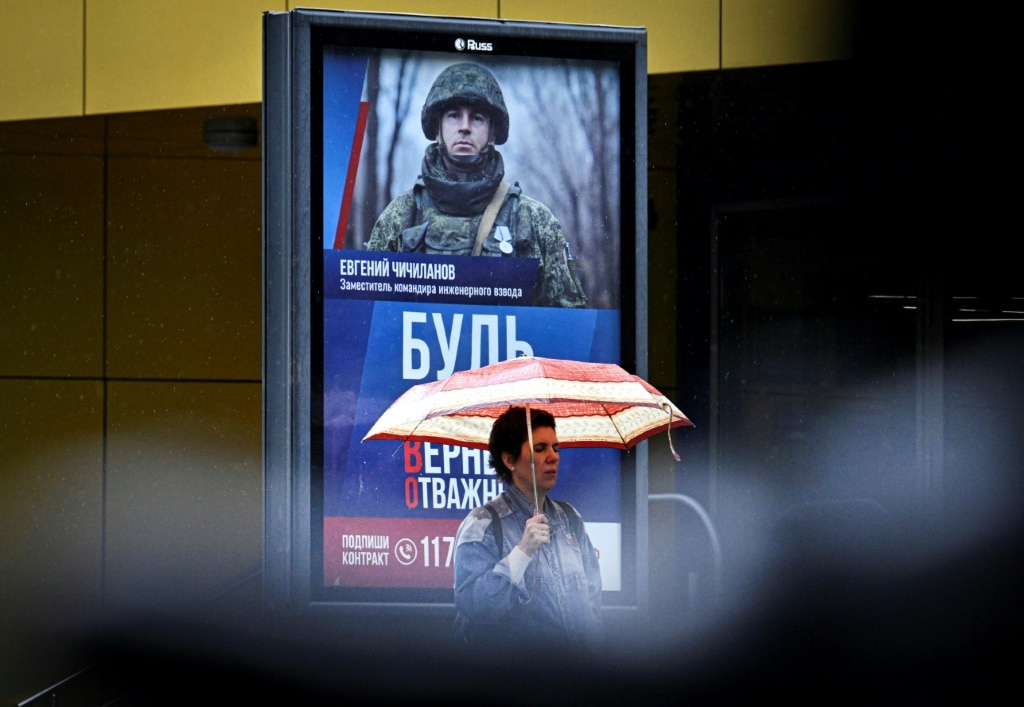
Three years into Russia’s full-scale invasion of Ukraine, the Kremlin has dramatically overhauled its once-permissive conscription system, closing off nearly all legal avenues for eligible men to avoid mandatory military service and building a sophisticated pressure apparatus to push conscripts into voluntary combat contracts bound for the Ukrainian front. These changes, documented through firsthand accounts collected by Agence France-Presse (AFP) and interviews with rights advocates working on behalf of conscripts, have upended civilian life for Russian men of military age, turning everyday public spaces into potential trap points for draft evaders.
For one young Moscow bank employee, avoiding conscription meant weeks of steering clear of the city’s metro network, where law enforcement had begun deploying facial recognition technology to flag men wanted by military recruitment authorities. But on a snowy Friday evening in late 2024, gridlocked road traffic forced him to take the underground to reach his mother’s home. Mid-journey, two officers boarded his train carriage and took him into custody for failing to respond to draft summons. Within just 72 hours, he was processed and transferred to a military base outside Moscow to begin his 12-month mandatory conscript service. Like dozens of other conscripts who spoke to AFP for this reporting, he agreed to share his story only on condition of anonymity, citing fear of retaliation from Russian authorities.
Prior to Russia’s 2022 invasion of Ukraine, avoiding conscription through legal means was widely accessible to eligible men. Medical exemptions were relatively easy to obtain, many young men extended their education to delay service indefinitely, and alternative civilian service options were available for those with objections to military service. “Before 2022, there were many ways to avoid the draft without doing anything illegal,” explained Artyom Klyga, a lawyer with the Movement of Conscientious Objectors, a Russian advocacy group. “Now very few legal ways remain.”
Over the past three years, the Russian government has systematically tightened conscription rules to expand the pool of available personnel for its war effort. The draft, once limited to two seasonal call-up periods per year, is now held year-round. The upper age limit for conscription was raised from 27 to 30, eligibility criteria for medical exemptions was sharply narrowed, and a new digital summons system was introduced that automatically enforces travel restrictions and other penalties once a summons is issued online. In major cities including Moscow, facial recognition surveillance integrated with a unified national recruitment database allows authorities to locate and detain draft evaders in public spaces in a matter of minutes.
Once conscripts are processed into the military system, intensive pressure to sign formal combat contracts — which deploy troops to the front lines in Ukraine — begins within days, advocates and conscripts report. Cut off from outside contact, most new conscripts have no access to their families, legal support or independent media, leaving them vulnerable to manipulation and coercion. Advocates say recruiters and commanding officers use a wide range of tactics to convince conscripts to sign contracts, from deceptive marketing to outright coercion.
Timofey Vaskin, a representative of Shkola Prizyvnika (School of Conscripts), a group supporting conscripts, says the most common approach is to frame a combat contract as a routine, well-paid job rather than frontline combat duty. Recruiters tell conscripts they will work standard nine-to-five shifts, earn significantly higher pay than conscripted service, and be exempt from menial base duties. Other promises include non-combat roles as drivers or clerks, and assurances that the contract will last only 12 months — matching the length of mandatory conscript service. In reality, all military contracts for combat service in Ukraine are effectively open-ended, with no guaranteed exit after one year.
“It is a major success of the Russian authorities that they have convinced many people that conscripts simply serve for a year,” Klyga said. “As a result, conscripts are now ending up in the war in record numbers.”
Official data confirms that the system is churning out unprecedented numbers of contract fighters. Former Russian president and current Security Council deputy chairman Dmitry Medvedev reported that 422,000 Russians signed voluntary combat contracts to fight in Ukraine in 2025, just 6% lower than the 2024 total. At the same time, roughly 295,000 men were called up for mandatory conscription service in 2025. Klyga says that for conscripts who agree to sign a contract, deployment to the front can happen in as little as 30 days.
For the detained Moscow bank worker, the pressure to sign began almost immediately after his arrival at the unit. Held for three days in a detention facility with no access to a shower or clean clothes, he was never explicitly forced to sign, but constant subtle pressure left no doubt about what was expected. “You’re a good fit, we need people like you,” his superiors told him, repeating the same pitch he had heard from other recruiters: that he would get a good position, earn good money, and avoid unpleasant routine base duties. While he never ultimately signed, many other men in his unit agreed immediately, he told AFP.
Other conscripts describe far harsher coercive tactics. A Moscow DJ who tried to avoid service for years told AFP he eventually gave in after authorities blocked him from obtaining a driver’s license and an international passport, both of which require proof of compliant military status. After he was assigned to a military medical unit for his 12-month service, he found even contracted combat soldiers were desperate to leave. “None of them want to serve,” he said. “They all want out.” Oddly, he even recalled some junior commanders warning new conscripts against signing contracts: “Don’t sign anything. Don’t ruin your life.”
Advocates have documented dozens of cases of outright abuse to force signatures. Vaskin described one incident where security personnel planted a prohibited mobile phone on a conscript, then gave him an ultimatum: sign a combat contract or face criminal detention. Klyga’s organization has collected complaints of conscripts being subjected to punitive sleep deprivation, forced to wear heavy chemical protection suits for 24 hours straight, and ordered to perform pointless repetitive labor such as digging holes and refilling them to break their resistance. In some extreme cases, advocates say, commanding officers have forged conscripts’ signatures on enlistment contracts without their knowledge or consent.
“Under constant pressure they break a person,” Klyga explained. One conscript told AFP that a man in his unit, desperate to avoid deployment to Ukraine, swallowed a needle in an attempt to secure a medical discharge. “He was covered in blood when they brought him in,” the conscript recalled. The man survived, and was ultimately discharged from service.
Many conscripts who do yield to pressure and deploy to the front choose not to inform their families of their new status, advocates say. “They simply leave, and the family only finds out later,” Klyga said. In the worst cases, parents only learn their son was pushed into frontline service after they receive notification he has been killed in combat.
The demand for legal help to avoid conscription has “risen sharply” across Russia, Vaskin said, as eligible men scramble to find any remaining path out of service amid the Kremlin’s tightened rules.