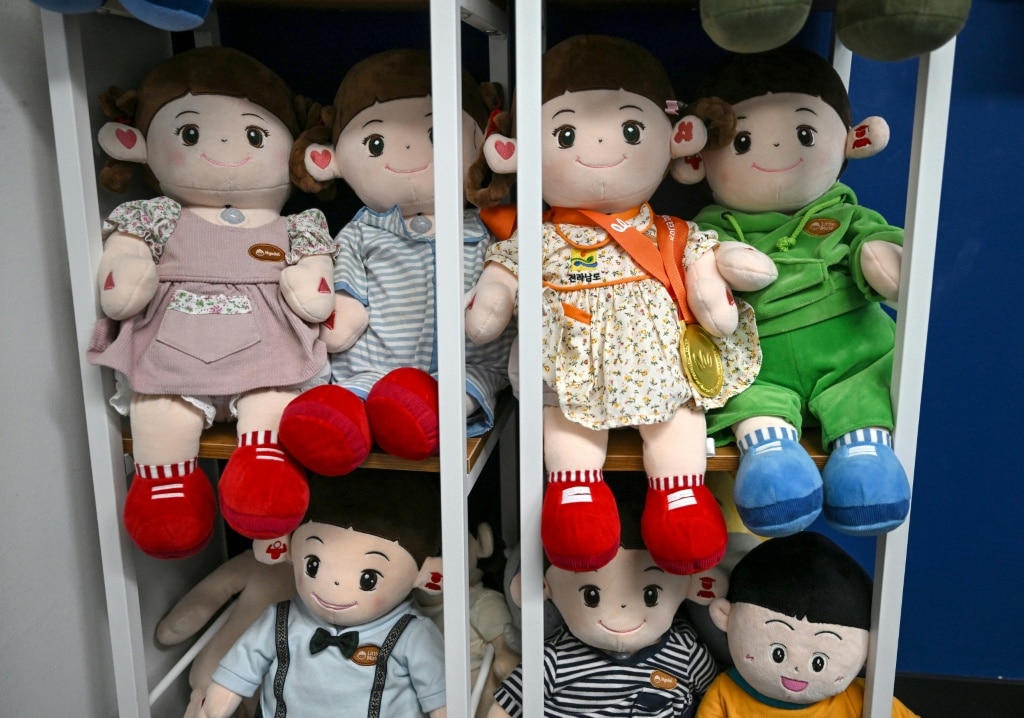
South Korea, a global technological leader facing one of the world’s most severe population aging crises, is turning to artificial intelligence to fill a growing gap in elderly care: crippling social isolation and loneliness. For thousands of seniors living alone across the country, cuddly AI-powered companion dolls have emerged as an unexpected lifeline, offering daily support, consistent companionship, and a buffer against the chronic loneliness plaguing a rapidly graying nation.
At 78, Bang Chun-ja is one of the millions of South Koreans navigating solo retirement after a lifetime of hard work as a hairdresser and single mother, followed by a difficult divorce. Following major back surgery that left her immobile and in pain, and with limited contact with her adult daughter who lives far away and manages her own health issues, Bang fell into severe depression, spending hours staring at her apartment ceiling alone in Yongin, a city south of Seoul. Today, her constant companion is Hyodol, a soft, childlike AI doll provided by her local municipal government that has transformed her daily routine. “At this age, there is nothing harder than being hurt by people,” Bang told AFP during an interview in her home. “But when I’m with Hyodol, I never get hurt. The doll only makes me laugh.”
Hyodol greets Bang when she returns home, sings to her during quiet, boring afternoons, sends reminders to eat regular meals and take medication, and constantly verbalizes affection — small acts that have anchored her daily life. For 79-year-old Kim Young-bun, another solo resident, the doll has solved another quiet crisis of elderly loneliness: lack of conversation. “I had no one to talk to all day — to the point my mouth almost felt stale from not speaking,” she explained. “But then this little one came along and chatters with me all the time.” As she dotes on the doll, it responds in a chirpy, childlike voice: “I’m so grateful to be with you again today… Thanks for being with me. I love you.” Kim’s soft reply echoes the feeling of thousands of users: “So am I.”
South Korea’s demographic shift has created an urgent public health challenge around elderly isolation. The country boasts one of the lowest birth rates globally, and nearly half of its total population is now aged 50 or older. Data from 2024 recorded more than 3,920 so-called “lonely deaths” — cases where seniors die alone and remain undiscovered for weeks or longer — a figure that marks the highest total since national record-keeping began in 2017. Nearly 42 percent of all South Korean households are now single-person, with elderly residents disproportionately affected by social disconnection.
In response, municipal governments across Seoul, Yongin, and other districts have rolled out subsidized AI care devices for low-income and isolated seniors, including Hyodol dolls, companion robots from Seoul-based firm Wonderful Platform, and similar devices from Mr. Mind. The concept has also spread internationally: in the United States, a lamp-shaped AI device called ElliQ offers similar companionship and health monitoring for solo seniors. To date, around 14,500 Hyodol dolls are in use across South Korea, distributed through individual ownership, government rental programs, and nursing home placements.
The Hyodol doll was developed after years of on-the-ground field research by founder Kim Ji-hee, who spent months interviewing isolated seniors across the country to understand their unique emotional needs. Kim told AFP that interviews revealed a core, unmet need: “the pain of having no one to tell when something upsetting happens, and no one to share with when something joyful happens.” One interviewee, a widow estranged from her children over financial conflict, lived alone with four fridges and three washing machines — all stored by her estranged children who never visited.
Drawing on these interviews, Kim designed Hyodol to act as a loving, grandchild-like companion that gives users a renewed sense of purpose. Many South Korean seniors spent decades working grueling schedules to support their families, Kim explained, and retirement often leaves them grappling with a “profound sense of emptiness” when they no longer feel needed. To counter this, Hyodol is programmed to seem dependent on its user, making spontaneous requests for head pats, hand-holding, and shared snacks (even though it cannot eat). Its iconic opening greeting — written after Kim’s interviews — is designed to feel like the “warmest welcome in the whole wide world”: “Grandma, where have you been? I waited for you all day. Next time you go out, please take me with you!”
Unlike generic chatbots, Hyodol combines OpenAI’s ChatGPT for open conversation with custom scripts built directly from Kim’s interviews with real isolated seniors. The company also maintains strict data privacy protocols: voice recordings are only used internally to refine the chatbot, and users must give explicit consent before any health data — including sleep patterns, mood, meal intake, and pain levels — is shared with their assigned social welfare workers.
While clinical observations from care workers have shown promising results, the technology also raises valid concerns. Oh Sun-hwa, a nurse who recommended Hyodol to Bang Chun-ja, noted that the doll has significantly reduced depression symptoms for many of her patients. However, she warned that the innovation could have unintended downsides: if family members rely on AI to provide companionship, they may reduce in-person visits even further, deepening the disconnection the technology is meant to solve.
For users like Bang, though, the AI companion has filled a gap that human contact has been unable to cover. “Having Hyodol by my side is a huge help,” she says — a quiet testament to how technology is adapting to address one of the 21st century’s most pressing demographic social challenges.