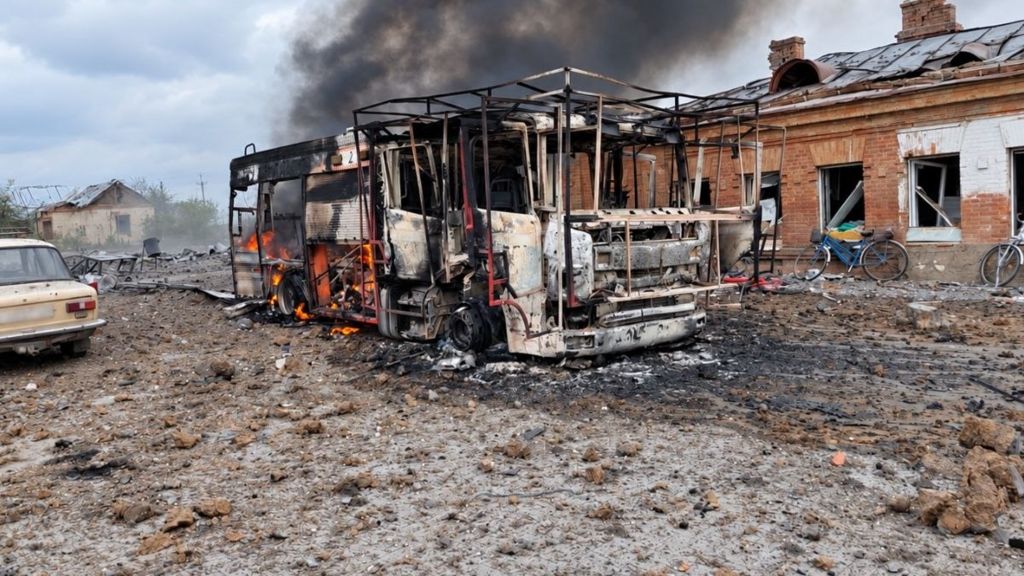
Newly released footage from the scene of a devastating Monday assault in the southern Zaporizhzhia region of Ukraine shows thick plumes of smoke billowing from a massive, bomb-created crater in the village of Komyshuvakha, where at least nine 3,000-kilogram Russian aerial bombs targeted civilian locations hosting humanitarian operations. Regional administration head Mykhailo Semikin confirmed the initial casualty breakdown in official briefings: alongside the 24 confirmed fatalities, five civilians sustained non-life-threatening injuries, and 27 people were initially unaccounted for immediately after the blasts. Ukrainian President Volodymyr Zelensky characterized the assault as an “utterly horrific” war crime in public statements, noting that the attack followed a deliberate double-strike pattern that is widely documented in conflict zones: the first wave of bombs hit a local school that had been repurposed as a regular weekly distribution point for critical food, medicine and shelter supplies for remaining local residents, while a second wave targeted the exact site where displaced and shocked civilians had gathered to take shelter in the aftermath of the first explosion. Zelensky shared the raw on-the-ground video via his official social media channels, which captures emergency response crews sifting through twisted rubble and scattered debris in a frantic search for survivors, alongside the gaping, bomb-carved crater that now dominates part of the village core. Ukraine’s State Emergency Service (DSNS) later updated casualty figures to clarify that the 24 confirmed dead included two first responders and four law enforcement officers who had rushed to the scene to assist civilians after the initial blasts. Zelensky emphasized in his post that the location of the aid distribution hub was widely known to local authorities, civilian populations, and would have been detectable via open-source monitoring, making it impossible for Russian military forces to claim they were unaware the site was serving exclusively non-combat humanitarian purposes. He went on to frame the attack as a deliberate rejection of tentative de-escalation momentum that had emerged following a rare successful joint Russian-Ukrainian civilian evacuation operation from the occupied southern city of Oleshky, which many international observers had hoped could serve as a foundation for broader peace negotiations. “There was a narrow window where coordinated, good-faith steps could have demonstrated that a peaceful path forward was within reach,” Zelensky stated. “These targeted killings send the unambiguous opposite signal: Russia’s leadership is actively choosing to pursue further bloodshed over any diplomatic resolution.” Zaporizhzhia regional chief Semikin echoed the grim assessment, describing the incident as an unfathomable tragedy for the tiny tight-knit village, and noting that ongoing search and rescue efforts have been repeatedly interrupted by additional Russian drone incursions in the surrounding area, slowing progress to reach dozens of people still believed to be trapped under collapsed concrete and debris. As of press time, the Russian Ministry of Defence has not issued any public statement addressing the reported airstrikes, which come nearly two and a half years after the Kremlin launched its full-scale unprovoked invasion of Ukraine in February 2022.