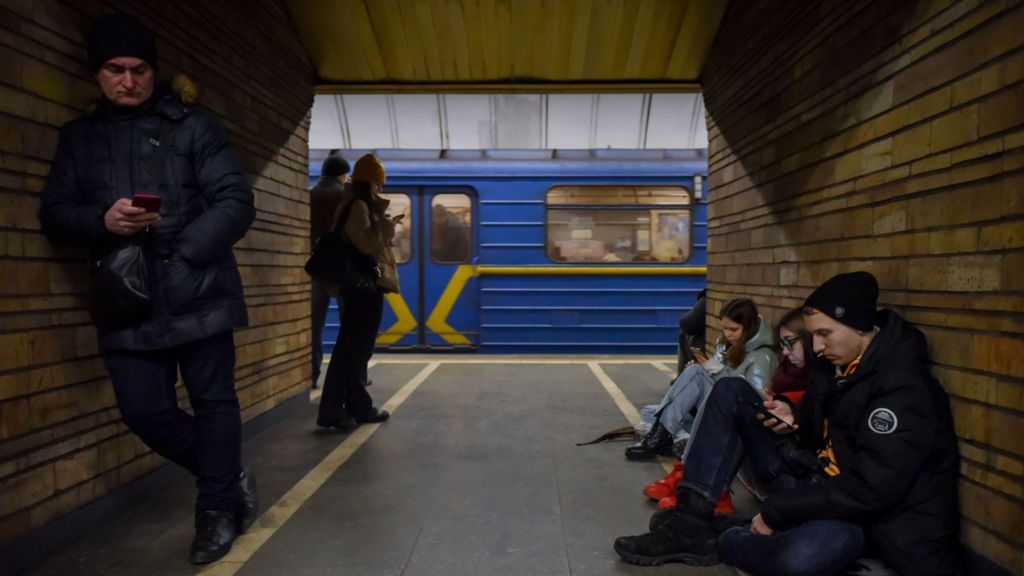
Millions of Ukrainians who have grown accustomed to near-constant, round-the-clock air raid alerts warning of incoming Russian missile and drone strikes faced a jarring, disorienting disruption to their usual routine on a recent Sunday night, when widely used emergency notification systems began pushing a cascade of unvetted, escalating fake threat alerts. The fraudulent notifications claimed imminent nuclear strikes, pending chemical weapons deployments, and active street combat across major urban centers including the capital Kyiv, sowing fleeting but tangible alarm across the country.
Many local residents, however, immediately flagged inconsistencies in the bogus messages that undermined their credibility. Sofia Kochmar, a 34-year-old mother of one residing in the western city of Lviv, recalled that her pulse spiked the second she spotted the word “nuclear” in the first pop-up alert, before a subsequent notice referencing supposed ongoing street battles in central Kyiv struck her as patently impossible, given the city’s relative stability at the time. Multiple fraudulent alerts were written partially in Russian, and one included an embedded hyperlink directing users to a public Telegram channel affiliated with an unidentified hacking collective.
Ukraine’s Air Force moved to issue a public statement within 15 minutes confirming that the official alert app ecosystem had been compromised, and explicitly clarified that no active radiation threat existed anywhere in the country. Even so, it took more than a full hour for authorities to roll out formal all-clear notifications to dispel the misinformation circulating across social media and private messaging groups. Anastasiia Romanytska, a 29-year-old professional ballerina based in Kyiv who does not use the official alert app, said she received forwarded copies of the fraudulent warnings from friends, triggering involuntary physical stress responses including a racing heartbeat and tightened abdominal muscles before she quickly realized the claims could not be legitimate.
The Ukrainian government’s official air raid alert infrastructure feeds standardized, verified threat data to a suite of third-party mobile applications, all of which display interactive maps marking active high-risk zones for users. Yevhen Baliutov, a leading cybersecurity researcher at the Kyiv School of Economics, confirmed in an interview with the BBC that the hack bore clear hallmarks of Russian-linked threat actors, noting that thousands of users who clicked the embedded malicious link in the fake alerts were routed to a pro-Moscow Telegram channel, leaving them exposed to subsequent waves of targeted disinformation, phishing scams, and potential personal data breaches. “This is an active war, so it is hardly unexpected that Russian actors will attempt to breach our systems, flood our information space with false narratives, manipulate public sentiment, and leverage these attacks for state propaganda purposes,” Baliutov explained.
While independent cybersecurity analysts widely confirm that both Ukrainian and Russian state-backed hacking units regularly launch offensive cyber operations against each other’s critical digital infrastructure, the unpolished, informal language used in the Sunday hoax alerts points to unaffiliated hacktivist groups that may operate in loose alignment with either Moscow or Kyiv, rather than teams under formal direct government command. Baliutov also noted that it would be operationally logical for Ukrainian cyber defense units to launch a reciprocal retaliatory strike against Russia’s own national emergency alert system, as both sides possess comparable advanced cyber warfare capabilities.
In the immediate aftermath of the incident, many Ukrainian residents leaned on their well-documented dark sense of humor to process the scare, with workplace and friend group chats rapidly filling with memes and lighthearted jokes about the false threats. Even with no recorded physical harm stemming from the breach, Baliutov emphasized that the incident laid bare critical structural vulnerabilities in a national public safety system relied on by millions of people every day. “This poses a very real, severe danger to Ukrainian civilians. When building public-facing digital services that serve as a lifeline for the entire population, security protocols cannot be treated as an afterthought, and no critical safeguards can be skipped during the development process. When millions of lives depend on a platform functioning reliably, we cannot afford to cut any corners on cybersecurity,” he stressed.
The breach adds a new layer of complexity for Ukrainian authorities, who have already struggled to maintain consistent public vigilance after 4.5 years of near-hourly air raid alerts that have left large swathes of the population desensitized to official warnings. Government officials now face the urgent task of restoring full public trust in the national alert infrastructure, to ensure that legitimate future threat notifications are taken seriously and acted on promptly.