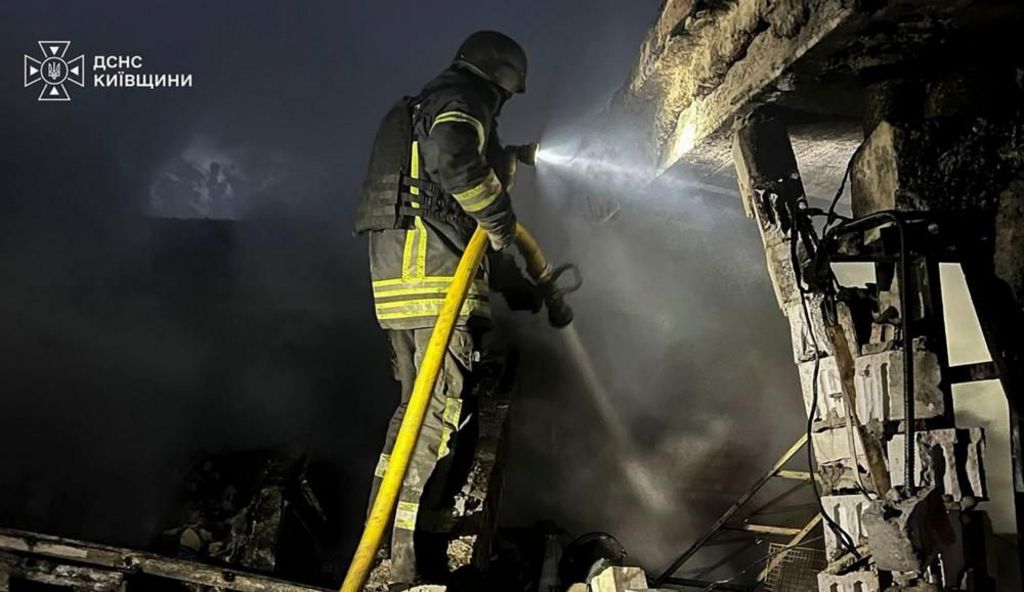
In a major escalation of targeted strikes against critical civilian infrastructure, Russia has carried out the largest-scale attack on Ukraine’s energy network since the spring of this year, with the capital Kyiv and its surrounding suburbs bearing the brunt of the assault, Ukrainian Prime Minister Serhiy Koretskyi has confirmed.
Local Ukrainian authorities confirmed Wednesday that the overnight barrage left at least six people dead across 11 different regions of the country, and injured 33 more. Among the fatalities is one child killed in the Kyiv region, whose body was recovered from the rubble of a destroyed residential home, according to Kyiv regional governor Timur Tkachenko.
The wave of combined strikes not only claimed civilian lives but also severely disrupted national power distribution, cutting electricity service to thousands of households. DTEK, Ukraine’s largest private energy provider, announced Wednesday that crews had managed to restore power to 8,000 homes in Kyiv following what the company described as an extraordinarily difficult night of restoration work amid ongoing security risks.
Russia’s defense ministry claimed one of its primary targets in the assault was the Trypilska power station, Kyiv’s single largest supplier of electricity. As of Wednesday afternoon, this claim remained unconfirmed by any Ukrainian official sources.
In an official statement posted to the messaging platform Telegram, Prime Minister Koretskyi noted that enemy strikes on Ukraine’s energy infrastructure have become a near-daily occurrence since the start of summer. “However, a mass and combined attack of this scale has occurred for the first time since the end of the last heating season,” he added.
Ukrainian officials have been preparing for months for a renewed, extended campaign of Russian attacks on the country’s energy grid – a pattern that has repeated every winter since Moscow launched its full-scale invasion of Ukraine in February 2022. The overnight assault marked the beginning of that anticipated campaign, as temperatures begin to drop ahead of the winter heating season.
Beyond energy facilities, the barrage also targeted civilian sites across 11 Ukrainian regions, including residential apartment blocks, public social infrastructure sites, private civilian enterprises, and railway lines, according to Koretskyi. Ukrainian President Volodymyr Zelenskyy confirmed that critical infrastructure was hit in the Zhytomyr, Mykolaiv, Kirovohrad and Rivne regions, extending the attack far beyond the Kyiv metropolitan area.
As of Wednesday, the Ukrainian energy ministry reported that multiple households in Kyiv, Dnipropetrovsk, Donetsk, Sumy and Kharkiv regions still remained without power. Ukrenergo, the country’s state-owned national grid operator, issued an urgent advisory asking residents to avoid using high-power electrical appliances between 10 a.m. and 4 p.m. local time, noting that overall electricity generation capacity remained well below normal levels after the strikes.
For residents of Kyiv, Wednesday morning brought a city shrouded in thick, acrid smoke, with the lingering echoes of explosions from overnight air defense engagements. An active air raid alert remained in effect for hours after the last strike, with the distant sound of anti-aircraft gunfire cutting through the hazy urban atmosphere. Local officials ordered residents in multiple Kyiv districts to keep their windows closed until the toxic smoke plume could dissipate completely.
Kyiv Mayor Vitaly Klischko confirmed that three people were killed in the capital alone, including a worker at a Ukrainian utility company who died at a targeted warehouse facility. It remained unclear Wednesday whether the child killed in the Kyiv region was included in this three-person death toll.
Regional officials confirmed additional fatalities outside the capital: two people were killed in the northeastern Sumy region, according to governor Oleh Hryhorov, and one more fatality was recorded in the southern Mykolaiv region, per acting regional governor Heorhiy Reshetilov.
Russia launched its full-scale invasion of Ukraine in 2022, and currently occupies approximately 18% of Ukraine’s internationally recognized territory, with fighting continuing along hundreds of kilometers of frontline in eastern and southern Ukraine.