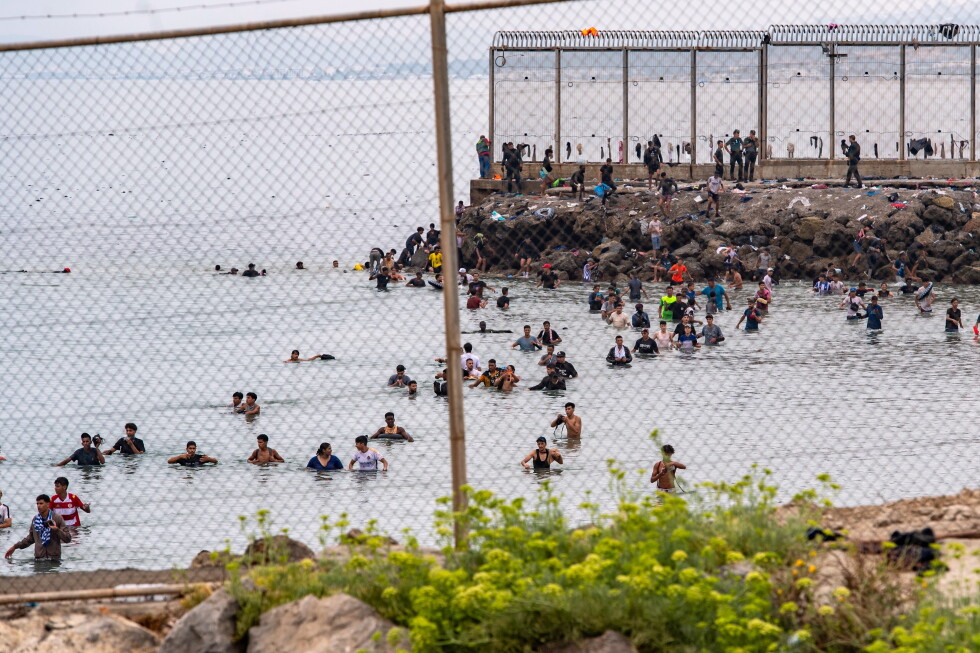
In the early days of last week’s unprecedented migration event along the Morocco-Spain border, the spark that lit the crisis was not an organized smuggling operation, but a cascade of false claims shared across mainstream social media platforms. What began as scattered Instagram posts claiming the border with the Spanish North African enclave of Ceuta had opened soon spread to Facebook and TikTok, building a viral wave of misinformation that drew more than 60,000 aspiring migrants to the crossing point in just 72 hours, in the largest single migration surge between the two nations in recent history.
The false narrative took root quickly across northern Morocco. Hundreds of kilometers from Ceuta in the coastal city of Larache, three young men saw a video posted to an Instagram account calling itself *Haraga Ceuta* — a name referencing the colloquial term for young Moroccans who destroy identity documents to attempt irregular entry to Europe — that claimed the border barrier had been lifted. For young people already grappling with systemic youth unemployment that leaves nearly four in 10 people aged 15 to 24 out of work, the claim was too promising to ignore.
Across multiple platforms, the misinformation evolved from a general rumor to step-by-step guidance for aspiring migrants. TikTok creators shared detailed route maps for the 5-kilometer swim around Ceuta’s border breakwater. Private Facebook groups dedicated to border crossing chatter shared screenshots of commercial vessel-tracking platforms to pinpoint windows when Spanish and Moroccan coast guard patrols were thinly staffed. Users traded tips for inflatable boat use and even advertised wetsuits for sale to people preparing the swim. By the time local and national authorities on both sides noticed the growing movement, thousands of people were already boarding packed buses, regional trains and taxis headed for the Moroccan border city of Fnideq, the primary starting point for Ceuta crossing attempts.
When the crowds converged on Ceuta’s narrow concrete breakwater, chaos erupted. Hundreds of migrants attempted to scramble up the structure’s slick, algae-covered rocks at once, pushing and climbing over one another to reach Spanish territory. Multiple migrants interviewed by the Associated Press described seeing people knocked into the churning water, trapped beneath the bodies of other climbers and unable to resurface. “I stepped on the face of a dead man while I was climbing out. I hope God forgives me and all those whose bodies were found,” said Lahcen Kalouch, a Moroccan migrant who returned home just days later, visibly distraught from the experience.
When the crisis finally eased, official counts placed the total death toll at more than 80: 72 fatalities on the Spanish side of the border, and 11 more on Moroccan territory, with deaths caused by drowning, stampede injuries and exposure. Nearly all of the 60,000 migrants who crossed into Ceuta have since returned to Morocco, expelled by Spanish authorities or choosing to leave after Ceuta’s infrastructure collapsed under the sudden surge, leaving new arrivals without access to shelter, clean water and food.
Many migrants were found to have misinterpreted recent Spanish policy changes as an open invitation to cross. Spanish Prime Minister Pedro Sánchez had recently announced a new immigration regularization program, but the policy only applied to people already residing in Spain before January 1 of this year — most of whom are Latin American migrants who entered legally but overstayed their visas. Online misinformation twisted the policy into a promise that any new migrant arriving in Ceuta would receive legal status and access to work, a false claim that spread rapidly despite no official endorsement from the Spanish government. “Pedro Sánchez is a liar. He told us if we came, we would get jobs and papers, but they sent us back,” said Adam Assil, a migrant from Casablanca, echoing the false narrative that circulated online despite Sánchez never making such a promise.
Officials on both sides have acknowledged that the spread of digital misinformation was a core driver of the mass movement, but failed to explain how such a large crowd was able to cross the border unchecked. Moroccan authorities opened an investigation into the spread of false claims, but have not released any evidence identifying who created or amplified the original misleading posts. Most of the social media accounts behind the rumors were deleted within days of the crossings, and attempts by the AP to contact account operators received no response. Ceuta’s local government says it warned the national Spanish government of an impending surge days before the crisis, but the Spanish Interior Ministry claims it received no such advance warning, while praising cross-border cooperation to repatriate most migrants.
“Nobody addressed how these individuals managed to breach the border,” said Mustapha Azaitraoui, a Moroccan geographer who specializes in migration dynamics. “If a large group of people can cross the border under these circumstances, it suggests a broader security issue that has yet to be acknowledged publicly.”
Both national governments have pinned blame on organized human smuggling networks, claiming criminal groups coordinated the mass crossing to profit from irregular migration. But most returning migrants interviewed by the AP rejected that framing, saying they made the decision to travel independently, motivated by the false rumor of an open border and desperate economic conditions at home. “No one smuggled me there. I wanted to go of my own free will, but that country is not worth all this sacrifice,” Kalouch said. 17-year-old Omar Danbor from Fnideq echoed that sentiment: “There are no mafias. The border was open, and I crossed. But now I regret it.” Spanish officials note that investigations into potential smuggling involvement are ongoing, while Moroccan authorities declined to answer questions about the issue.
Beneath the viral misinformation that triggered the surge, analysts and migrants point to persistent economic inequality and lack of opportunity for young Moroccans as the root cause of the event. While Morocco’s national economy is projected to grow by 4.5% this year, with major investments in automotive manufacturing, advanced ports and industrial infrastructure that have positioned the country as a rising regional economic hub, those gains have not trickled down to many young people. Youth unemployment sits at 37% nationwide, and nearly 20% of university graduates are unable to find work. For many, the dream of building a stable life in Europe is reinforced by family members who migrated and returned with visible signs of success: new cars, imported clothing and steady foreign income.
One 16-year-old migrant, who asked to remain anonymous out of fear of stigma after his failed attempt, summed up the desperation that drove thousands to join the surge. Growing up just dozens of kilometers from Ceuta, he had long seen Europe as a dream that was physically close but permanently out of reach. When he saw viral Facebook posts claiming the border was open and thousands were already crossing, he joined the crowd. Days later, he was back on Moroccan soil, begging strangers for taxi fare to get home, still shaken from the experience. “They fired tear gas at me and beat me with batons. There’s nothing for me there,” he said, wiping away tears. “I just wanted to provide for my mom.”