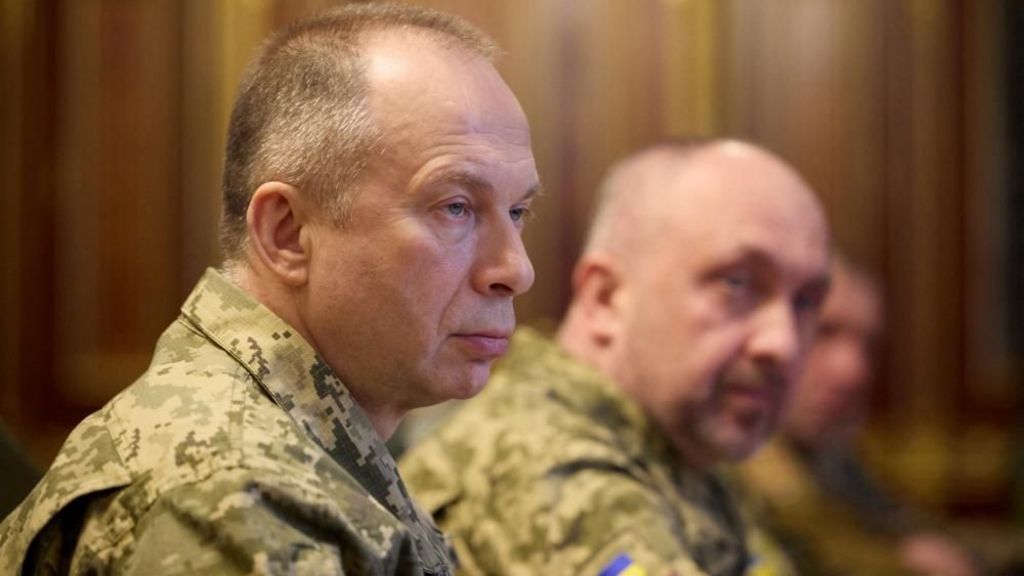
Kyiv, Ukraine — Just one week after Ukrainian President Volodymyr Zelensky’s decision to dismiss popular Defence Minister Mykhailo Fedorov sparked a domestic political crisis, the country has been thrown into further upheaval, as swirling rumours surrounding the future of Commander-in-Chief Oleksandr Syrsky have dominated public discourse and protesters issued an ultimatum for dramatic leadership changes by the end of this week.
Organisers of daily demonstrations backing the ousted defence minister have issued a clear, hardline threat: unless Syrsky is removed from his post and Fedorov is reinstated as Defence Minister by Friday, July 24, they will launch an open-ended, nationwide protest that will span every major Ukrainian city. No demonstrations are scheduled ahead of the deadline, leaving the nation on edge as it waits for a resolution to the growing internal rift. Dmytro Koziatynsky, an army veteran representing the protest organisers, outlined the demand in a public post on social media, amplifying pressure on Zelensky’s administration amid already tense public discourse.
Over the weekend, Kyiv was abuzz with unconfirmed reports of closed-door meetings between Zelensky, senior cabinet ministers and top military generals, as the president works through potential adjustments to Ukraine’s defence leadership structure. Amid the flood of speculative reports, Ukraine’s General Staff was forced to publicly issue a denial, pushing back against claims that Syrsky was either on the brink of dismissal or had already been removed from his command. Additional unconfirmed reporting has also suggested that Fedorov has rejected a proposed offer to return to government in a different cabinet role.
In a public appeal to the nation on Tuesday, Kyrylo Budanov, head of the presidential office, urged Ukrainians to set aside their anger and remain calm. “The situation surrounding the latest internal changes has caused strong emotions,” Budanov acknowledged in a social media statement, speaking as angry chants from protesters in Kyiv’s Ivana Franka Square — located just steps from the presidential palace — could be heard echoing through the city centre. “I understand people who express their position… The position of society has been heard.”
Budanov, a former head of Ukrainian military intelligence, also warned demonstrators against turning public anger inward, noting that Russia is closely watching every internal Ukrainian division and waiting for the country to fracture from within. “The enemy is closely monitoring our every internal dispute and is waiting for us to start fighting among ourselves,” he said. “The work is underway. There will be results.”
After days of remaining out of the public eye amid growing criticism, 60-year-old Syrsky broke his silence on Monday, publishing a lengthy op-ed in the Ukrainian outlet Militarny to defend his professional record and push back against claims of a bitter public rift with the 35-year-old Fedorov. Contradicting Zelensky’s recent claim that the two men could not even bear to share a room for official meetings, Syrsky said he was caught off guard by reports of a personal conflict. “I perceived our relationship as a working one,” he wrote. “If I offended anyone, Mykhailo Albertovych [Fedorov], I’m sorry.”
The commander-in-chief pushed back against the simple, slogan-driven demands carried on protest signs across Kyiv, arguing that the complex issues of military contracting, weapons procurement and troop mobilization are far more nuanced than the public discourse suggests. “Decisions on which people’s lives depend are not made with slogans,” he said. “Real work, not the public drama surrounding it, wins the war.” In a thinly veiled rebuke of Fedorov’s high-profile public briefings, Syrsky added: “Presentations should not turn into self-representations. Behind each slide there should be a document, a budget and a procedure. Otherwise, instead of a decision the army gets disappointment.”
Despite Syrsky’s defense, public opinion in Ukraine has largely aligned with Fedorov, particularly among younger Ukrainians, who broadly view the former defence minister as the driving force behind military innovation that has improved Ukraine’s ability to repel Russia’s larger invading force. Many critics also frame Syrsky as a representative of outdated, Soviet-era military doctrine that is ill-suited to the modern, drone-centric battlefield that defines the current war.
“Right now, the war is changing, so we need new ideas and a new structure,” Tetiana Makarenko, a 44-year-old law firm employee, told reporters at a weekend protest. “It’s often said that a small Soviet army can’t defeat a big Soviet army. It’s time to change the mindset and start the new type of war.” During Fedorov’s six-month tenure leading the defence ministry, Ukraine has notched a series of significant military gains, a run of success that many Ukrainians have credited to his leadership. “We had this feeling because we saw the changing situation,” Makarenko said. “We had the feeling that we can do this.”
Syrsky also pushed back against claims that he has resisted embracing modern drone technology, noting he oversaw the creation of a separate branch of the Ukrainian military dedicated to unmanned systems. Even so, he argued that shifting an entire million-strong military to prioritize drones exclusively cannot be accomplished in just two months, and that traditional military capabilities remain critical to Ukraine’s war effort. “I cannot transform a million-strong army to drones in two months and say: now we fight like this,” he explained. “I am not at war with the defence ministry, I am at war with Russia,” he added.
As Syrsky defends his position, speculation is growing about potential candidates to replace him if Zelensky opts for a shake-up. All of the leading names are younger generation officers with distinguished combat records: Mykhailo Drapaty, commander of the Joint Forces; Andriy Bileksky, commander of the Third Army Corps; Oleh Apostol, commander of the Airborne Assault Forces; and Ihor Obolensky, commander of the National Guard Corps. The youngest contender, 35-year-old Brigadier General Denys Prokopenko, commander of the National Guard, gained international fame for leading the Azov Regiment’s legendary defense of Mariupol during the 2022 Russian siege. Prokopenko was held as a Russian prisoner of war after the city fell, but returned to Ukraine in a July 2023 prisoner exchange and resumed his command despite Russian objections. While Prokopenko remains politically controversial due to longstanding allegations of far-right ties to the Azov Regiment, he retains strong popular support among many Ukrainians for his combat leadership.
Zelensky has confirmed that he is still finalizing plans for adjustments to Ukraine’s defence leadership, thanking all parties for their “openness, honesty and substantive contributions” to the discussions. With Russia expected to launch a new campaign of strikes against Ukraine’s critical energy infrastructure ahead of the autumn cold, Zelensky has stressed that Ukraine must be fully prepared and as strong as possible when August begins.
For now, the daily protests have paused ahead of the July 24 deadline, leaving the nation holding its breath as Zelensky weighs what many see as a fateful set of decisions that could shape the trajectory of Ukraine’s war effort against Russia.