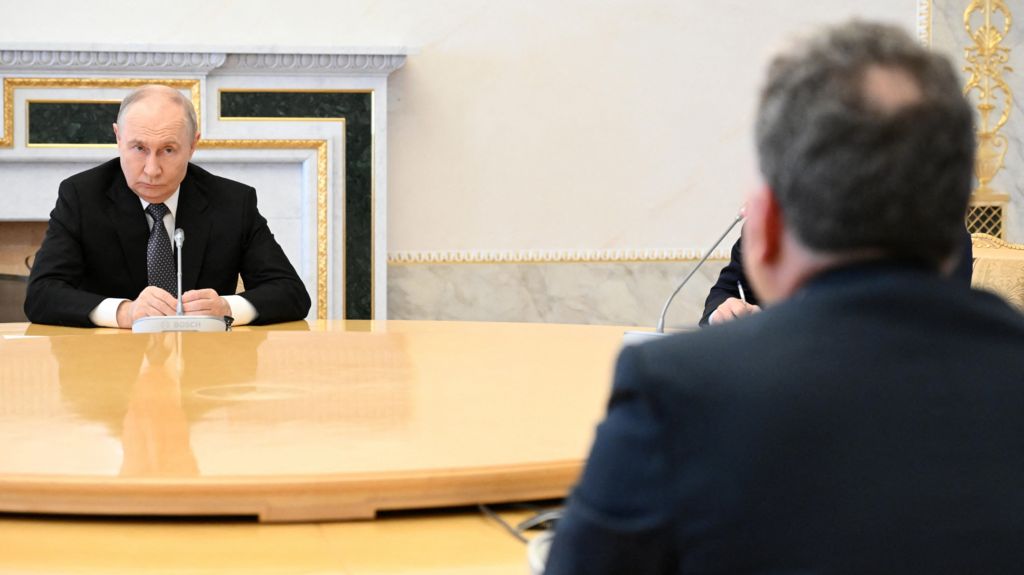
After two days of back-to-back diplomatic negotiations across Oslo, Norway, and St. Petersburg, Russia, the critical question lingers: has any meaningful progress been made toward ending the nearly three-year war in Ukraine?
Norway’s prime minister characterized Tuesday’s discussions involving Ukrainian President Volodymyr Zelenskyy, Steve Witkoff — U.S. President Donald Trump’s special envoy — and European representatives as “good and constructive.” During the Oslo meeting, participants floated the idea of a high-level trilateral summit, with the initial expectation that Witkoff’s visit to St. Petersburg would clear the path for a face-to-face meeting between Putin, Zelenskyy, and Trump to negotiate a ceasefire and a long-term peace deal.
However, Putin has so far demonstrated little willingness to sit down with Zelenskyy on neutral ground, insisting that any such meeting must take place in Moscow. The Kremlin has indicated it would be open to resuming trilateral discussions next month in Abu Dhabi, but only at the technical working level, not among top leaders.
Witkoff himself acknowledged the slow pace of progress in a post on X, admitting that “there is still important work to do” while reaffirming that “President Trump remains committed to seeing this war end.”
The most revealing assessment of the talks came from Yuri Ushakov, Vladimir Putin’s foreign policy aide, who took part in the St. Petersburg negotiations. Ushakov confirmed that Witkoff had shared details of the Oslo discussions with Putin, including what Witkoff described as “new approaches from the Europeans and Kyiv.” But the Kremlin advisor made clear he was unimpressed with the proposals, stating bluntly: “In terms of resolving the Ukraine crisis, there wasn’t much there that was useful.”
When pressed by Russian state television on how close the parties are to a peace deal, Ushakov offered only a vague, noncommittal response: “I don’t know how close we are getting, but things are moving in that direction.”
This ambiguity points to a broader reality: Putin currently feels no urgent pressure to wrap up the conflict. He is well aware that Ukraine’s air defense systems are under unprecedented strain, and that the arrival of winter creates an opportunity to ramp up missile and drone strikes on energy infrastructure in an attempt to force Ukrainian submission. Additionally, Putin knows that the sitting U.S. president has repeatedly expressed a desire to pursue a closer, more economically beneficial relationship with Moscow.
In recent weeks, Trump has paused the implementation of several new sanctions against Russia, approved the purchase of Russian diesel, and issued sharp public criticism of Zelenskyy — all moves that reduce diplomatic and economic pressure on the Kremlin. This shift has been warmly received by Russian officials. “Right now Trump is the only leader in the Western world who is doing something for peace,” Evgeny Popov, a Russian member of parliament and state television anchor, remarked in an interview. When asked if this meant peace on Russia’s terms, Popov responded plainly: “Of course!”
While a trilateral summit between Putin, Zelenskyy, and Trump does not appear imminent, another high-profile meeting may go ahead next month on the sidelines of the APEC summit in China, where Putin, Trump, and Chinese President Xi Jinping are expected to gather. Some Russian commentators have already labeled this potential gathering “The New Yalta,” drawing a parallel to the 1945 Yalta Conference where Allied leaders Joseph Stalin, Winston Churchill, and Franklin D. Roosevelt met to reorganize the political and territorial order of post-WWII Europe.
“Russia, China and the United States are the only superpowers right now in the world,” Popov noted. “Of course, it will be good for the entire world if our leaders meet in China.” After nearly three years of war, such a meeting would place Putin exactly where he has long sought to be: back at the center of global high-stakes politics.