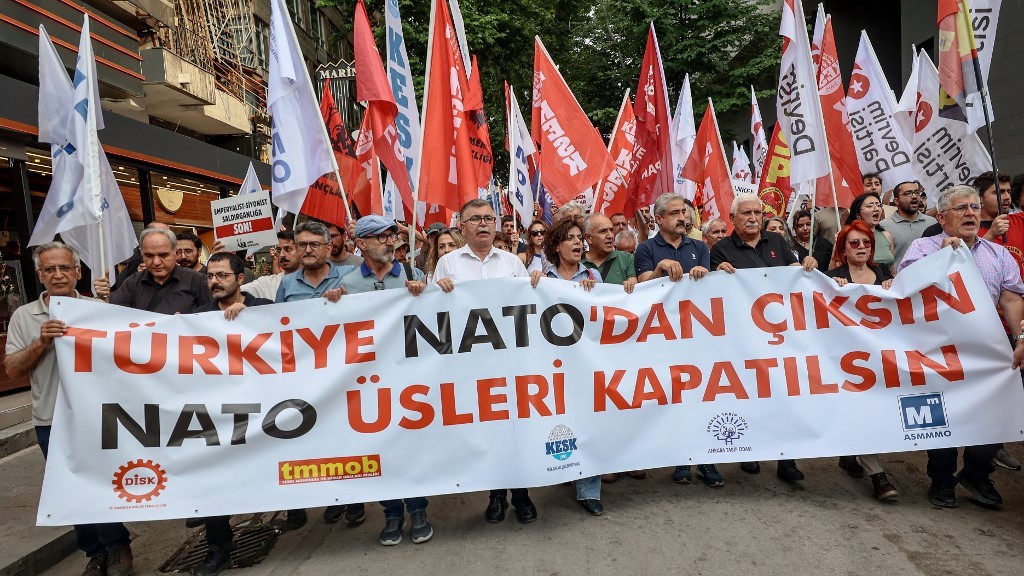
As the 32-nation NATO alliance prepares to convene its upcoming summit in Ankara this July 7–8, sweeping pre-event security measures implemented by Turkish authorities have drawn fierce international condemnation from human rights and press freedom advocates.
Last week, the Ankara Governorate unveiled a 13-day province-wide prohibition on all public gatherings, set to begin Sunday. Officials justified the broad restriction by citing the need for enhanced national security and protective measures surrounding the high-stakes leadership conference. The ban has been accompanied by a large-scale law enforcement crackdown that has resulted in the detention of hundreds of people across Turkey.
Turkish authorities confirm that 225 individuals have been taken into custody, with the government identifying many detainees as alleged affiliates of two groups: the leftist Revolutionary People’s Liberation Party/Front (DHKP/C) and the Islamic State. However, the detainee pool also includes a number of prominent Turkish civil society figures unaffiliated with any militant organization. Among those held are academic Emel Memis, LGBTQ rights activist and journalist Yildiz Tar, Nevzat Ozer, a representative from leading environmental NGO the Tema Foundation, Burcu Arikan, spokesperson for the independent labor union Umut-Sen, and Semra Demir and Kursat Bafra, two attorneys with the Progressive Lawyers Association. State-run Anadolu Agency confirmed that 178 of the detained suspects have been formally arrested, while the remaining 34 have been released conditional to judicial supervision.
Global human rights watchdog Amnesty International has issued a scathing rebuke of the measures, framing the protest ban and mass arrests as an unjustifiable assault on foundational rights to peaceful assembly and free expression. “All the excessively broad and disproportionate restrictions that prevent the exercise of the right to peaceful assembly must be lifted,” stated Esther Major, Amnesty International’s deputy research director for Europe. Major also called out a separate, parallel restriction on press freedom: NATO’s decision to deny press accreditation to dozens of Turkish journalists, including reporters from leading independent Turkish outlets such as Cumhuriyet, Sozcu, Anka, T24 and Medyascope. Major described the accreditation denial as a direct blow to media freedom, urging the alliance to reverse its decision and allow excluded journalists to cover the summit.
The upcoming summit marks a landmark gathering for the alliance, bringing together heads of state from all 32 member states, including U.S. President Donald Trump. Turkey has held NATO membership since 1952, and currently boasts the alliance’s second-largest standing land army. For decades, the country’s NATO membership has faced criticism from Turkish leftist groups and some Islamist factions, who argue the alliance has locked Turkey into U.S. geopolitical dominance and suppressed domestic socialist and anti-imperialist movements. Public anger over the summit has intensified in recent months, fueled by widespread opposition to U.S. support for Israel’s military campaign in Gaza and recent U.S. strikes on Iran, leaving the Turkish government eager to prevent large-scale public demonstrations during the leaders’ meeting.
Following the accreditation denial, a coalition of global and Turkish press freedom organizations released a joint statement last Friday condemning NATO’s decision. The statement highlighted a striking contradiction at the heart of the rejection: NATO’s own accreditation criteria list editorial independence as a core eligibility requirement, making it deeply inconsistent that the alliance would reject applications from outlets that are explicitly defined by that standard of independence. “Should a governmental institution with a documented track record of restricting press access have played any role in this process, NATO risks allowing domestic media pressures to influence what should be an independent credentialing framework,” the joint statement added.
Outlets that do not meet accreditation requirements in the upcoming NATO Summit. Middle East Eye, which first reported on the unfolding controversy, reached out to NATO press officials for comment on the accusations, but received no response by the time of this publication.
This report has been prepared for independent news dissemination from the original reporting by Middle East Eye, which provides unrivaled independent coverage and analysis of the Middle East, North Africa and broader global affairs.