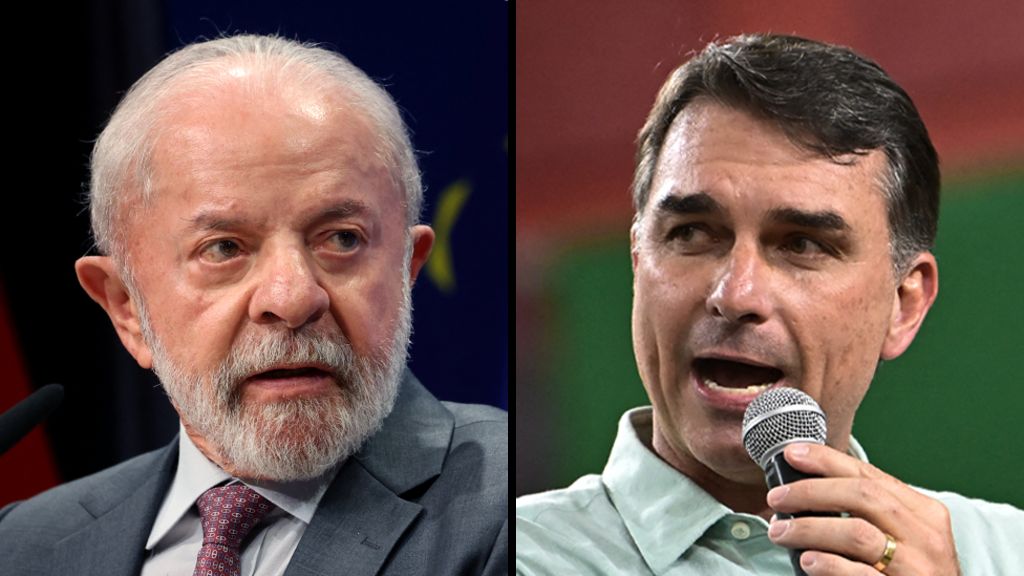
Brazil’s 2026 presidential election has entered a tense final stretch after a dramatic first-round outcome that defied pre-vote polling, putting right-wing candidate Flávio Bolsonaro just two points ahead of incumbent left-wing President Luiz Inácio Lula da Silva. With nearly all ballots counted, Bolsonaro secured 47% of the vote to Lula’s 45%, leaving both candidates short of the outright majority required to win the presidency outright. A head-to-head runoff has been scheduled for October 25 to decide the leadership of Latin America’s largest economy.
Flávio Bolsonaro, 45, is the eldest son of former far-right President Jair Bolsonaro, who is currently serving a 27-year prison sentence for orchestrating a failed coup attempt following his narrow 2022 election loss to Lula. Barred from running for public office himself, the former president endorsed his son as his political successor, a bid that gained additional momentum Sunday when Flávio’s stepmother Michelle Bolsonaro won election to the Brazilian Senate. His right-wing Liberal Party (PL) also dominated down-ballot races, securing more governorships, Senate seats, and federal deputy positions than any other party, positioning it to hold major sway over the next Congress regardless of the runoff outcome.
Sunday’s result upended pre-election expectations. Lula, 80, who was seeking an unprecedented fourth presidential term after winning office in 2002, 2006, and 2022, had held a slim lead in polling heading into the first round and had openly predicted he would secure victory without needing a runoff. Speaking after results were confirmed, the incumbent acknowledged the outcome was unexpected, framing the upcoming runoff as an extra-time battle for Brazilian voters. “The game is about to start. We are in extra time. In extra time, we will win over the Brazilian people,” Lula told supporters. Throughout the campaign, Lula framed the election as a stark choice between democratic governance and what he has called “barbarism,” referencing the 2023 Capitol-style riot staged by Jair Bolsonaro’s supporters after the 2022 election result.
Flávio Bolsonaro, for his part, struck a confident tone after his first-round showing. “I am very happy with the real possibility that, three weeks from now, Brazil will give a definitive answer by choosing a modern government,” he told reporters, echoing his father’s populist conservative messaging of freeing the Brazilian people from bureaucratic overreach and left-wing economic policies. The candidate has made a number of high-profile pledges that resonate with his base: he has promised to grant amnesty to his father and to the hundreds of rioters convicted for their role in the January 8, 2023, attacks on government buildings, to loosen gun laws further, to designate major Brazilian criminal gangs as terrorist organizations, and to build a network of maximum-security prisons modeled on the facilities used in El Salvador to crack down on gang violence.
This election has re-deepened the political polarization that has divided Brazil since the 2022 race. Voter priorities have shifted across demographic and geographic lines: Lula draws his strongest support from low-income families, Catholics, women, and the poorer rural northeast, where his signature social welfare program Bolsa Família lifted millions out of poverty. Flávio Bolsonaro, by contrast, leads among wealthier voters, evangelical Christians, and voters in the more industrialized southern Brazil. Top issues on the campaign trail have included corruption, public security, economic performance, and national sovereignty, each cutting sharply across partisan lines.
The corruption debate gained new traction this cycle following a sprawling financial fraud scandal orchestrated by jailed banker Daniel Vorcaro, which has entangled senior figures across the political spectrum. Voice recordings confirmed Flávio Bolsonaro requested 134 million reais (approximately $25.9 million) from Vorcaro to fund a biographical film about his father, though Bolsonaro has defended the interaction as a standard fundraising request. Lula has also been indirectly tied to the scandal: police have alleged Vorcaro contacted Supreme Court Justice Alexandre de Moraes, who presided over Jair Bolsonaro’s coup trial and is widely viewed as aligned with Lula, to seek leniency ahead of his arrest. Moraes has denied any wrongdoing in the case.
On public security, voters have expressed growing frustration with rising street crime and ongoing drug trafficking, even as Brazil’s national homicide rate has declined in recent years. Flávio Bolsonaro has leaned into hard-on-crime messaging, building on his father’s legacy of loosening gun ownership restrictions. Lula, by contrast, has pushed for systemic reforms to crack down on organized crime’s financial networks, improve homicide investigations, and reform prison infrastructure, while criticizing US efforts to designate Brazilian gangs as terrorist organizations as an overreach of foreign power.
Economic policy has also divided the two candidates. Lula’s legacy is rooted in expansive social welfare programs that reduced inequality, though Brazil currently faces slowing economic growth and high levels of household personal debt. The incumbent has also prioritized environmental protection, cutting Amazon deforestation dramatically after it surged under Jair Bolsonaro’s presidency, even as he has backed targeted oil exploration that has drawn criticism from environmental activists. Flávio Bolsonaro has run on a libertarian economic platform, promising to cap public debt, cut government spending, revise the existing social welfare system, and expand investment in Brazil’s critical minerals sector.
The race carries major geopolitical implications for the Western Hemisphere. A majority of Latin American nations have now elected right-wing presidents aligned with former US President Donald Trump’s foreign policy agenda, and a Flávio Bolsonaro victory would cement that shift by bringing Brazil, the region’s largest country, into the pro-US bloc. Earlier this year, Flávio Bolsonaro successfully lobbied the Trump administration to designate two of Brazil’s largest gangs as terrorist organizations, and Trump has already praised the candidate’s first-round performance, telling reporters at the White House that it was a “very, very big victory.” A Flávio Bolsonaro win would likely see Brazil join the US-led “Shield of Americas” anti-narcotics coalition and align much more closely with US foreign policy. Lula, meanwhile, has made national sovereignty a core pillar of his campaign, repeatedly accusing the US of interfering in Brazil’s domestic election, a claim the US has repeatedly denied. Last year, Trump used Jair Bolsonaro’s coup trial as justification to impose new tariffs on Brazilian imports and sanction top Brazilian officials and judges, a move that escalated bilateral tensions.
Brazil’s Supreme Electoral Court confirmed Sunday that it has found no evidence of international interference in the electoral process, clearing the way for the three-week runoff campaign that is already underway. With most eliminated first-round candidates coming from the right, political analysts now consider the runoff a competitive race that leans in Flávio Bolsonaro’s favor heading into the final stretch.