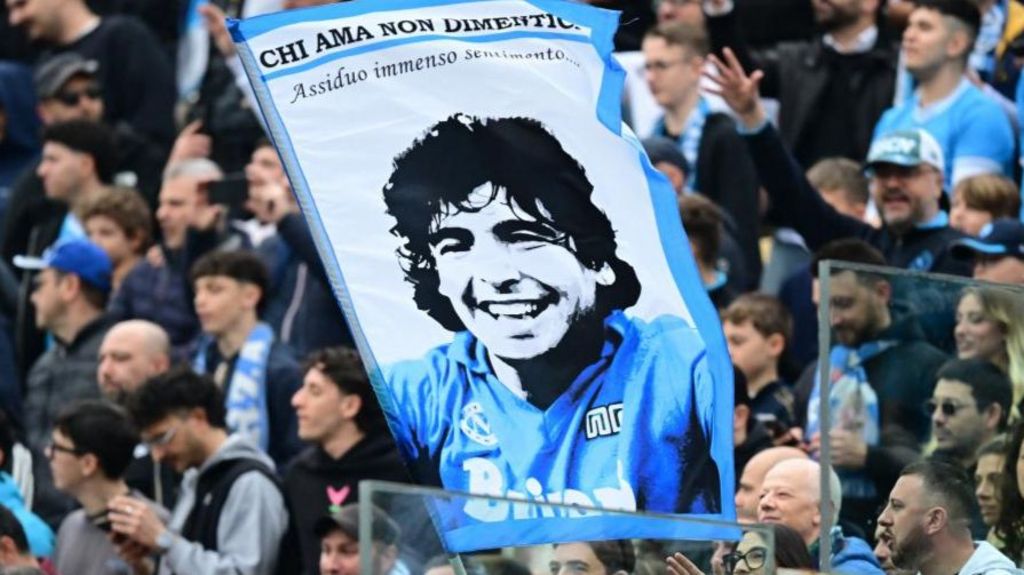
One of the most iconic and gifted footballers in the history of the sport, Diego Maradona, died at the age of 60 in November 2020 from heart failure, and six years later, a new legal chapter into the investigation of his death is getting underway. On Tuesday, a retrial for seven members of Maradona’s medical circle opened, after the original 2025 trial was abruptly derailed over a courtroom ethics scandal.
The first trial, held in May 2025, collapsed after it emerged that one of the three presiding judges allegedly permitted unapproved, off-the-record filming inside the courtroom for an upcoming commercial documentary, a violation of judicial protocol that forced the entire proceeding to be scrapped. Ahead of the new trial, Maradona’s supporters gathered outside the San Isidro, Argentina courthouse, holding banners calling for “Justice for God” — a nod to the legend’s widespread nickname as “Diego, the God of Football.”
At the center of the case are allegations that Maradona’s medical team failed to deliver appropriate, life-saving care after he underwent successful surgery to remove a brain blood clot in early November 2020. Following the procedure, Maradona moved to his private home in Tigre, a Buenos Aires suburb, to recover, where he died weeks later on November 25. Prosecutors have charged all seven defendants with homicide with possible intent, a charge similar to involuntary manslaughter under Argentine law. All seven have repeatedly denied any wrongdoing, but if convicted, they face prison sentences ranging from 8 to 25 years.
Prosecutors argue the defendants were fully aware of the extreme fragility of Maradona’s health following his brain surgery, yet neglected to take the basic, necessary precautions to monitor and treat his condition, directly contributing to his death. A preliminary autopsy confirmed Maradona’s heart failure triggered acute pulmonary edema, a life-threatening condition where fluid accumulates in the lungs, leading to his death. An independent panel of medical experts commissioned by prosecutors found the at-home care Maradona received was “deficient and reckless,” concluding the football icon would have had a significantly higher chance of survival if he been treated at a proper medical facility with adequate resources.
The seven defendants standing trial include Maradona’s lead personal physician Leopoldo Luque and his personal psychiatrist Agustina Cosachov. A separate eighth person connected to the case, Maradona’s former nurse Dahiana Gisela Madrid, will face trial in a separate, independent proceeding at a later date. Over the course of the retrial, roughly 100 witnesses are scheduled to give testimony before the new panel of judges, including several of Maradona’s daughters. Court officials expect the proceedings to run through July.
Maradona’s death in 2020 sparked an outpouring of grief across Argentina and the global football community. Then-Argentine President Alberto Fernández declared three days of national mourning, releasing a statement that read, “Thank you for having existed, Diego. We’re going to miss you all our lives.”
Born to a working-class family in Buenos Aires, Maradona launched his professional career with Argentinos Juniors before rising to global stardom. He went on to represent Argentina at four consecutive FIFA World Cups, scoring 34 international goals, including the controversial “Hand of God” goal against England during Argentina’s 1986 World Cup championship run — one of the most famous moments in football history. Off the pitch, Maradona struggled for decades with substance use disorders, including a well-documented cocaine addiction that led to a 15-month competition ban in 1991 after he tested positive for the drug. He retired from professional play in 1997, on his 37th birthday, during his second tenure with Argentine club giants Boca Juniors.
Following his retirement, Maradona moved into coaching. He took the helm of the Argentine men’s national team in 2008, leading the side through the 2010 World Cup, where they were eliminated by Germany in the quarterfinals. He later went on to manage club sides in the United Arab Emirates and Mexico, and was serving as head coach of Argentine top-flight club Gimnasia y Esgrima when he died in 2020. Today, he remains universally regarded as one of the most talented and culturally impactful footballers to ever play the game.