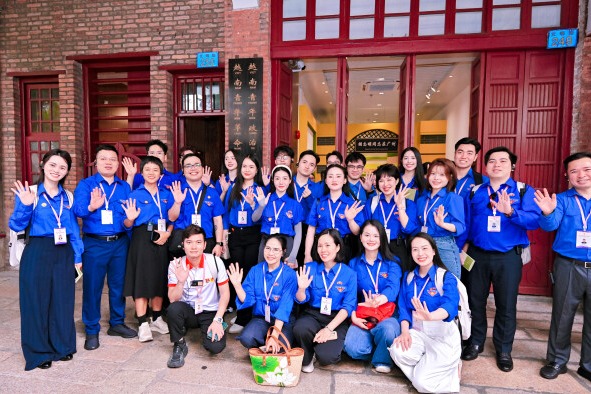
In a landmark cross-border youth exchange initiative hosted in Guangzhou, the capital of China’s southern Guangdong province, 200 young Vietnamese delegates from diverse professional backgrounds gathered in mid-April 2026 for a three-day “Red Study Tour” designed to deepen understanding of the shared revolutionary history and dynamic cultural connections between China and Vietnam.
Organized by the Central Committee of the Communist Youth League of China, the delegation brought together young participants spanning civil servants, youth league cadres, working journalists, university students, youth advocates, and digital content creators — reflecting the broad cross-section of contemporary Vietnamese youth society.
Over the three-day program from Saturday to Monday, delegates toured a curated lineup of historically significant, cultural, and innovation-focused sites across Guangzhou. These included the former headquarters of the Vietnamese Youth Revolutionary Comrades Association, the resting place of Vietnamese revolutionary martyr Pham Hong Thai, the Memorial Hall of the First National Congress of the Socialist Youth League of China, and the Whampoa Military Academy Memorial Hall — sites that anchor the shared revolutionary legacy of the two nations. The tour also extended to cultural landmarks such as the historic Yongqing Fang old alley district, modern infrastructure at Guangzhou Metro Group, the advanced Fushan Circular Economy Industrial Park, leading Chinese technology enterprises, and popular scenic destinations.
Throughout their visits, participants explored the deep revolutionary camaraderie forged between early Chinese and Vietnamese pioneers who fought side-by-side for national independence and liberation. The experience allowed delegates to gain a more nuanced, personal understanding of the sacrifices that laid the foundation for modern national development in both countries, and to reaffirm the enduring value of bilateral friendship and cooperative partnership.
To strengthen people-to-people connections, the tour included three themed symposiums and a collaborative joint painting project that brought Vietnamese delegates together with local Chinese young people, creating space for open dialogue and relationship-building beyond guided visits.
Huynh Thi Thanh Thuy, the 2022 Miss Vietnam and 2024 Miss International titleholder, who was among the delegates, praised the rich artistic expression and inclusive cultural fusion that defines Lingnan culture, the regional culture of southern China’s Guangdong area. She proposed a new vision for youth-led cross-border cultural collaboration that leverages digital platforms.
“I hope young people from both countries can work together to breathe new life into cultural heritage through digital platforms,” she said. “For example, we could create joint music projects that blend traditional Lingnan and Vietnamese musical instruments with modern harmony and orchestration, or integrate the iconic imagery of Vietnamese ao dai into the traditional architectural spaces of Guangzhou’s Xiguan old mansions. This is how heritage can truly come alive in the hearts of Generation Z.”
Tran Tuan Hiep, a performer of Tuong, Vietnam’s centuries-old traditional theatrical art form, highlighted that both China and Vietnam boast deep-rooted, distinct cultural heritages — noting that Peking Opera holds a similar place as a iconic national cultural treasure in China, mirroring Tuong’s role in Vietnam.
“Having had the opportunity to visit China in person, I am deeply impressed by your country’s outstanding efforts in preserving traditional culture,” he said. “I hope there will be more opportunities for exchanges in the future so that we can learn from each other and jointly protect and develop the traditional arts and cultures of our two countries.”
Vietnamese children’s book author Bui Thi Thu Ha emphasized that cultural and artistic exchange acts as a durable bridge between the two peoples, helping build greater mutual understanding of shared and distinct values, traditions, and national identities.
“Through artistic performances, exhibitions, music, food and other events, we can not only appreciate beauty but also feel the soul, history and way of thinking of each nation,” she said.
The Guangzhou leg of the tour concluded on Monday afternoon, with the delegation set to travel to Beijing to continue their study tour and explore more of China’s cultural and historical heritage, extending what organizers frame as a growing people-to-people partnership between the next generations of the two neighboring nations.