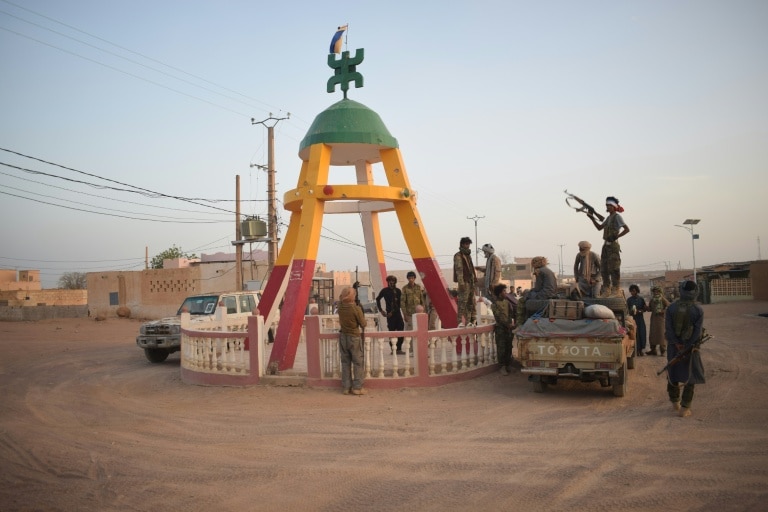
In a major escalation of armed opposition to Mali’s ruling military junta, a coordinated alliance of Tuareg separatists and al-Qaeda-linked jihadists has captured a key strategic military outpost in the country’s far north, after junta-aligned forces withdrew without major resistance.
The fall of the Tessalit military base — a strategically critical installation nicknamed a “super-camp” located just kilometers from the Algerian border — was confirmed by multiple independent sources speaking to Agence France-Presse, following a wave of large-scale coordinated attacks across the West African nation that have already killed a top junta leader and left at least 23 other people dead.
A senior official with the Tuareg-dominated separatist Front for the Liberation of Azawad (FLA), the group leading the rebel advance, confirmed that all remaining Malian army troops and their Russian mercenary allies surrendered the camp and retreated southward ahead of rebel forces entering the area. A security source based in Gao, the largest city in northern Mali located south of Tessalit, confirmed no significant armed clashes broke out during the capture, as regular Malian forces had fully evacuated the base before rebel fighters arrived. A locally elected official in the region further confirmed that Russian mercenary personnel, who have been embedded with Malian troops across the country to counter insurgent movements, also abandoned their positions at the outpost.
Geopolitical and military analysts have underscored the outsize strategic importance of the Tessalit base. Originally constructed by French colonial authorities, the installation features a well-maintained airstrip capable of accommodating military helicopters and larger fixed-wing aircraft, and its isolated position in the far northern Sahara offers unobstructed monitoring of cross-border movement across the entire Sahara region. Prior to its capture, the base hosted a large contingent of Malian army troops and Russian mercenary allies, and stocked a substantial arsenal of military equipment.
The capture of Tessalit comes as the culmination of a series of coordinated rebel offensives that mark the most significant armed challenge to Mali’s junta in nearly 15 years. Last weekend, separatist FLA fighters and jihadists from the Group for the Support of Islam and Muslims (JNIM) — an al-Qaeda-affiliated insurgent group — launched coordinated large-scale fatal attacks across multiple key junta strongholds across the country. The attacks included a car bombing at the residence of Mali’s defense minister Sadio Camara, a core leader of the 2020 junta, in the garrison town of Kati near the capital Bamako. Camara, 47, died of his wounds from the attack, and the junta held an official state tribute for him earlier this week. During the weekend offensive, rebel forces also seized full control of the major northern city of Kidal, and FLA leaders have publicly predicted their alliance will soon take control of all of northern Mali and topple the junta entirely.
Just one day before the fall of Tessalit, JNIM launched a full road blockade of the capital Bamako, permitting only exit for residents already inside the city and cutting off most inbound supply routes. This is not the first time the group has targeted the Malian economy with blockades: late in 2024, JNIM imposed widespread blockades on imported gasoline and diesel trucked into the country from neighboring Ivory Coast and Senegal, in an attempt to cripple government revenue and basic services.
Mali’s current political trajectory has been shaped by its 2020 military coup, which brought the current junta to power. In the years following the coup, Mali joined neighboring junta-led Burkina Faso and Niger in cutting all diplomatic and security ties with former colonial power France, and aligned closely with the Russian government. Russia has deployed thousands of mercenary fighters to the three Sahel states to support counter-insurgency operations against jihadist groups. Earlier this year, the three nations formed the Alliance of Sahel States (AES), a joint security bloc with a stated combined force of 15,000 troops. Late Thursday, the government of Niger announced that the AES had launched intensive air campaigns across Mali in response to last weekend’s rebel attacks.