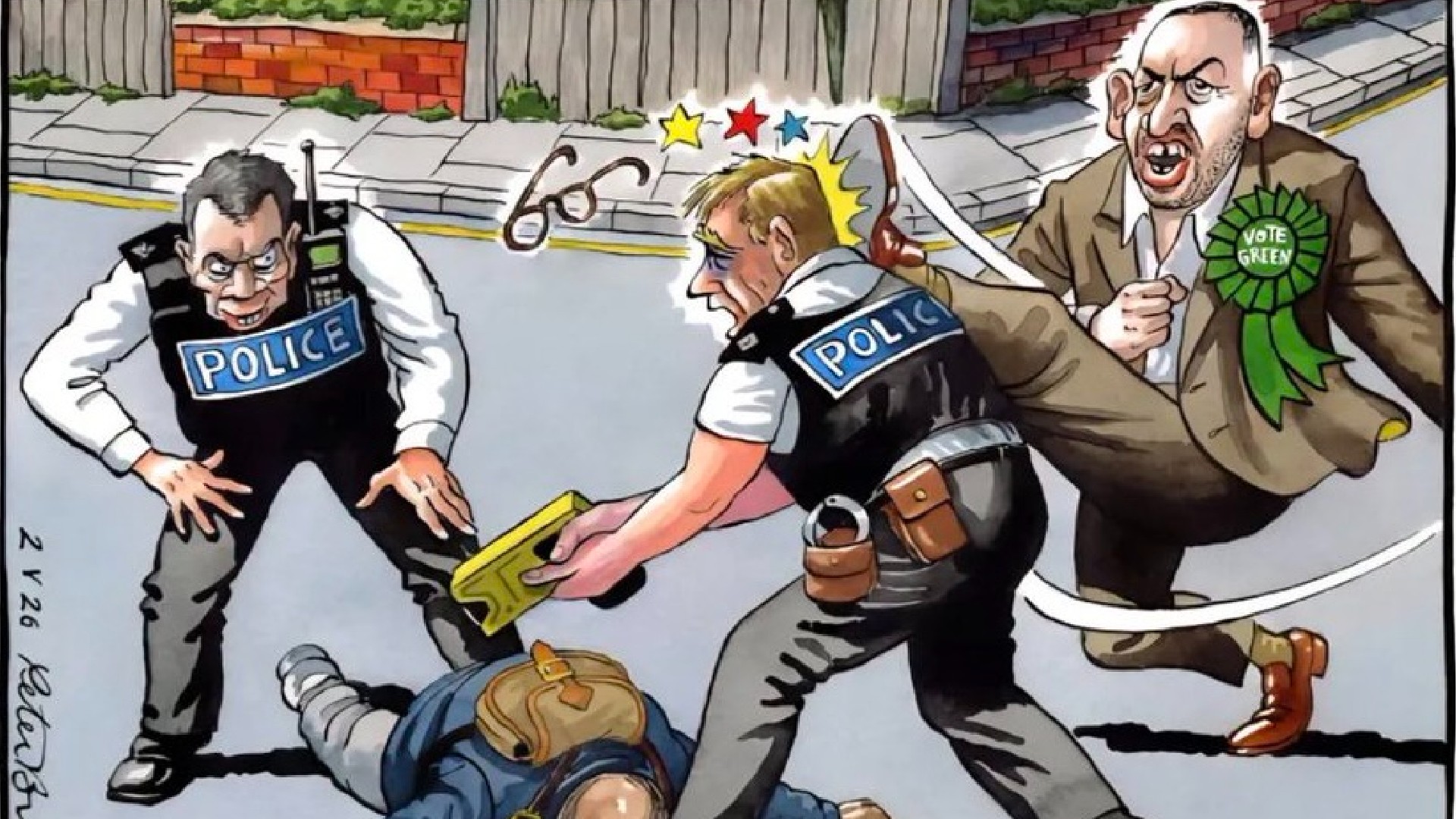
A major political and media controversy has swept the United Kingdom this week, centered on a deeply divisive cartoon published by The Times of London depicting Green Party leader Zack Polanski, who is openly Jewish. Polanski and his party have lambasted the national newspaper for running what they describe as a blatantly antisemitic caricature, echoing harmful age-old tropes about Jewish people.
The cartoon depicts Polanski with an exaggerated hooked nose — a visual trope long used to dehumanize Jewish people in antisemitic propaganda — kicking police officers who were in the process of arresting Essa Suleiman, the 45-year-old Somali-born British suspect in a recent stabbing attack in Golders Green, a heavily Jewish neighborhood in northwest London. Suleiman stands accused of stabbing two Jewish men in the attack, alongside a separate charge of attempted murder for a separate incident earlier the same day where he allegedly targeted a Muslim acquaintance of 20 years, Ishmail Hussein.
The illustration references circulating cell phone footage that appears to show arresting officers repeatedly kicking Suleiman in the head during his apprehension. After the attack, Polanski publicly condemned the stabbings, but later retweeted a post on the social platform X that raised questions about the officers’ use of force during the arrest. That retweet sparked immediate backlash from senior political and law enforcement figures across the UK.
Metropolitan Police Commissioner Mark Rowley released an open public letter to Polanski expressing his disappointment with the Green leader’s response, a move that prompted its own criticism from observers who questioned the police’s commitment to political impartiality and called for the letter to be withdrawn.
Top politicians have levied harsh criticism at Polanski in the wake of the incident. Former Conservative minister and current Reform UK figure Robert Jenrick went so far as to accuse Polanski of being “on the side of terrorists”, while UK Prime Minister Keir Starmer labeled Polanski’s criticism of officer conduct “disgraceful” and claimed he was “not fit to lead any political party”.
Polanski has hit back at these attacks, noting that he is the only Jewish leader of a national political party in the UK, and accusing Starmer of weaponizing antisemitism to score cheap political points. He added that he already faces persistent antisemitic abuse on a daily basis, revealing that two separate people have been arrested for antisemitic actions targeting him in just the last six weeks. He also shared that he was targeted with a Nazi salute by a Reform UK supporter at a recent rally in Hastings.
The Green Party has confirmed it filed an official complaint with The Times editor Tony Gallagher over the cartoon, saying it is “astonishing” that a major national outlet would choose to publish such imagery at a time when antisemitic sentiment and violence are rising across the UK. In a statement, the party condemned what it called the “deeply irresponsible” rhetoric from both senior politicians and media outlets, arguing that their attacks open Polanski up to further targeted harm in the aftermath of a violent attack on the Jewish community he is part of.
Speaking in an interview with BBC’s Laura Kuenssberg on Sunday, Polanski confirmed that The Times has yet to issue an apology or withdraw the offensive caricature. He later issued an apology for sharing the retweet questioning officer conduct, acknowledging that X was not an appropriate forum to raise concerns about police behavior. He did, however, stand by his view that all public servants, including police officers, should be open to scrutiny, and noted he has requested a meeting with Rowley to resolve the tensions between him and the Met.
In further developments related to the case, the Metropolitan Police confirmed last Friday that Suleiman — who had only been released from a psychiatric hospital days before the attacks — would not face terrorism charges. He has instead been charged with three counts of attempted murder and one count of illegal possession of a bladed weapon in public.
The Golders Green attack has already become a flashpoint in ongoing national debates about pro-Palestine protests, which have been held across the UK since the outbreak of the 2023 Israel-Gaza war. Starmer and other senior politicians have seized on the attack to call for greater restrictions on pro-Palestine marches, even suggesting that some demonstrations could be banned entirely, and that offensive language used during protests should be policed.
When Kuenssberg asked Polanski whether he agreed with Starmer’s labeling of the common protest chant “globalise the intifada” as racist, Polanski rejected the prime minister’s framing. He reaffirmed his support for freedom of speech and freedom of protest in the UK, arguing that policing protest language would do nothing to improve safety for Jewish communities. Noting that the term intifada originally refers to uprisings against Israeli occupation in the 1980s, Polanski pointed out that the occupation remains ongoing, making public discussion of the issue a legitimate and necessary part of public discourse. He added that he opposed creating new laws to restrict protest, and instead called for protections for peaceful protest activity.
On the question of whether the Green Party takes the threat of antisemitism seriously, Polanski noted that Jewish safety is not an abstract issue for him as a Jewish community member. He acknowledged that no political party has fully eliminated antisemitism within its ranks, and agreed that all parties need to expand anti-racism training and improve candidate vetting to address antisemitism, Islamophobia and all other forms of racism across the political spectrum.