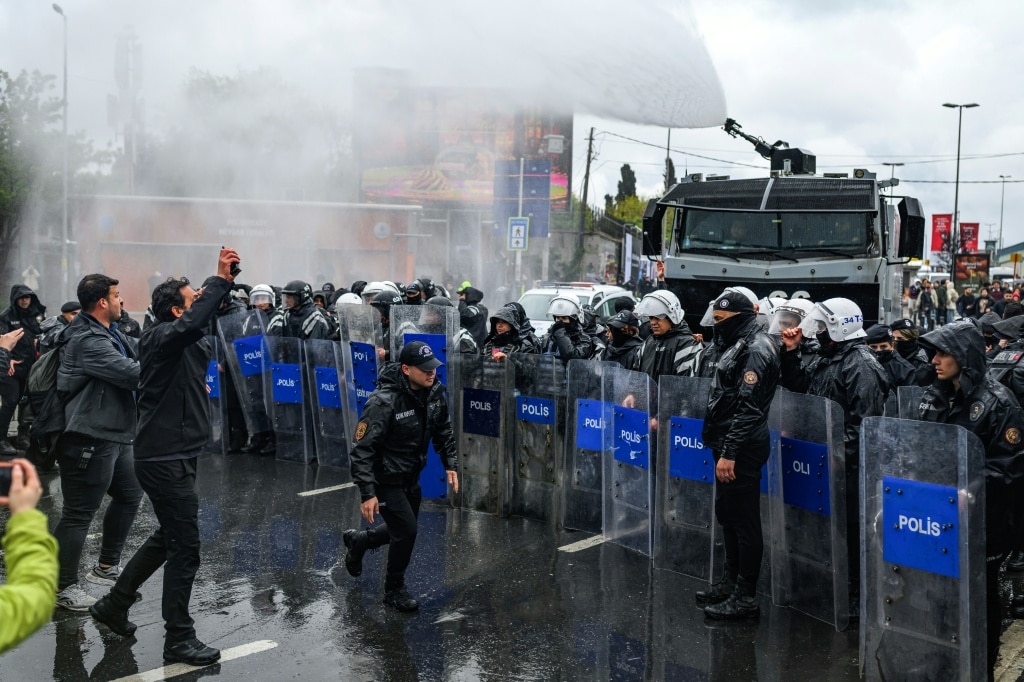
On Friday, thousands of workers and activists across Turkey took to the streets for annual May Day demonstrations, with the most intense confrontations unfolding in Istanbul, where security forces deployed tear gas and detained hundreds of participants seeking access to a iconic protest site.
Taksim Square, a public space that has long been a flashpoint for anti-government demonstrations in Turkey, was locked down by police overnight ahead of the planned rallies. Two groups of protesters had explicitly announced their intention to march to the sealed square on the city’s European side, triggering a swift, heavy-handed response from law enforcement.
AFP journalists on the ground confirmed that riot police used vehicle-mounted tear gas launchers to disperse crowds gathered in Istanbul. Data collected by the CHD Lawyers’ Association, which had legal observers present at the demonstrations, puts the number of arrests in the city at a minimum of 370 as of 11:00 GMT, a figure that approaches the 400+ detentions recorded at 2023’s Istanbul May Day protests. Footage broadcast by opposition broadcaster HALK TV showed Turkish Workers’ Party leader Erkan Bas directly targeted with pepper spray during the clashes.
Speaking before the confrontation, Bas emphasized the core purpose of the demonstration: “Those in power already speak 365 days a year, so let workers talk about the hardships they face at least one day a year.”
Shortly after publicly condemning the closure of Taksim Square to demonstrators, Basaran Aksu, a senior union official, was taken into custody by police. In remarks before his arrest, Aksu criticized the unequal access to the central public space, saying “You can’t close off a square to the workers of Turkey. Everyone uses Taksim, for official ceremonies, for celebrations. Only the labourers, the workers, the poor find the square closed to them.”
May Day protests have drawn heavy police deployment in Turkey for years, with authorities routinely sealing off large swathes of central Istanbul around Taksim Square to prevent unauthorised gatherings. On Friday this year, the city’s central neighbourhoods were blocked off by metal barricades, with thousands of officers in full riot gear positioned to block access.
In Istanbul’s Mecidiyekoy district, AFP reporters witnessed police use tear gas against a group that included members of the leftist HKP party, who attempted to break through police lines while chanting anti-government and anti-American slogans. In the Besiktas neighbourhood, officers surrounded demonstration zones and intervened violently whenever protesters began chanting, with multiple demonstrators seen being tackled and thrown to the ground by security forces.
The 2024 demonstrations were organized by a coalition of trade unions and civil society groups under the unifying slogan “Bread. Peace. Freedom”, a call rooted in the country’s ongoing severe cost-of-living crisis. Official data puts Turkish inflation at 30 percent, but independent economic analysts estimate the real rate is closer to 40 percent, squeezing working-class households across the country.
In the capital city of Ankara, around 100 coal miners joined the May Day march after staging a nine-day hunger strike to demand payment of long-overdue wages. The march in Ankara drew a notably large, young crowd, and was also closely monitored by a heavy police deployment, an AFP correspondent reported.
The crackdown on Friday came days after Turkish authorities issued arrest and search warrants for 62 people, 46 of whom include working journalists, trade union leaders, and opposition figures. Authorities labeled the group “likely to carry out attacks” ahead of the May Day demonstrations.