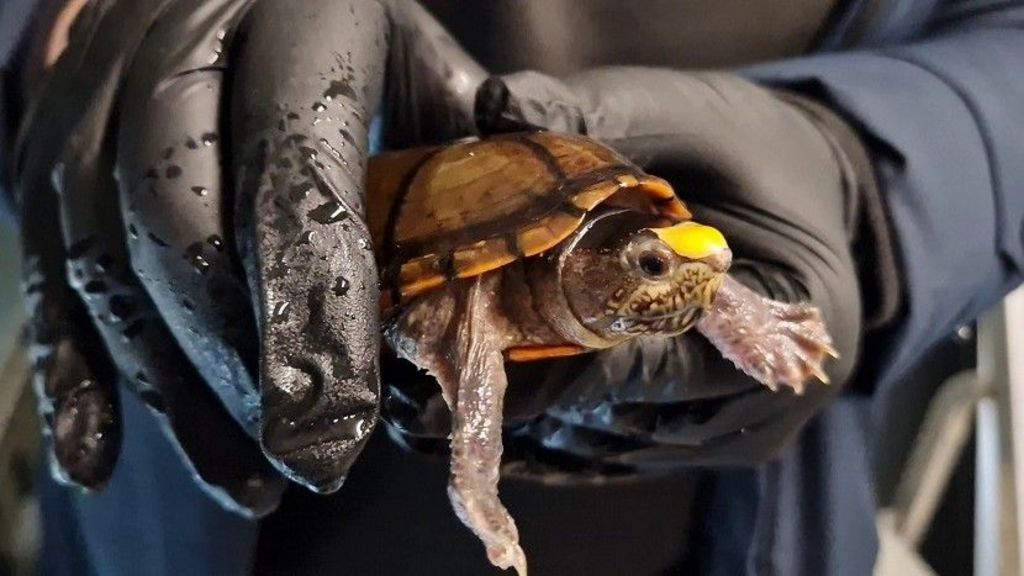
Amsterdam’s Schiphol International Airport, a major global transit hub, became the site of a critical wildlife enforcement operation on a recent Saturday, as customs officials intercepted a shipment of 26 Vallarta mud turtles hidden in the checked baggage of a transiting traveler, announced the Netherlands Food and Consumer Product Safety Authority (NVWA) in an official public statement. The male suspect, who was traveling on a route originating in Mexico and bound for Hong Kong via the Dutch capital, was immediately taken into custody following the discovery, and remains in detention as a full-scale criminal investigation unfolds.
The seized reptiles, classified as the smallest freshwater turtle species on Earth with a maximum recorded adult length of just 10 centimetres (4 inches), are formally designated as critically endangered on the International Union for Conservation of Nature (IUCN) Red List of Threatened Species. NVWA inspectors confirmed that the turtles had been cruelly wrapped in duct tape to restrict their movement during the long-haul flight, stashed in two separate unassuming locations inside the traveler’s suitcase: the majority were tucked inside a cardboard box alongside a children’s toy car, while the remaining individuals were sealed inside a closed fabric sock to avoid detection during routine baggage scans. Agency officials noted preliminary evidence indicates the rare creatures were almost certainly poached illegally from their native wild habitats in Mexico.
All 26 turtles have since been transferred to a dedicated, expert-run reptile sanctuary where specialized veterinary teams are providing round-the-clock rehabilitative care to address the stress and potential injuries sustained during the smuggling attempt. Conservation data from U.S.-based non-profit Turtle Island, published in 2025, estimates that fewer than 300 mature Vallarta mud turtles remain in their natural wild ecosystems, making every individual recovered from illegal trafficking a significant win for species survival.
Wildlife trade monitors have long flagged the exorbitant black market value of the species in Asian consumer markets: environmental news platform Mongabay reports that a single live Vallarta mud turtle can fetch $10,000 or more on unregulated exotic pet markets in the region. The Schiphol bust is the latest in a string of high-profile endangered turtle smuggling incidents targeting Hong Kong this year alone. In October 2024, Hong Kong customs officials seized eight endangered turtles with a combined estimated black market value of $54,000, just three months after local border enforcement teams foiled two separate smuggling operations that intercepted 42 live rare turtles worth a total of $210,000. The coordinated series of interceptions underscores the growing transnational criminal networks that profit from the illicit trade of critically endangered reptiles, prompting calls for enhanced cross-border cooperation between customs, conservation agencies and law enforcement across North America, Europe and East Asia to crack down on the lucrative wildlife trafficking pipeline.