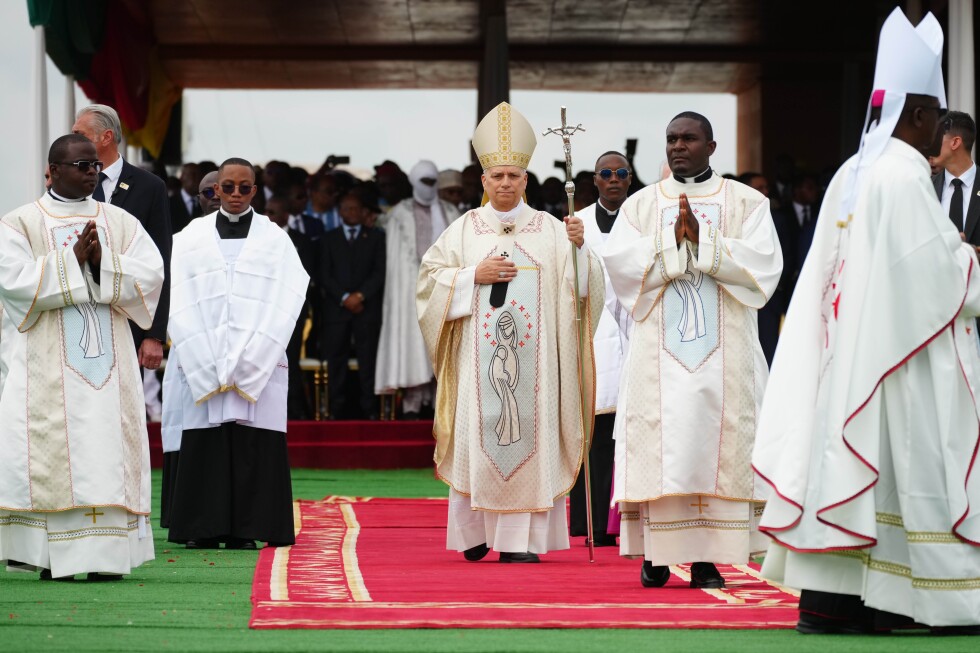
As the third stop of his ambitious four-nation tour of Africa gets underway, Pope Leo XIV has wrapped up his visit to Cameroon, leaving behind a wave of joyful devotion and a clear call for collective action to lift marginalized communities across the continent. On Saturday, the pontiff celebrated an open-air Mass at Yaounde’s international airport, drawing tens of thousands of worshippers — including 93-year-old Cameroonian President Paul Biya, the world’s oldest sitting head of state. Accounts from the scene describe a vibrant, crowded gathering, where even worshippers with limited mobility were carried to the service in wheelbarrows by loving family members, a testament to the deep impact of the pontiff’s visit on the majority-Christian nation.
Cameroon, a former French colony where Catholics make up roughly one-third of the population, is just the second stop on Leo’s African journey. Throughout his time in the country, the pope centered his message on two core themes: encouraging disillusioned young people to hold onto hope for the future, and calling out wealthy and powerful elites for exploiting the continent’s land and people for private gain. In his final homily in Yaounde, delivered in French, Leo framed respect for human dignity as the non-negotiable foundation of a functional society.
“For this reason, every community has the obligation to create and sustain structures of solidarity and mutual aid in which, when faced with crises — be they social, political, medical or economic — everyone can give and receive assistance according to their own capacity and needs,” he told the gathered crowd. He doubled down on earlier criticisms of systemic graft, denouncing the “chains of corruption” that block inclusive development across the continent, and condemning the “handful of tyrants” who fuel conflict and exploitation that leaves millions of Africans trapped in poverty.
After closing the Cameroon leg of his tour, the pontiff departed Saturday for Luanda, the capital of southwestern Angola, where his visit will confront the nation’s layered, often painful history on multiple fronts. Angola won its independence from Portugal in 1975, but almost immediately descended into a 27-year civil war that only ended in 2002. Fought as a Cold War proxy conflict — with the U.S. and apartheid South Africa backing one faction, and the Soviet Union and Cuba supporting the other — the war claimed an estimated 500,000 lives and left deep physical and social scars that persist today.
Today, Angola is one of Africa’s most resource-rich nations: it ranks as the continent’s fourth-largest oil producer, among the top 20 global oil producers, the world’s third-biggest diamond exporter, and holds substantial reserves of gold and other in-demand critical minerals. Yet despite this abundant natural wealth, 2023 World Bank data shows more than 30% of Angola’s 38 million people survive on less than $2.15 per day. Much of this inequality is tied to decades of systemic corruption: former long-time president Jose Eduardo dos Santos, who ruled the nation for 38 years until 2017, was accused of siphoning an estimated $24 billion in public funds — most from oil revenues — to his family and inner circle, while ordinary Angolans faced widespread poverty. Current President Joao Lourenco, who took power after dos Santos stepped down, has made anti-corruption campaigns and recovery of stolen public funds a central policy pledge, but critics argue his actions have largely targeted political opponents to consolidate power, leaving deep-rooted systemic graft unaddressed.
For many ordinary Angolans, the pope’s visit carries expectations of messages that speak directly to the nation’s ongoing struggles. “I would like to hear a message of peace, a message of reconciliation,” Luanda resident Sergio Jose told reporters. “I would also like to hear good political messages and I would also like to hear that the pope would also talk about the upcoming elections in Angola.”
Observers expect the pontiff to echo the themes of anti-corruption and equitable development he laid out in Cameroon during his time in Angola. The most anticipated event of his visit will be a trip Sunday to Muxima, a coastal town south of Luanda that is home to one of Angola’s most important Catholic shrines, the Church of Our Lady of Muxima. Built by Portuguese colonizers in the late 16th century as part of a fortress complex, the site was a central hub of the transatlantic slave trade, a tangible reminder of how the spread of Catholicism was intertwined with the colonization and exploitation of the African continent. As a former Portuguese colony, Angola was the epicenter of the transatlantic slave trade: more than 5 million enslaved Africans were shipped across the Atlantic from Angolan ports, more than from any other region on the continent.
The visit to Muxima carries unique personal meaning for Pope Leo, the first U.S.-born pope in history. Genealogical research has confirmed the pontiff has both Black and white ancestors, including people who were held as enslaved people and people who owned enslaved people. He will pray the Rosary at the shrine, which has been a popular pilgrimage site since reports of an apparition of the Virgin Mary there in 1833.
This report includes contributions from Imray, reporting from Cape Town, South Africa. The Associated Press’ religion coverage receives support through a collaboration with The Conversation US, with funding from Lilly Endowment Inc. The AP retains sole responsibility for all content.