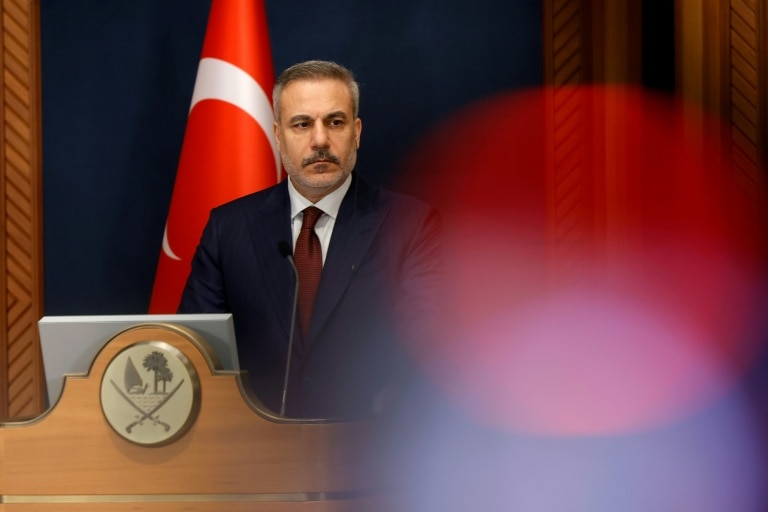
Amid a sustained surge in cross-border diplomatic friction between Ankara and Jerusalem, Turkey’s top foreign policy official has leveled sharp accusations against Israel, claiming the Jewish state is hiding territorial expansion ambitions behind a veneer of legitimate security concerns. Turkish Foreign Minister Hakan Fidan delivered the scathing critique Saturday during a high-profile panel discussion at the Antalya Diplomacy Forum, a key annual gathering of global diplomatic leaders held in Turkey’s Mediterranean resort city of Antalya.
In prepared remarks delivered in English, Fidan pushed back against Israel’s longstanding framing of its military actions across the Middle East as acts of self-defense, arguing this narrative has created a misleading “illusion” for the international community. “Israel is not after its own security. Israel is after more land,” Fidan stated directly, adding that Israeli Prime Minister Benjamin Netanyahu’s administration deliberately leverages security justifications to legitimize the seizure of additional territory.
Fidan traced this pattern of expansion across multiple regional flashpoints: from long-disputed Palestinian territories including Gaza, the occupied West Bank, and East Jerusalem, to the growing border tensions between Israel and Lebanon, and ongoing spillover into Syrian territory. “This is onward occupation and expansionism in the region, and I think this has to stop,” he added. Fidan went on to argue that lasting peace for Israel in the Middle East can only be achieved if the country respects its neighbors’ right to sovereignty, territorial integrity, and personal security, rather than relying on military dominance to achieve its goals.
Public disagreements between Turkey and Israel have become a near-daily occurrence in recent months, fueled by competing stances on the Gaza war, rising geopolitical tensions involving Iran, and long-running disagreements over the future of Syria. Bilateral relations between the two regional powers have been severely damaged since 2010, when Israeli commandos raided an aid flotilla attempting to break Israel’s naval blockade of Gaza, killing nine Turkish activists and one American national. The flotilla was organized in part by a Turkish humanitarian aid group.
On the sidelines of the Antalya forum, Fidan held diplomatic talks Friday with his counterparts from Pakistan, Saudi Arabia, and Egypt, with the ongoing Middle East conflict topping the agenda. Fidan emphasized that regional nations must take collective ownership of shared regional challenges, noting that Israel remains the sole actor in the region pursuing deliberate territorial expansion.
Turning to another major global conflict, Fidan also addressed Turkey’s long-running quiet diplomatic efforts to resolve the Russia-Ukraine war, noting that these mediation efforts have been pushed off the global agenda in recent months by rising tensions surrounding Iran. “That has left the Russia-Ukraine war on the side,” Fidan said, adding that the international community should refocus its attention on negotiating a resolution to the conflict as soon as Iran-linked tensions de-escalate. He also warned that the ongoing conflict between Russia and Ukraine remains vulnerable to further escalation.
Turkey has positioned itself as a neutral mediator between Moscow and Kyiv since the full-scale invasion began in 2022, having hosted multiple rounds of direct peace negotiations between the two sides. This year’s Antalya Diplomacy Forum continues that mediation role, hosting Russian Foreign Minister Sergei Lavrov and Ukrainian Foreign Minister Andrii Sybiha for separate panel appearances during the event.