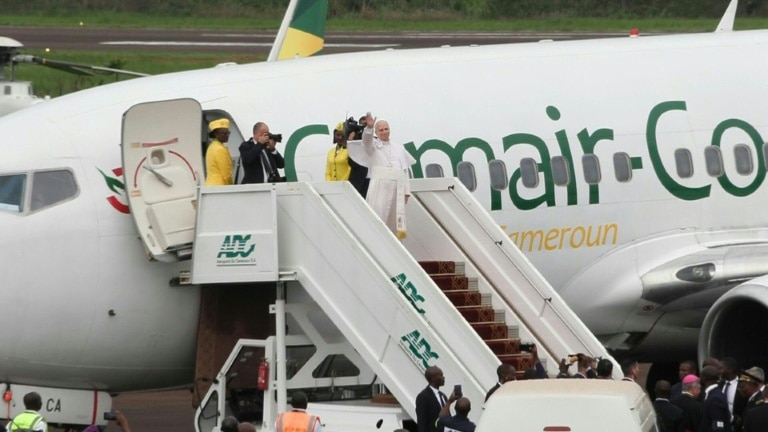
On a high-stakes 11-day tour of Africa that has already captured global attention, Pope Leo XIV is set to hold a massive open-air mass Friday in Douala, Cameroon’s bustling economic capital and one of Central Africa’s busiest deep-water ports. The event is expected to draw more than one million worshippers, marking the largest gathering of the pontiff’s trip, which has been defined by bold calls for global peace and an unprecedented public clash with former U.S. President Donald Trump.
Six months prior to the visit, Douala was the site of a brutal government crackdown on protests following the disputed re-election of 93-year-old incumbent President Paul Biya, the world’s oldest sitting head of state who has held authoritarian control over Cameroon since 1982. Witnesses confirm security forces opened fire on unarmed demonstrators, with authorities admitting dozens of deaths amid widespread unrest, though an exact casualty count has never been released. By Thursday evening, thousands of devoted Catholic pilgrims were already streaming into the city to claim viewing spots on the esplanade outside the 50,000-seat Japoma Stadium, where the mass will take place. After the service, the Pope is scheduled to visit Saint Paul’s Catholic Hospital in the city.
This landmark African tour has marked a clear shift for Pope Leo, who has set aside prior diplomatic restraint to deliver impassioned, unflinching remarks on conflict, inequality, and political corruption. The high-profile dispute with Trump erupted after the Pope called for an immediate end to the ongoing war in the Middle East, drawing a sharp rebuke from the former American president. During a solemn address Thursday at Saint Joseph’s Cathedral in Bamenda, the heart of a nearly 10-year separatist insurgency that has killed thousands of Cameroonians, Pope Leo declared, “The world is being ravaged by a handful of tyrants.”
Trump responded hours later, stating the Pope was free to share his views but needed to grasp the realities of what he called a “nasty world.” Despite the transatlantic political drama, the pontiff has been met with jubilant, singing crowds across every stop of his Cameroon itinerary, with locals turning out in massive numbers to welcome the leader of the world’s 1.4 billion Catholics.
Even ahead of the visit, the trip sparked quiet controversy among some Cameroonian Catholics, who raised concerns that a high-profile papal visit could inadvertently help Biya rebrand his authoritarian rule on the global stage. Pope Leo has not shied away from sharp critique, however, avoiding direct naming of Biya or Trump but delivering pointed remarks that hit at both domestic and global issues. He pushed back against calls from U.S. Vice President JD Vance, a Catholic, to limit his public remarks to purely moral issues, instead using his platform to condemn exploitation and corruption.
“Woe to those who manipulate religion and the very name of God for their own military, economic and political gain, dragging that which is sacred into darkness and filth,” the Pope told crowds in Bamenda. During a Thursday mass, he also targeted foreign and elite exploitation of the continent, saying: “those who, in the name of profit, continue to lay their hands on the African continent to exploit and plunder it.” Cameroon boasts abundant natural resources, including oil, timber, cocoa, coffee, and rare minerals, which have drawn foreign investment and been exploited by local and global elites for decades.
Shortly after arriving in Cameroon’s capital Yaoundé Wednesday, the Pope delivered his critique directly to Biya and other top government officials, urging leaders to root out systemic corruption and human rights abuses committed in the name of national security. “Security is a priority, but it must always be exercised with respect for human rights,” he said, speaking within earshot of the long-ruling president.
Samuel Kleda, Archbishop of Douala and one of the most prominent clerical critics of Biya’s government, shared cautious optimism ahead of the mass, saying he hopes the papal visit will catalyze progress toward resolving the country’s multiple ongoing crises. “Our country has gone through many crises; some crises are still ongoing. The fruit we must draw from this visit is to commit ourselves as architects of peace,” Kleda said. Catholicism holds a major social and cultural role in Cameroon, where more than one-third of the country’s 30 million residents identify as Catholic.
The African tour began in Algeria, a majority-Muslim nation, where the visit was marred by two deadly suicide bombings. After leaving Cameroon Saturday, Pope Leo will travel to Angola, before concluding the 18,000-kilometer tour in Equatorial Guinea.